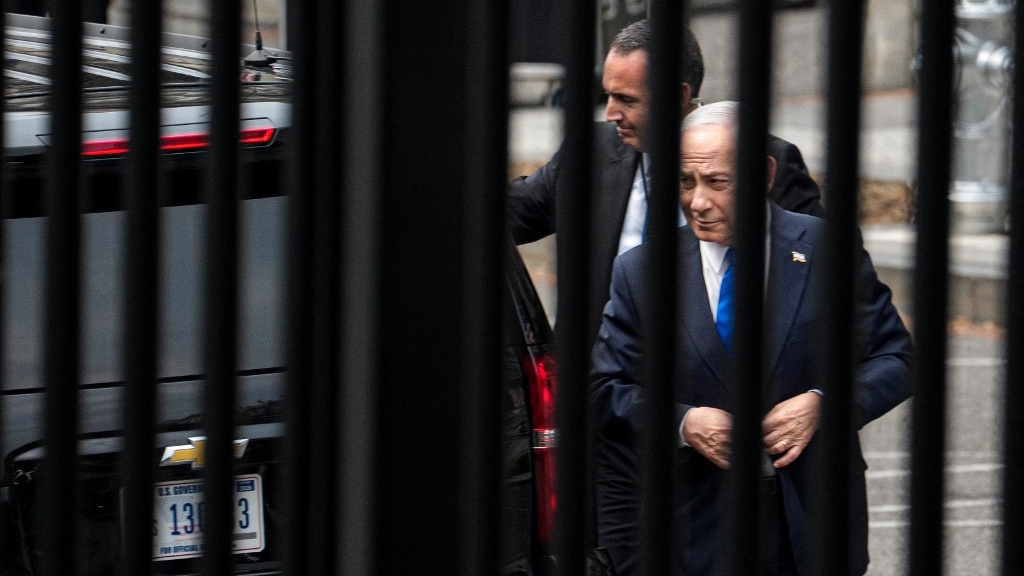
Freshly revealed secret recordings have pulled back the curtain on a coordinated plot between late U.S. Senator Lindsey Graham and Israeli Prime Minister Benjamin Netanyahu to weaponize unproven sexual misconduct allegations against then-International Criminal Court Chief Prosecutor Karim Khan, in a bid to block the court from issuing long-awaited arrest warrants for Netanyahu and his senior cabinet over alleged Gaza war crimes.
The explosive disclosure, first reported this week by The New York Times, draws from three years of audio recordings captured by British documentary filmmaker Alex Holder, who tracked Graham’s political ties to former U.S. President Donald Trump and Netanyahu. The exchanges offer the clearest evidence to date of a sustained, high-level intimidation campaign targeting the ICC over its Palestine investigation — a campaign that Middle East Eye first documented in depth last year.
The plot came to light weeks after Graham’s passing earlier this month, and just days after ICC member states voted to remove Khan from his post as chief prosecutor last Friday at a secret ballot held at U.N. headquarters in New York. Eighty-two of the court’s 125 member states supported the dismissal, overriding a unanimous prior ruling from an independent judicial panel that cleared Khan of all wrongdoing in March. That panel, appointed by the ICC’s governing Assembly of State Parties (ASP) bureau, found the U.N. investigation’s findings failed to prove any misconduct or breach of professional duty on Khan’s part.
The first recorded conversation between Graham and Netanyahu took place on October 29, 2024 — five months after Khan submitted applications for arrest warrants against Netanyahu, Israeli Defense Minister Yoav Gallant, and three Hamas officials, and just weeks before ICC judges were set to announce their decision on the warrants. During the call, Netanyahu flagged the pending sexual allegations against Khan, arguing that the “great cloud” of the claims could be leveraged to delay the court’s ruling on the arrest warrants.
Netanyahu suggested that Graham lead a bipartisan group of U.S. senators in sending an official letter to the ICC, demanding a full review of the entire prosecution process before any warrants were issued, arguing the “stain” of the allegations had to be addressed first. Graham immediately agreed, saying he would work to secure signatures from Democratic senators as well to broaden the letter’s political weight.
In a follow-up call the same day, Graham told Netanyahu the effort had secured backing from two high-profile Democratic senators: Richard Blumenthal and Ben Cardin. “We got them both,” Graham said, asking Netanyahu to share the text he wanted included in the letter. The senator even joked that Netanyahu should “pay me for all this. I should get tons of shekels,” adding that “it would take more than dinner” and asking the prime minister to personally call the two Democrats to thank them for their support, while also tying the cooperation to ongoing efforts to advance Saudi-Israeli normalization. The letter, signed by Graham, Blumenthal, Cardin and other senators, was sent on November 1, 2024. Neither Blumenthal nor Cardin has responded to requests for comment from The New York Times on their involvement.
Despite the pressure campaign, ICC judges moved forward with issuing the arrest warrants on November 21, 2024. Netanyahu and other senior Israeli officials subsequently responded by claiming Khan had pushed for the warrants specifically to distract from the misconduct allegations against him — a claim contradicted by a 2023 Middle East Eye investigation that confirmed Khan notified U.S. officials of his plan to apply for the warrants weeks before he was even made aware of the sexual allegations.
This was not the first time Graham leveraged his position to pressure Khan over the ICC’s Palestine investigation. In a May 2024 conference call with Khan, senior ICC officials, and a bipartisan group of senators, Graham openly threatened the prosecutor, saying “if you proceed with the warrants you may as well shoot the hostages yourself” and that the U.S. would impose sanctions on him. He also infamously argued the ICC was “made for Africa and thugs like [Russian President Vladimir] Putin, not democracies like Israel,” a remark that was later confirmed by British barrister Andrew Cayley, who led the ICC’s Palestine investigation, who told The Observer Graham was “screaming at us” during the exchange. Graham later defended the pressure campaign in a public statement, claiming the public misconduct allegations against Khan had cast a “moral cloud” over the warrant application, and argued the senators only urged Khan to respect the principle of complementarity and negotiate in good faith with Israeli officials before issuing any rulings against Israel.
The vote to remove Khan last Friday capped an 18-month disciplinary process that Palestinian rights advocates, former ICC judges, and Khan’s own legal team have universally condemned as overtly politicized. After the independent judicial panel cleared Khan, a bloc of largely Western and European ASP bureau members pushed forward with dismissal, ignoring the panel’s findings and relying instead on the original U.N. investigation report. The bureau concluded Khan had engaged in an inappropriate sexual relationship with the complainant, arguing the power imbalance between his position as chief prosecutor and the complainant made any such relationship inherently improper. Khan has repeatedly denied all allegations, including that any sexual relationship occurred; the complainant’s original account centered on claims of non-consensual misconduct.
Many independent observers have drawn a direct line between Khan’s removal and the long-running campaign to kill the Netanyahu arrest warrant. “Khan’s removal lines up neatly with the fight to neutralise Netanyahu’s arrest warrant. Coincidence is a luxury intl law can no longer afford,” Francesca Albanese, the United Nations Special Rapporteur on the Occupied Palestinian Territories, wrote on X shortly after the vote.
Netanyahu himself openly celebrated the decision, revealing in a social media post that he had spoken with U.S. Secretary of State Marco Rubio about delivering “the coup de grace” to the ICC. He reaffirmed U.S. and Israeli commitment to confronting the court, claiming it “undermines justice, attacks democratic and sovereign nations, and seeks to subordinate their security to the decisions of unaccountable and corrupt officials in The Hague.”
Israeli media, citing anonymous senior government officials, has also confirmed that Israeli Foreign Minister Gideon Saar established a dedicated interagency task force to lobby ICC member states directly to vote for Khan’s removal. This campaign fits into a broader pattern of pressure: last year, the U.S. imposed harsh sanctions on Khan, his two deputy prosecutors, and multiple ICC judges over the Palestine investigation. Rubio reiterated Washington’s hardline stance earlier this month, saying the U.S. would “dismantle the ICC – brick by brick, if necessary.”