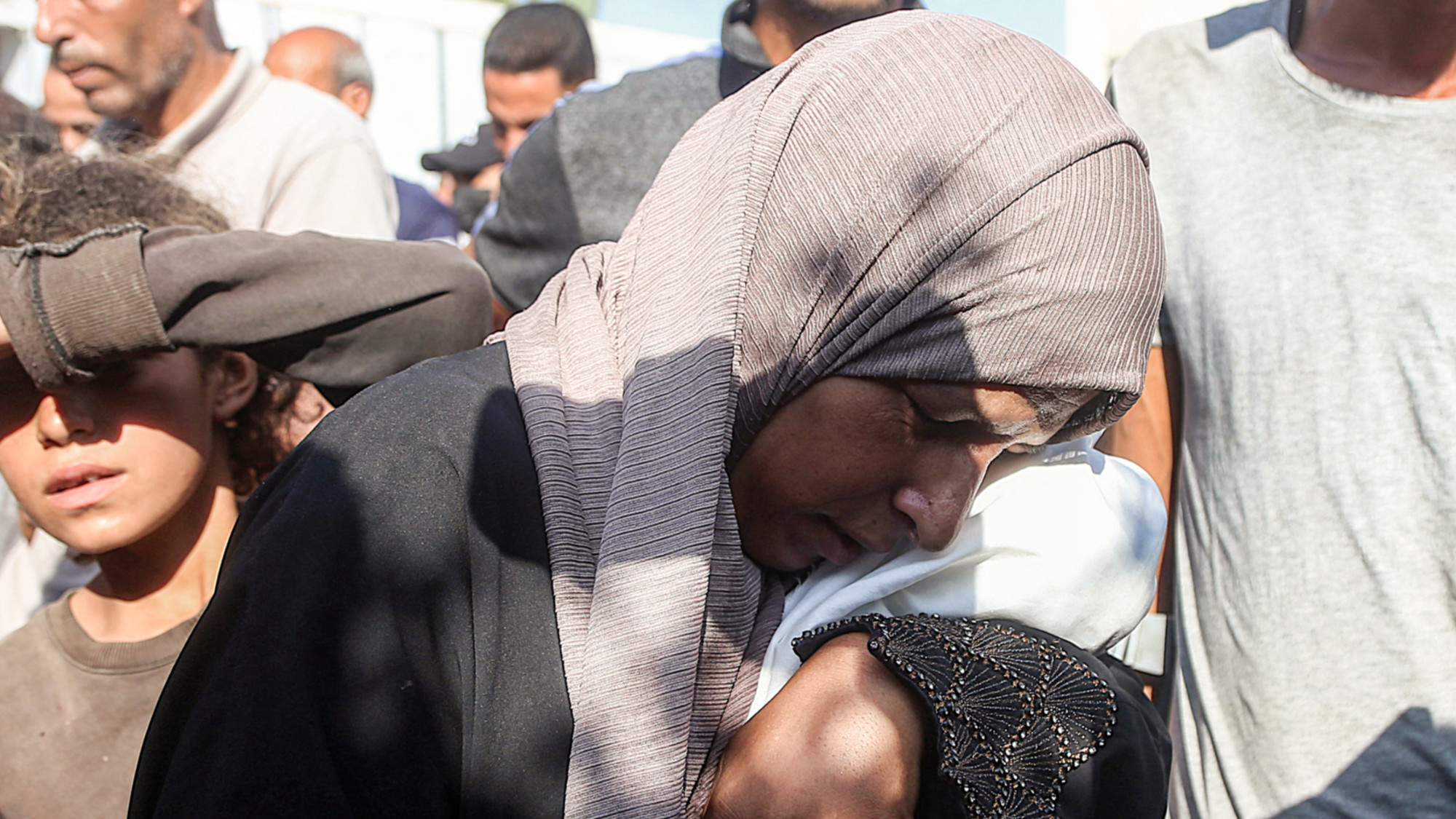
Seven years of waiting for a child ended in heartbreak for 34-year-old displaced Palestinian Sahar al-Majdalawi, one of thousands of pregnant women in Gaza whose pregnancies have been lost amid the ongoing humanitarian catastrophe triggered by the Israeli military campaign launched in October 2023.
Just one month after confirming her first pregnancy, al-Majdalawi was crippled by unrelenting abdominal cramps so severe they mirrored active labor pains. Fearing for the life of her unborn child, she and her husband set out on foot in the dark for the nearest functioning medical facility: Israeli bombardment had flattened key infrastructure, left all roads impassable and paralyzed public transport across the Gaza Strip, leaving no other option for evacuation. After walking for hours under the cover of night, the couple finally reached Al-Awda Hospital in the central Gaza Nuseirat refugee camp.
“We had to walk so far because there was no transport despite my pain. The whole time, I was begging God to keep my baby safe,” al-Majdalawi recounted to Middle East Eye in an interview.
An ultrasound delivered the devastating news she had dreaded. “They said: ‘The foetus is still in your womb, but there is no heartbeat,’” she said. “At that moment, it felt as though my own heart stopped beating. I realised I had lost the dream I had waited years to fulfil.”
al-Majdalawi’s tragedy is far from an isolated case in Gaza, where ongoing conflict has gutted healthcare systems, erased food security and pushed public health to a breaking point. Official and international data confirms a catastrophic surge in pregnancy complications, led by a skyrocketing miscarriage rate that has overwhelmed already depleted medical services.
According to the International Planned Parenthood Federation, at the peak of active hostilities, miscarriage rates jumped 300 percent above pre-October 2023 levels. Current data places the miscarriage rate at 460 per 1,000 births, a stark jump from just 140 per 1,000 births recorded across Gaza in 2022. Palestinian Ministry of Health figures document 3,958 confirmed miscarriages in the first six months of 2026 alone — a figure senior obstetrics and gynaecology consultant Dr. Adnan Radi, head of the ministry’s advisory committee, calls “shocking.”
Dr. Radi emphasizes that even these staggering official numbers underestimate the full scale of the crisis. “Official statistics, whether from international organisations or the Ministry of Health, undercount the true scale, but there is an undeniable and sharp surge in miscarriages during the war years,” he explained. Hundreds of additional cases go unrecorded, he noted, because most women cannot travel through war-damaged territory to reach care, and systematic data collection across Gaza’s sprawling, overcrowded tent camps for displaced people has become effectively impossible. “Although an exact number is hard to pin down, there is a consensus that miscarriage rates have multiplied. The Ministry of Health indicated the rate could be as high as 70 percent of total births in certain areas, which is a tragedy.”
While there is no single standalone cause for the surge, medical experts uniformly link the crisis directly to the cascading consequences of war. Dr. Radi points to severe anaemia as a primary driver: an estimated 70 percent of all pregnant women in Gaza currently live with the condition, worsened by widespread acute malnutrition across the enclave.
Last week, the Integrated Food Security Phase Classification (IPC) issued a grim warning that 67 percent of Gaza’s population — roughly 1.14 million people — will face critical or catastrophic levels of acute food insecurity through the end of December. The body estimates that nearly 25,000 pregnant and breastfeeding women will require life-saving nutritional intervention in the next year.
Beyond hunger, Dr. Radi cites widespread infectious disease, contaminated drinking water, catastrophic breakdowns in sanitation, and constant exposure to toxic dust from the thousands of tonnes of explosives dropped by Israeli military forces as key contributing factors. “Although comprehensive studies are lacking, there is a clear link between environmental toxicity, malnutrition, anaemia and the rise in miscarriages and premature births,” he said. He added that toxic residues from bombardment may alter the genetic makeup of Gaza’s population, leaving a generational public health crisis that will persist long after active fighting ends.
For al-Majdalawi, no clear medical explanation for her miscarriage was available at the overstretched hospital, but she holds no uncertainty about its root cause. “Deep down, I know the war caused this. I was displaced countless times, my body was completely exhausted, and I suffered five injuries in separate air strikes,” she said. “I endured famine in northern Gaza, lost weight, and my health deteriorated. On top of that came the psychological torment of losing our home when our neighbourhood was bombed.”
Today, al-Majdalawi and her husband live in a flimsy tent in the Nuseirat refugee camp, their original home in Jabalia destroyed in Israeli airstrikes and the area now off-limits, lying close to the Israeli military’s designated “Yellow Line” security boundary. She is one of nearly 2 million displaced Palestinians in Gaza, all struggling to survive in overcrowded, unsanitary tent settlements that offer none of the basic conditions needed for a healthy pregnancy.
“My husband did everything he could to make life in the tent easier so my pregnancy would go smoothly, but there is only so much anyone can do,” al-Majdalawi said. “Imagine sleeping on a paper-thin mattress on uneven ground inside a flimsy tent baking in the summer heat. Sometimes I feel my heart will stop because of how hot it gets. My back aches constantly.”
Even after the October ceasefire, constant fear remains a daily reality. Intermittent Israeli bombardment and repeated evacuation orders keep Gaza’s civilian population in a state of chronic stress. “Not a day passes without the thunder of bombardment or the buzz of the quadcopter drones overhead. Sometimes they even open fire. It keeps me in a constant state of psychological distress,” al-Majdalawi said.
Access to nutrient-dense food was another insurmountable barrier during her pregnancy. World Bank data puts unemployment in Gaza above 80 percent, with poverty approaching 100 percent. Nearly all families rely exclusively on limited food aid, which mostly consists of shelf-stable staples such as rice, beans, lentils, pasta and canned meat. “My husband lost his job because of the war, so we depend on charity kitchens for free meals. Buying fruit, vegetables or fresh meat regularly is impossible without money,” al-Majdalawi added.
Rising miscarriages are just one dimension of the full-blown crisis unfolding in Gaza’s remaining maternity wards. Physicians across the enclave are also reporting unprecedented spikes in premature births and severe congenital birth defects, with almost no resources to treat vulnerable newborns.
“We have seen a sharp increase in premature births before 26 weeks of pregnancy,” Dr. Radi said. “In recent months, we have observed a drastic increase in severe foetal abnormalities. In previous years, seeing a baby born without limbs or feet was an extremely rare occurrence. Now, it has become a recurring phenomenon in delivery wards.”
The surge in high-risk births comes as Gaza’s hospitals face a catastrophic shortage of neonatal intensive care unit (NICU) beds and equipment, drastically reducing the survival odds for premature and low-weight infants. In February, UNICEF reported that nearly one in five newborns in Gaza required intensive care or thermal incubation due to a combination of maternal malnutrition, chronic maternal stress and a near-total lack of accessible prenatal care.
As frontline doctors fight to save as many mothers and infants as possible with depleted resources, al-Majdalawi remains in her tent, grappling with grief and a persistent, crippling fear that the conflict will rob her of the chance to have a healthy child. “I don’t know when the day will come when I can hold my baby in my arms without the terrifying fear of losing them or seeing them born with deformities,” she said.