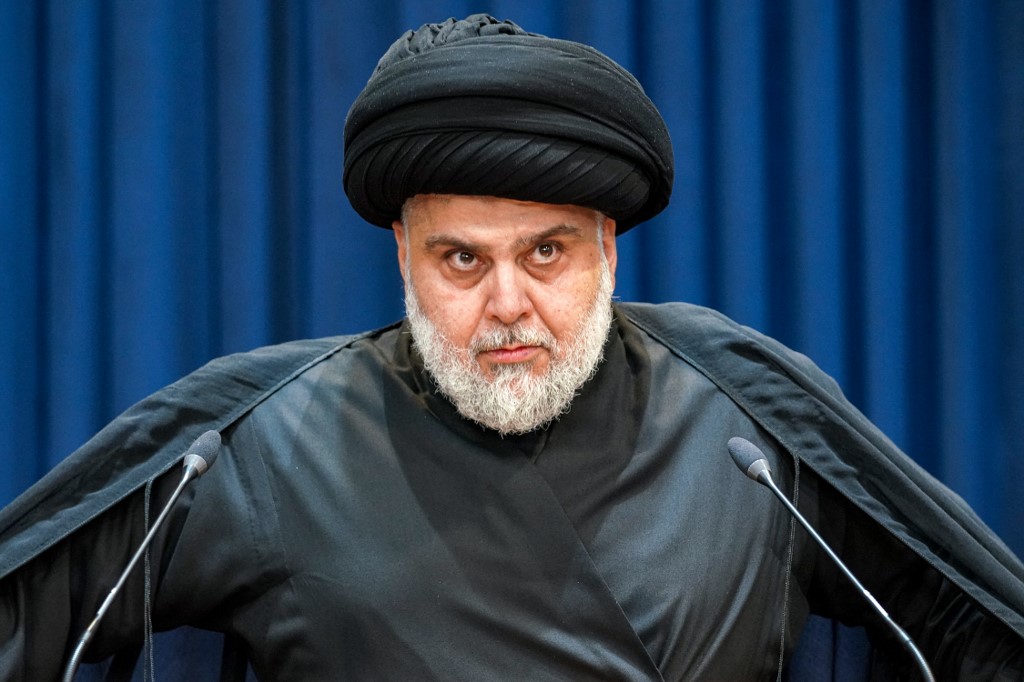
Tensions across the Middle East have spiked once again, with influential Iraqi Shia cleric Muqtada al-Sadr stepping forward to issue a urgent public call for Iran’s Islamic Revolutionary Guard Corps (IRGC) and its affiliated armed factions to halt cross-border attacks launched from Iraqi territory.
In a post shared on the social platform X, Sadr warned that these unauthorized operations risk dragging Iraq, a country already grappling with decades of unresolved instability, into a devastating new regional conflict. He stressed that rogue militias operating outside state control must not give neighboring Gulf nations any justification to launch military strikes on Iraqi soil, which he described as a sacred homeland for the Iraqi people.
Sadr also urged all regional factions to avoid falling prey to what he framed as “the schemes of the Zionist-American enemy,” which he accused of inciting inter-Arab and inter-Muslim conflict to advance foreign interests. Echoing his long-standing nationalist stance, he emphasized that the Iraqi public has an overwhelming need for peace, and repeated his call for a region fully free of foreign military bases and external colonial domination.
Sadr’s comments come in immediate response to a recent joint air strike operation carried out by the United States and Saudi Arabia targeting pro-Iranian armed groups inside Iraq. Two unnamed members of Iraq’s Popular Mobilisation Forces (PMF) told AFP that at least 10 PMF fighters were killed in the coordinated strikes that hit multiple locations across the country. Following the strikes, Iraqi Prime Minister Ali al-Zaydi called an emergency high-level security meeting to address the escalating security crisis.
Separately, Iranian state media reported that an anonymous Iranian military source has denied all accusations that Iran was involved in recent projectile attacks launched from third countries against targets inside Saudi Arabia.
A key contextual note for Sadr’s intervention is the cleric’s complex political standing: while he has collaborated closely with Iran in the past, he has long maintained a fiercely independent political streak, prioritizing Iraqi national interests over Iran’s broader regional geopolitical agenda.
Today, Iraq finds itself once again caught in the middle of escalating tensions between the US, Israel and Iran, a standoff that has plunged the entire Gulf region into renewed chaos. Though Iraq shares a common Shia religious identity with Iran, the country has still not fully recovered from the 2003 US-led invasion that toppled Saddam Hussein, leaving behind a decades-long legacy of sectarian division and political fragility. Iraq is home to a wide network of Shia armed factions, most of which maintain close ties to Iran and work within the framework of the Iraqi central government — but not all factions align completely with Tehran’s foreign policy priorities, creating a tense internal political balancing act for Baghdad.