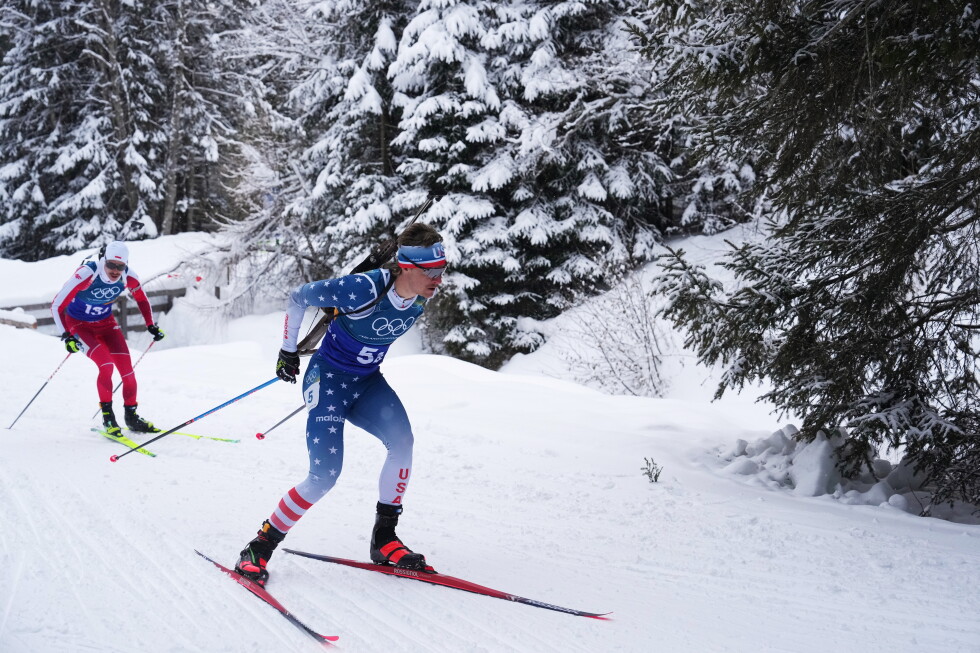
A rare proposed consolidation between two U.S. Olympic national governing bodies has thrown the future of American biathlon into question, as leaders of the U.S. Biathlon Association push to bring the sport under the umbrella of U.S. Ski & Snowboard (USSS) — a move backed by financial necessity according to supporters, but decried as an existential threat by long-time participants of the sport. The U.S. Biathlon board of directors is scheduled to cast its final vote on the integration plan this Wednesday, months after exploration of the proposal began in the wake of another medal-less performance by American biathletes at the 2022 Beijing Winter Olympics. Members of the association were first formally notified of the talks in May.
U.S. Biathlon CEO Jack Gierhart told association members that shifting fiscal pressures left leadership with little choice but to explore the partnership: the U.S. Olympic and Paralympic Committee has cut the organization’s funding by 22%, and private corporate sponsors have reduced their commitments amid broader economic tightening. Integration with USSS, Gierhart argues, would open access to expanded funding streams, enhanced support services for competing athletes, and greater exposure to the larger cross-country skiing community to recruit new competitors to biathlon, a hybrid sport that combines cross-country skiing and precision rifle shooting. Sophie Goldschmidt, CEO of USSS, told the Associated Press that the larger governing body is well-positioned to elevate American biathlon to new competitive heights, saying “We feel that we can help take biathlon to the next level.”
USSS is undeniably a powerhouse in American winter sports: it currently oversees 11 Olympic disciplines, counts 250 elite athletes among its ranks including global superstars like alpine skiing champion Mikaela Shiffrin and cross-country skiing gold medalist Jessie Diggins, holds a $70 million annual budget, and boasts 40,000 registered members. By comparison, U.S. Biathlon operates on just a $4 million annual budget and counts only 1,407 registered members. Though biathlon is a massively popular spectator and participation sport across much of Europe, it has never produced an Olympic medal for the United States, a long-standing performance gap that has contributed to its limited domestic funding and profile.
Supporters of the merger argue the partnership would deliver mutual benefits for both organizations. Kikkan Randall, an Olympic cross-country skiing gold medalist and current USSS board member, noted that tapping into biathlon’s massive European popularity could open new marketing and sponsorship opportunities for the merged organization. “There’s a recognition of how big biathlon is in Europe. Being able to tap into that popularity and marketability is really intriguing,” Randall said. Under the proposed terms of the alliance, U.S. Biathlon would retain its own governing board (expanded to include USSS-appointed representatives) to manage sport-specific decisions, all existing U.S. Biathlon staff would transfer to the larger organization, and biathlon would secure two permanent seats on the USSS board. Gierhart emphasized that the additional resources from USSS would allow the organization to invest in grassroots growth: providing equipment to local clubs, expanding existing youth recruitment programs, and delivering much-needed support to underresourced community programs. “The long-term implications of what this could bring is really profound from a growing-the-sport perspective and pushing support out to the communities and clubs that need it,” Gierhart said.
But the proposal has sparked fierce pushback from a large cohort of long-time biathlon athletes, coaches, and supporters, who have organized town halls, launched an opposition website, and filed formal ethics complaints against U.S. Biathlon board leadership. Critics argue the board has fast-tracked the merger without sufficient input from rank-and-file members, and warn that biathlon will be sidelined and eventually erased within the larger organization, overshadowed by more popular, high-revenue sports like alpine skiing and snowboarding. Many opponents fear the merger will lead to eventual funding cuts for the national biathlon team, pointing to USSS’s past cuts to funding for U.S. ski jumping in 2010 and Nordic combined in 2014 as a cautionary example.
“I don’t want to see biathlon disappear into another organization,” said Art Stegen, author of *Unique and Unknown: The Story of Biathlon in the United States*, who is one of the most visible voices of opposition. Stegen, retired sports lawyer Ed Williams, and former Olympic biathlete Joan Wilder filed a formal ethics complaint with the U.S. Biathlon ethics committee last week, alleging that board chair Bob Hall violated organizational rules by holding closed merger discussions without notifying the full membership, and that board member Dexter Paine holds an unreported conflict of interest due to his concurrent seat on the USSS board. While the ethics committee acknowledged this month that “it appears there is merit to some of the allegations,” it dismissed the complaints entirely, noting it lacks the legal authority to remove a sitting board member.
A 2024 analysis of the merger conducted by veteran biathletes Jon Schafer and Marc Sheppard concluded that any partnership with USSS should only be pursued as a “last resort.” The pair’s interviews with hundreds of members of the biathlon and cross-country skiing communities found that “The overwhelming consensus is that everyone is terrified of destroying the long-term future of the organization for possible short-term financial gain.” Opponents also argue that grassroots growth is already underway through existing programs, and that the sport can expand its revenue and membership without ceding control to a larger governing body.
Beyond internal opposition, the proposal also faces a potential major legal obstacle under federal Olympic law. Steven Bank, a UCLA law professor specializing in sports law, explained that the 1978 Ted Stevens Olympic and Amateur Sports Act bars one national governing body from overseeing multiple sports that fall under separate international federations. Currently, USSS falls under the governance of the International Ski and Snowboard Federation, while biathlon is governed by the International Biathlon Union — a separation that could put the merger in conflict with the 46-year-old law, which was designed to prevent jurisdictional disputes over team selection, rule-setting, and competitive standards.
This is not the first time USSS leadership has pursued expansion through acquisition: Goldschmidt launched a bid to take over USA Surfing last year, but abandoned the effort after widespread opposition from surfing community members. Goldschmidt confirmed to the AP that USSS is also currently in exploratory talks with USA Skateboarding about a potential future partnership, signaling that the biathlon merger is part of a broader push by the winter sports powerhouse to expand its footprint across Olympic sports.