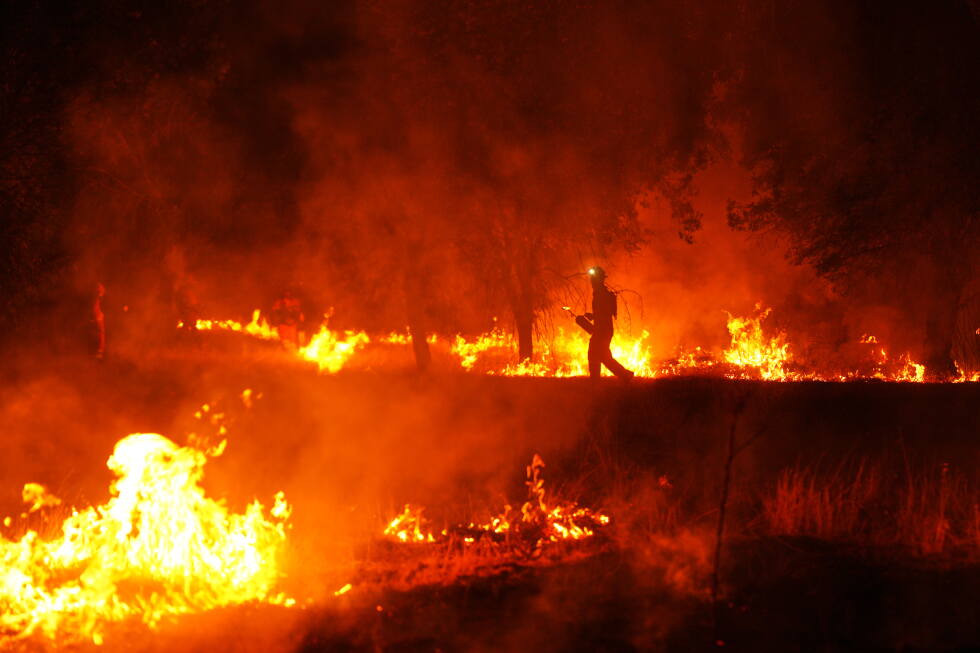
BARCELONA, Spain — For veteran Spanish wildland firefighter Javier García, 20 years of defending rural communities and wooded landscapes have prepared him for nothing that matches the scale of the historic megablaze burning through central Spain, west of the capital Madrid.
In an interview ahead of another grueling 12-hour shift on the fire line, García described the unprecedented inferno as an event without any parallel in his decades of service. Currently, the out-of-control blaze has already scorched 500 square kilometers of terrain — an area five times larger than the entire city of Barcelona — and forced 25,000 residents to evacuate their villages across the smoldering hills of Ávila.
The unprecedented ferocity of this wildfire, the largest ever recorded in Spain, has upended longstanding firefighting strategies. Fire commanders have been forced to completely shift operational priorities: evacuating at-risk communities and protecting populated property now take precedence over direct fire suppression, as fast-moving flame walls and extreme heat create deadly conditions that make frontal attacks on the blaze far too dangerous.
García called the fire’s rapid spread alarming, noting a profound shift in how his brigade operates. Where once his team would advance to battle wildfires deep in wilderness areas, they now serve as a last line of defense focused exclusively on saving human lives. To date, no fatalities have been reported across the three active major blazes burning across Spain: the Ávila fire, a second blaze in the Madrid region, and a third in eastern Castellón. Combined, the three fires have forced nearly 79,000 people to leave their homes. “That gives us more work and more stress,” García explained. “Now it is lives first, then homes, and after, the forest.”
García is part of Spain’s national emergency wildfire brigade, a mobile unit that deploys to support regional fire crews when blazes outgrow local capacity. Based in Ávila, his 40-person team has already spent three consecutive days battling the current inferno, after wrapping up assignments at two other recent major blazes in Guadalajara and near Zaragoza in recent weeks. The Guadalajara fire alone burned 320 square kilometers, making it the third largest wildfire recorded in Spanish history.
“Until last year, I had never experienced fighting one big fire after another,” the 43-year-old firefighter said.
Spain’s hot, dry summers have long made large swathes of the country naturally prone to wildfires. But climate experts and Spanish government officials confirm human-caused climate change has dramatically amplified risk: it has increased the frequency and intensity of heat waves and extended multi-year drought periods, stretching the annual high wildfire risk window far beyond historic norms. Once ignited, today’s wildfires grow at speeds and intensities that were rarely seen even a decade ago.
García notes that where his team once faced roughly 15 days of extreme fire risk annually, that number has jumped to between 30 and 40 days a year. So far in 2025, wildfires across Spain have burned 1,530 square kilometers of land — six times the total area scorched by blazes in the first half of last year, according to Spanish Ecology Minister Sara Aagesen.
Spain’s wildfire crisis is part of a broader regional emergency across southwestern Europe. A separate megablaze in neighboring France has already forced more than 200,000 people to evacuate their homes, prompting France to order an additional 4,000 evacuations as ongoing heat waves hamper fire suppression efforts.
For Raúl Guerrero, a 29-year-old firefighter with 10 years of experience in Castilla y León, the autonomous region that includes Ávila, the current blaze is unlike any he has ever fought. Multiple times over the course of the response, his 40-person unit has been forced to retreat to safer ground when the fast-moving fire put them at risk of being trapped.
He described the blaze as repeatedly exceeding Spain’s wildfire extinguishing capacity. “The fire is so virulent and has such power that no matter what you do, you can’t put it out,” he said. When asked about the emotional weight of that reality, Guerrero responded simply: “above all, impotent.”
While wildfires are most often ignited by lightning or accidental sparks from agricultural equipment, firefighters and experts point to a second human-caused factor that has made modern blazes far more dangerous: the gradual abandonment of rural land use. For generations, small farms, orchards and local forestry industries created natural buffer zones of cleared land around villages and populated areas that slowed fire spread. As those industries have disappeared and rural populations have declined, unmanaged vegetation now grows right up to the edge of residential areas.
Guerrero called this unmaintained overgrowth “pure gunpowder” waiting to ignite, and urged local authorities and private property owners to implement year-round brush clearing and forest management to reduce future risk.
Across the Atlantic, the wildfire crisis is not limited to Europe: a major wildfire in the U.S. state of Oregon has forced the closure of 70 miles of a major interstate highway, demonstrating how extreme wildfire has become a global challenge driven by shifting climate patterns.