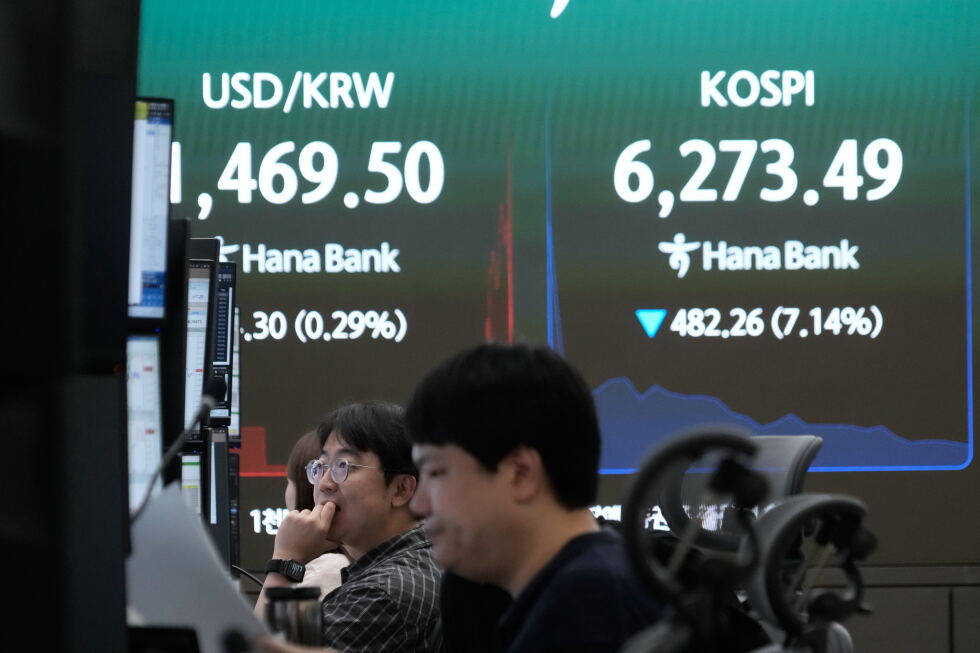
A wave of widespread selling swept through Asian equity markets on Tuesday, driven by growing investor jitters over the future trajectory of the red-hot artificial intelligence boom, which sent South Korea’s benchmark Kospi index plummeting more than 10% by midday trading. The sharp downturn, heavily concentrated in top domestic chipmaking stocks that have led recent regional market gains on AI demand optimism, triggered an automatic temporary trading halt as the index slid to its lowest level since April.
By midday session, the Kospi stood 10.5% lower at 6,051.19, with industry giants Samsung Electronics and SK Hynix leading the collapse. Samsung’s share price tumbled 12% from Monday’s close, while SK Hynix dropped an even steeper 12.7% as investors rushed to exit positions in AI-linked semiconductor assets.
Market analysts point to shifting competitive dynamics in the global chip sector as a core catalyst for the sudden selloff. Fears are growing that rising competition from Chinese AI startups and domestic memory chipmakers could erode the outsized profit gains that have pushed share prices of global chip giants to record highs during the 2023-2024 AI frenzy. These concerns were amplified by a blockbuster trading debut for Chinese memory chipmaker ChangXin Memory Technologies (CXMT) on Monday, when its share price surged 466% on the Shanghai Stock Exchange’s STAR Market, a tech-focused board for innovative domestic firms. CXMT raised at least $8.6 billion through its initial public offering, marking one of the largest global tech listings of the year and underscoring the rapidly growing scale of China’s homegrown semiconductor industry.
The selling pressure spilled across most of the Asia-Pacific region on Tuesday. Japan’s Nikkei 225, which has also rallied sharply on AI optimism in recent months, dropped 4% to 62,350.18, while Taiwan’s Taiex — home to many of the world’s top contract chip manufacturers — slid 3.9%. Mainland China’s Shanghai Composite Index lost 1%, and Hong Kong’s Hang Seng Index edged a modest 0.1% lower to 25,178.21. Bucking the regional downward trend, Australia’s S&P/ASX 200 gained 0.6% to close at 8,944.40.
Beyond equities, global oil prices extended their retreat, falling more than 1% amid easing geopolitical tensions in the Middle East. For three consecutive days, neither the United States nor Iran has launched new military strikes, and regional mediators report incremental progress in pushing the two sides toward renewed negotiations. By Tuesday afternoon, Brent crude, the global benchmark for oil prices, fell 0.8% to $85.16 per barrel, while U.S. West Texas Intermediate crude dropped 0.9% to $81.86 per barrel.
U.S. equity futures showed little change in early Tuesday trading, pointing to a muted open on Wall Street following a mixed close in the previous session. On Monday, the S&P 500 gained less than 0.1%, the Dow Jones Industrial Average added 0.5%, and the Nasdaq Composite slipped 0.2% to mark its fourth consecutive daily loss.