Generations of Yemeni society have operated under a deeply entrenched tradition where children inherit their fathers’ professions, a path most commonly followed by those denied access to formal education who enter the workforce as teenagers. For 28-year-old Ridhwan Raweh, this meant picking up the family trade of shoe polishing from his father, a routine he followed for more than 13 years. Each morning, he would sling a worn leather bag holding a dented hammer, scuffed polishing brushes, and half-empty jars of polish, then walk to Taiz’s central market to sit cross-legged on the sidewalk, display a handful of shoes for repair, and wait for customers.
Raweh is a member of the Muhamasheen, an ethnic and social minority group whose name translates directly to “the marginalized” – a label that reflects centuries of systemic, caste-like discrimination that has pushed the community into extreme poverty and social exclusion. For generations, rigid social barriers have confined most Muhamasheen to low-paying, informal work such as street sweeping, shoe repair, and waste collection, jobs that members of majority groups refuse to take.
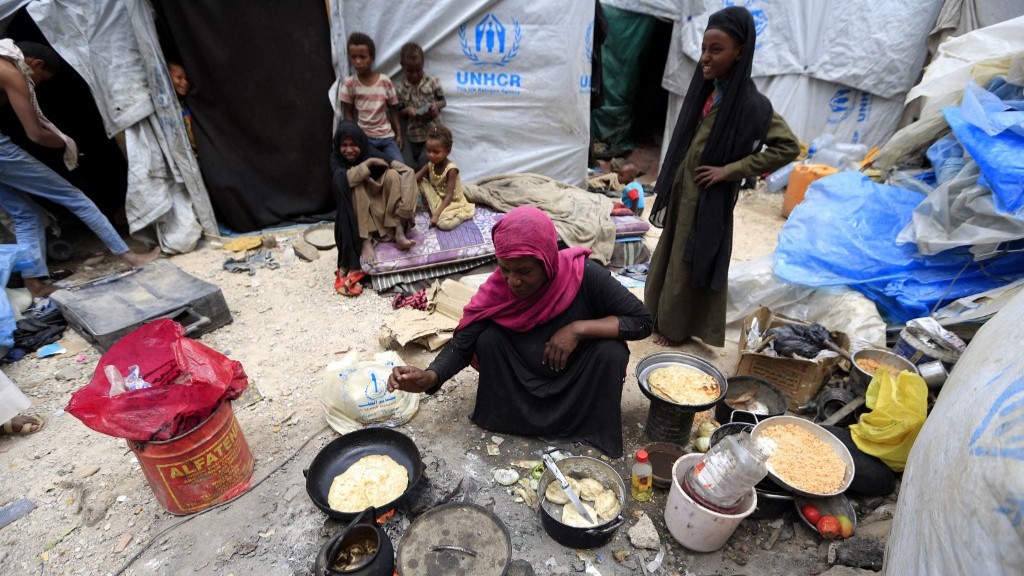
While Raweh’s shoe polishing work earned just enough to allow him to marry and support his three young children, it could not lift his family out of the desperate conditions that defined Muhamasheen life. For years, they lived in a flimsy makeshift shelter draped over a wooden frame, with no access to running water or electricity, a leaking roof that offered no protection from monsoon rains, and no permanent walls to guard their privacy and basic dignity.
Unlike most members of his community who accepted their intergenerational poverty as fate, Raweh was determined to build a safer, more stable life for his children. “I grew up surrounded by hardship, and I never stopped dreaming of changing that story for my family,” he told reporters from Middle East Eye. “But progress was impossible. My work barely put one meal on the table each day – there were days we had nothing at all.”
As Yemen’s years-long civil war dragged on, Raweh watched a growing number of young men from both his Muhamasheen community and majority Yemeni groups leave their civilian jobs to join armed factions deployed along front lines. Many of these men sought postings to units funded by foreign backers, where fighters received steady salaries paid in stable currencies such as Saudi riyals or U.S. dollars, a stark contrast to the devalued Yemeni rial that left most civilian workers struggling to afford basic goods.
Raweh recalled that many of his regular customers, close relatives, even small shop owners in the market closed their businesses and traveled to front lines along the Saudi border to fight against Houthi forces. “They came back after months driving new cars and building solid, permanent homes, so I made the decision to join the same battle lines to make my dream come true,” he said.
In early 2023, Raweh joined a group of 12 other young Yemeni men who traveled from their homes in Taiz to Marib Governorate, before moving north to the Saudi border front. None of the men had any prior military training or combat experience; their only motivation was the promise of a steady salary and the chance to escape generational poverty.
After two years of service on the relatively quiet border front, Raweh returned home with far more than unfulfilled dreams: he had the savings and clear plans to build the stable life he had long sought. “I didn’t even go back to our old tent first – I checked straight into a hotel where my family was waiting for me,” he said. “The very next day, I rented a proper home far from our old slum neighborhood. I swore I would never go back to that tent life, and I would keep my children far away from that suffering.”
Today, Raweh earns a monthly salary of 2,500 Saudi riyals (approximately $665), a wage that puts him far above most Yemeni civilians. With his accumulated savings, he purchased a plot of land, built a two-story permanent home for his family, and bought two minibuses. He drives one minibus himself for a local transport route, and leases the second to another driver for a steady daily income.
Raweh emphasized that since the UN-brokered truce came into effect in April 2022, large-scale combat operations across most Yemeni front lines have largely halted. This period of relative calm has made enlistment even more attractive to desperate young men, who can collect a steady foreign-currency salary without facing the high risk of dying in intense combat. “There was no heavy fighting along the border when I was there, so it was a good opportunity for me to reach my goal and give my family a better life,” he said, speaking with clear pride in what he had achieved.
Even as he celebrates his improved circumstances, Raweh has no intention of passing his new path down to his children, just as he refuses to let them inherit the shoe polishing trade he learned from his father. “I was forced to fight to put food on my family’s table, but I will never let my children do that. They will have civilian careers,” he said. Today, his three children attend a well-regarded private school in Taiz. Denied a formal education himself, Raweh has prioritized their schooling, hoping it will free them from the cycle of marginalization that has trapped generations of Muhamasheen. “I inherited shoe polishing from my father, but I refuse to pass either that job or fighting to my kids,” he said. “We hope for a better Yemen, where our children can build a peaceful future.”
Raweh’s story of success is far from the norm, however. In recent months, thousands of desperate young Yemenis have attempted to enlist in the Saudi-backed factions along the border and the Republic Guards on Yemen’s west coast, where salaries are paid in stable foreign currency. But many have been turned away, as recruitment for these units has been paused in recent months.
One of those rejected was 39-year-old Hani, another Muhamasheen man who had worked as a low-paid street cleaner for years. Left with no other options to earn a living wage, Hani was targeted by unlicensed brokers recruiting Yemeni fighters to deploy to the Russia-Ukraine war, who promised large salaries and signing bonuses.
“Like so many other men here, Hani couldn’t provide for his family, and he felt he had no other choice but to go to war,” his wife Ahlam told Middle East Eye. “He didn’t want to go to Russia, but after he couldn’t enlist with the local factions, it felt like his only option left.” After more than two months of hesitation and grief over leaving his family, Hani departed for Russia two months ago, hoping to save enough money to return home, open a small business, and build a permanent home for his wife and children, just as his more successful neighbors had done.
“We were heartbroken when he left, but we held onto hope that he would come back and give us the better life we all dreamed of,” Ahlam recalled. “Unfortunately, we weren’t as lucky as the other families. A month ago, we lost all contact with Hani and all the friends he traveled with.” For weeks, the family waited anxiously for any word from Hani, their sole provider who had promised them a future out of poverty. But their worst fears were confirmed just 10 days ago, when they received official notice of his death.
Ahlam says she deeply regrets that she could not convince Hani to stay, and now she urges all families to block their loved ones from enlisting in any conflict, “even if you have to starve.” “I advise every woman to stop her husband, son, or brother from joining battles anywhere,” she said. “Nothing is worse than losing them forever.”
There are no official government statistics on the total size of the Muhamasheen population, but local research and nonprofits estimate the group numbers around 3.5 million people, roughly 10 percent of Yemen’s total population. The vast majority live in makeshift slum settlements on the outskirts of major Yemeni cities, with little to no access to clean water, electricity, healthcare, or formal education. While this level of deprivation has long been unique to the Muhamasheen, the 2015 outbreak of full-scale civil war has pushed millions of other Yemenis into similar desperate conditions. According to the United Nations Office for the Coordination of Humanitarian Affairs (OCHA), an estimated 22.3 million Yemenis – more than half the country’s total population – still require urgent humanitarian assistance and protection.
The growing flow of marginalized Yemenis into armed groups has already reshaped the country’s centuries-old social hierarchy, a shift visible in even small daily interactions. Abdullah, a 51-year-old government worker who asked to only use his first name, currently rents a home in Taiz from a Muhamasheen fighter – a situation that would have been unthinkable a generation ago, when Muhamasheen were almost never able to afford to own multi-story residential buildings.
“Today, it’s fighters – both from the Akhdam (the local name for the Muhamasheen) and other groups – who have the money to build large multi-story homes. Meanwhile, people like me who get irregular, small salaries can barely afford to pay rent,” Abdullah said. Even with a bachelor’s degree in accounting and a stable job at Taiz’s public electricity authority, Abdullah’s modest salary is not enough to support his family of seven. His eldest son was forced to drop out of high school to work as a daily construction laborer to help cover the family’s basic costs.
“I don’t look down on any social group,” Abdullah said. “I am just pointing out that uneducated fighters now get more respect from society and more recognition from leaders than educated professionals, all because they carry guns.”
Yemeni sociologist Fahd Al-Thobhani explains that war always reshapes social hierarchies, a process that disproportionately rewards fighters and war profiteers while the vast majority of civilian society suffers. “We see Muhamasheen men who can’t even write their own names owning modern, comfortable homes, while university professors are forced to work as street vendors just to feed their families,” Al-Thobhani said. “This is the natural outcome when formal state governance breaks down, and power shifts to armed groups that value fighters over scholars.”
Al-Thobhani warned that the greatest long-term damage will fall on Yemen’s next generation, who grow up watching educated professionals struggle to get by while armed fighters enjoy wealth and high social status. He added that while Yemen’s centuries-old rigid caste system is breaking down, this shift is not happening for progressive or equitable reasons.
“The Muhamasheen have been stuck at the bottom of Yemeni society for as long as the caste system has existed,” he said. “Today, though, we see traditional upper-class Yemenis taking orders from a Muhamasheen commander simply because he has money and armed power. Money – not traditional family lineage, not education – now controls people who are desperate for work and stability.”