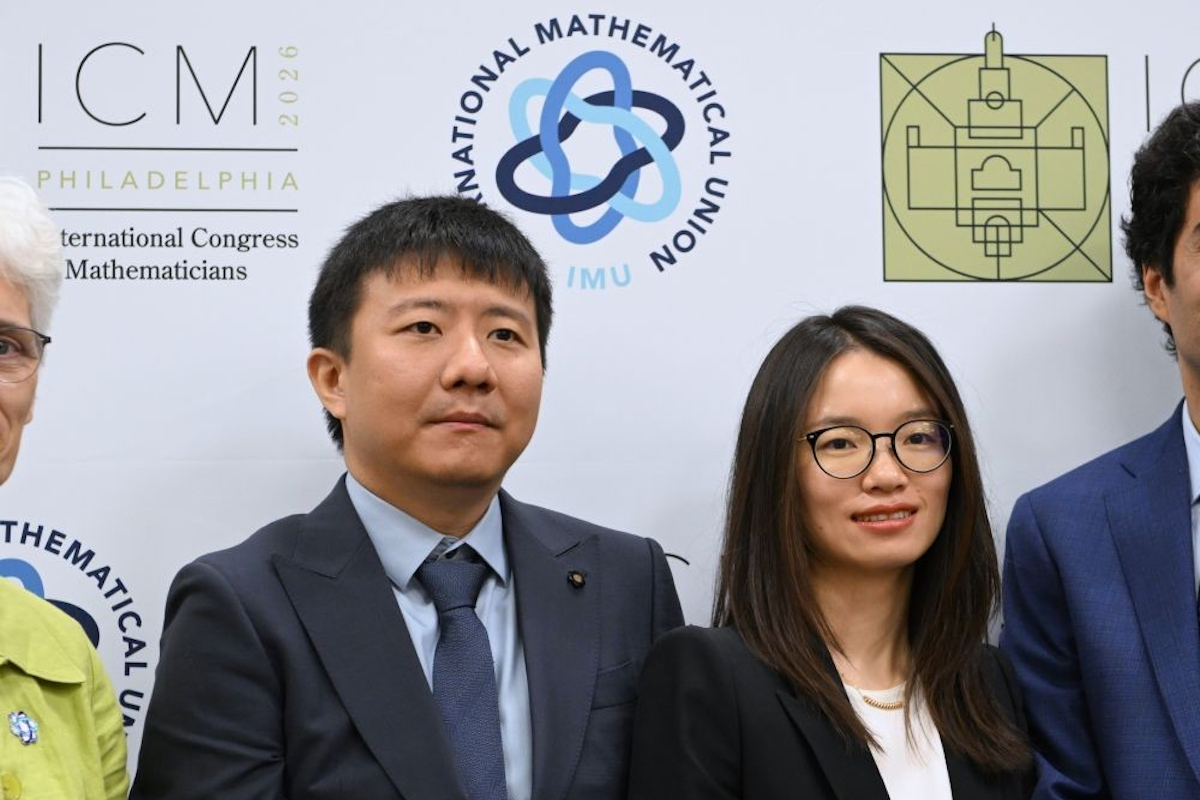
On July 23, 2026, a historic milestone unfolded at the International Congress of Mathematicians hosted in Philadelphia: Hong Wang and Yu Deng became the first citizens of the People’s Republic of China to claim the Fields Medal, the 90-year-old highest honor in the field of mathematics. Beyond this groundbreaking first, Wang added a second layer of history to the moment, joining just two other women — Maryam Mirzakhani and Maryna Viazovska — to ever receive the award.
While this achievement is universally celebrated, it opens a far more nuanced question that neither nationalist triumphalism nor dismissive skepticism can answer: what exactly does the Fields Medal measure? The answer is far from a real-time snapshot of any nation’s current scientific policy. Like light emitted from distant stars, awards in fundamental science reach audiences long after the work that earned them was set in motion. Any government that interprets this year’s win as an up-to-date grade for its latest research strategy is misreading the signal entirely.
Many observers default to framing the Fields Medal as a national scoreboard, but the career trajectories of Wang and Deng defy this simplistic framing. Both mathematicians enrolled at Peking University as part of the 2007 incoming cohort, but their paths quickly extended beyond China’s borders. Wang pursued graduate study in France before completing her doctorate at the Massachusetts Institute of Technology, while Deng transferred to MIT in 2009 and earned his PhD at Princeton University. Today, Wang holds dual academic appointments at New York University and France’s Institut des Hautes Études Scientifiques, and Deng is a faculty member at the University of Chicago. Even French President Emmanuel Macron highlighted Wang’s cross-border career when he called to congratulate her, using her story to promote France as a global hub for scientific talent. In truth, three or four different nations could justifiably claim a stake in this pair of historic achievements.
This transnational footprint is no accident — it is the core structure of elite modern scientific discovery. The foundational phase of talent development: the rigorous K-12 schooling, competitive problem-solving circuits, and intensive undergraduate training that cultivates researchers capable of tackling century-old unsolved problems, is largely rooted in national systems and takes roughly two decades to complete. But the phase where talent truly flourishes — access to world-class mentors, collaborative seminar cultures, and institutional tolerance for a decade of apparent unproductivity — is an increasingly transnational process, shaped by global research networks. In the case of Wang and Deng, China laid the exceptional foundational groundwork, while specialized research institutions across three countries created the conditions for their breakthroughs. Neither phase alone could have produced a Fields Medal-worthy result.
Digging deeper into this story reveals a broader lesson that applies to research systems across the globe. For decades, China dominated the International Mathematical Olympiad, the premier high school competition, but failed to produce a Fields Medalist — and that gap held clear lessons. Olympiad success rewards quick problem-solving on questions that are already known to be solvable within a tight four-hour window. Cutting-edge mathematical research demands the exact opposite mindset: the patience to commit to a problem that could take a decade to solve, or may never yield an answer at all.
Wang and her collaborator Joshua Zahl ultimately resolved a century-old open question first posed by Soichi Kakeya in 1917. Deng, working with co-researchers Zaher Hani and Xiao Ma, closed out a long-standing formulation of one of David Hilbert’s famous 1900 list of 23 unsolved mathematical problems. Few modern research metrics and evaluation systems are designed to reward work that unfolds on this multi-decade timeline.
This is the widely transferable insight from the 2026 awards, and it challenges more research systems than it praises. Research funding bureaucracies across Asia, Europe, and North America have increasingly converged on short performance review cycles, overreliance on publication counts, and rigid near-term deliverable requirements. Very few of these systems successfully protect the long time horizons that ground-breaking fundamental work requires. In this light, the Fields Medals stand as a quiet but powerful argument for patient investment in science — the very kind of long-horizon funding that most public and private funders have steadily retreated from in recent years.
Within hours of the medal announcement, two competing national anxieties emerged, both of which miss the core point of the achievement. On Chinese social media, users questioned why the nation’s top undergraduate students leave to pursue graduate study and careers abroad. In Washington D.C., the same win was framed as evidence of American scientific decline. Both readings treat leading mathematicians as national assets in a zero-sum global competition, a framing that ignores how modern mathematical discovery actually works.
This zero-sum framing is fundamentally incorrect, and the breakthroughs themselves prove it. Wang’s landmark result was completed in collaboration with a researcher at the University of British Columbia, while Deng’s work relied on partnerships with scholars based at the University of Michigan. Once a mathematical theorem is published, it becomes a permanent global public good: it is non-rival, meaning one researcher’s use does not diminish another’s, and non-excludable, available to any graduate student in Lagos or Lahore the moment it is posted to the open access preprint server arXiv. The real downstream impact of work like the Kakeya conjecture resolution, which underpins advances in harmonic analysis, wave propagation, signal analysis, and medical imaging, accrues to any researcher who chooses to build on it, regardless of what passport they hold.
If there is a meaningful policy lesson to draw from this year’s awards, it does not center on which nation can claim a win. Instead, it asks whether the cross-border pipeline that produced these two winners can survive growing geopolitical pressure. That pipeline depended on unimpeded academic mobility: Chinese undergraduates gaining seamless access to top American doctoral programs, French research institutions hiring the best global talent regardless of nationality, and collaborative teams forming freely across national borders. Today, as governments increasingly sort researchers by nationality and perceived security risk, that open pipeline is growing far harder to sustain. Gradually, the free circulation of talent is being replaced by rigid sorting along national lines.
This shift carries a steep potential cost. The 2026 Fields Medals are the product of an open, interconnected global research system. It is reasonable to ask whether a more closed, fragmented system will be able to produce similarly groundbreaking results when the next International Congress of Mathematicians meets in 2030.
The awards also arrive at a moment of growing debate over artificial intelligence’s role in mathematical discovery, reinforcing a key truth: greater computational power does not eliminate the need for human judgment to identify which problems are worth devoting years, even decades, of work to.
Ultimately, the most honest reading of the 2026 Fields Medal ceremony in Philadelphia is not a story of one nation’s ascendance nor another’s decline. It is a reminder that mathematics remains one of the few truly borderless human enterprises, and its greatest breakthroughs still emerge only from systems brave enough to fund a hard question for a century and wait for an answer.