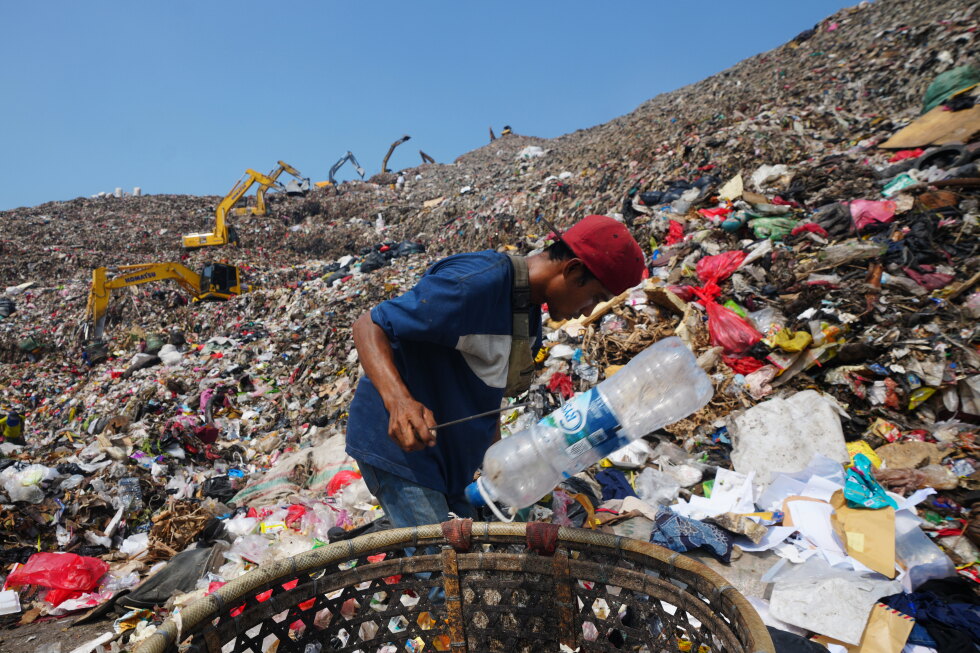
In the pre-dawn darkness that hangs over Indonesia’s Bantargebang, the country’s largest landfill site on the eastern outskirts of Jakarta, thousands of waste pickers already scramble across towering heaps of garbage to hunt for recyclable and resalable materials before fresh waste buries their finds. Among them is 35-year-old Nur Wencih, a widow who has followed in her parents’ footsteps working at the site for 20 years. For Wencih, who lives alone in a small rented room near the landfill, sorting discarded cardboard, plastic bottles, and discarded toys has paid for daily food, rent, and the education of her two teenage daughters, who stay with relatives in a rural village. On a good day, she earns roughly $12, and occasional lucky finds of forgotten gold jewelry feel like winning the lottery, she told the Associated Press during a break from the sweltering July heat. But like thousands of her colleagues, Wencih now faces an uncertain future as Indonesia launches one of its most sweeping national waste management reforms in decades.
Starting August 1, the Bantargebang site will end its current open dumping operations and transition to a controlled, sanitary landfill system. This shift is part of a national policy that will shut down open dumping at 343 of Indonesia’s 550 existing disposal sites nationwide. Under the new rules, all landfills will gradually shift to only accept non-recyclable, non-compostable residual waste — items such as soiled diapers, used paper towels, and adhesive stickers that cannot be processed for reuse. At the same time, Indonesian households will be required to sort organic and recyclable waste for separate processing, a large-scale practice that most of the population has never been trained to adopt.
The core driver of this reform is climate action. Open, unmanaged landfills produce massive amounts of methane, a greenhouse gas that traps 80 times more heat in the atmosphere than carbon dioxide over its first 20 years, and is responsible for roughly one-third of current global warming. Cutting methane emissions is widely recognized by global climate leaders, including U.N. Secretary-General António Guterres, as one of the fastest, most effective ways to slow the pace of near-term global warming.
Bantargebang itself has become a flashpoint for global methane reduction efforts. Originally opened in 1989 as a properly designed sanitary landfill with a working methane collection system, the site gradually shifted to full open dumping after a private sector management contract expired in 2016. Today, only 2 of its original 12 methane extraction wells still operate. Satellite data analyzed by UCLA’s STOP Methane initiative ranked Bantargebang as the world’s second-highest methane-emitting landfill in 2025, outranked only by a large site in Argentina. Covering 110 hectares (272 acres), the landfill has grown into a 60-meter-tall man-made mountain — as high as a 20-story building — that receives 7,500 tons of Jakarta’s waste every single day. In March, a landslide triggered by heavy rain at the site killed seven people, a tragedy that underscored the urgent risks of the site’s overloaded, unmanaged state. “Its carrying capacity is reaching, or even exceeding, its limits,” said Agung Pujo Winarko, head of the Bantargebang facility.
Under the government’s rehabilitation plan, large sections of the Bantargebang site are already being covered with impermeable tarps to capture escaping methane, with the full overhaul estimated to cost up to $12 million. Dudi Gardesi Asikin, head of Jakarta’s Environment Agency, says the reform will deliver major public benefits: improved environmental health, reduced local pollution, and deep cuts in harmful methane emissions. It will also make daily work far safer for the people who sort waste here, he noted: currently, thousands of pickers race alongside heavy construction excavators to reach recyclable materials before they are buried, putting their lives at constant risk.
But the reform also creates a pressing national dilemma: how to protect the livelihoods of roughly 600,000 informal waste pickers across Indonesia who depend on open dumps for their income. At Bantargebang alone, more than 4,000 registered waste pickers work the site every day, and their work supports an entire local ecosystem of recycling traders, rental housing, and food stalls that serve the worker community. “What worries me most is how I will feed my family,” Wencih said. Local community leader Bunin, a 53-year-old resident who lives near the site, added that while the landfill has brought severe pollution to the area, it has also created critical economic opportunities for low-income local families. “The landfill not only brings negative impacts, there are also economic benefits,” he said.
Government officials say the reform will ultimately create better, more formal, safer jobs for waste pickers in the new recycling and composting sectors, and that pickers already receive basic social security and healthcare through national programs. But the transition remains fraught with uncertainty for the workers who have built their lives around Bantargebang, many of whom are third-generation waste pickers like Wencih, who hopes her own daughters will never have to work in the landfill.
The success of the broader national reform also depends on changing decades-old waste habits across Jakarta, where residents have never been required to sort household waste before disposal. Many ordinary residents say the new rules have already created confusion, as public education campaigns have been slow to reach all communities. “All we know is to throw the trash in the bin, not to sort it,” said Rukasih Wanti, a resident of Central Jakarta. “The new rule is confusing us. It’s inconvenient, creates extra work and wastes our time.”
Environmental advocates say the urgent need for this reform highlights decades of delay in updating Indonesia’s waste management infrastructure. Currently, only about 25 percent of the country’s daily waste is processed through formal waste systems, with the rest dumped, burned, or left unmanaged. David Sutasurya, executive director of Indonesian environmental organization YPBB, noted that up to 80 percent of Jakarta’s waste is either compostable or recyclable, meaning most waste currently going to landfills could be diverted with the right infrastructure. “We delayed transforming our waste-management system for too long, and only realized the problem when landfills were already close to full,” he said.
Still, grassroots activists are working to build public support for the shift across the country. In a West Jakarta neighborhood, community organizer Monica T. Anggriani has spent more than a decade persuading neighbors to sort their household waste, building a community waste bank that now processes one ton of organic waste daily through composting, maggot cultivation, and urban farming. “Our generation was never taught to separate waste,” Anggriani said. “If we don’t start now, nothing will change in the future.”