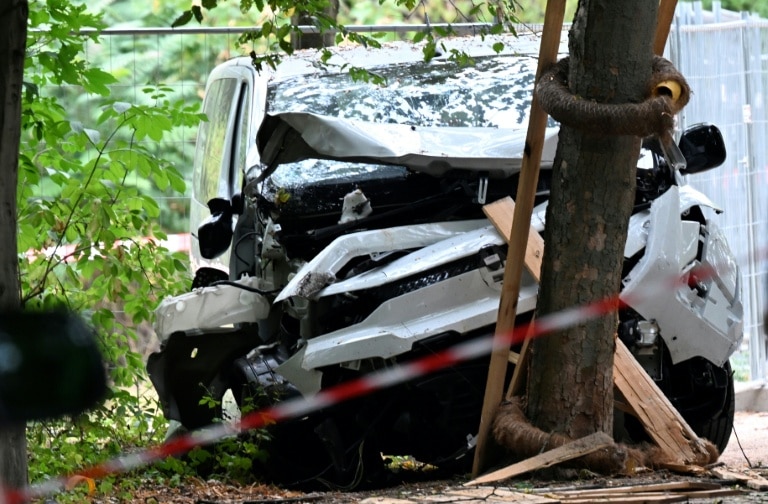
In the hours after a violent car-ramming attack that left one woman dead and 16 other people injured near Berlin’s annual Christopher Street Day (CSD) Pride celebration, German law enforcement launched an urgent manhunt Sunday for the prime suspect tied to the violent incident.
The attack unfolded shortly before 10 p.m. local time Saturday, just hundreds of meters from the end of the CSD parade route and the event’s main stage near Berlin’s iconic Brandenburg Gate. A white Citroen minivan, registered in Berlin, plowed into a crowd of pedestrians on the southern edge of central Berlin’s Tiergarten park before crashing into a standing tree. Multiple people in the vehicle fled the scene after the ramming, and investigators confirmed several victims also suffered stab wounds. Emergency responders confirmed one 35-year-old woman was killed in the attack, and three of the 16 injured remain in critical, life-threatening condition as of Sunday morning.
By Sunday morning, the wrecked minivan remained cordoned off at the crash site, where uniformed officers and forensic investigators combed the surrounding area for physical evidence, collecting soil samples and tracing clues to identify the attackers and map out the sequence of events. Organizers immediately cut short the day-long celebration, which had drawn hundreds of thousands of attendees to one of the largest annual Pride events in Europe, and directed crowds to evacuate the area safely.
Law enforcement officials have named 21-year-old Abdul B. as the prime suspect in the attack, releasing his photograph and a public appeal for any information about his current whereabouts. Investigators say there is clear evidence the suspect was motivated by Islamist ideology, with leading German outlets *Bild* and *Der Spiegel* confirming he is a known supporter of the so-called Islamic State (IS) militant group. Abdul B. has a prior criminal conviction in Germany for “preparing a serious act of subversive violence,” and attempted to travel to the Middle East last year to join IS, though his attempt was unsuccessful. Police described the suspect as approximately 1.9 meters tall, thin with black hair, and believed he was wearing a black hoodie and white trousers when he fled the scene. Investigators have not ruled out the possibility of additional accomplices, and have increased security checks at all Berlin train stations as part of the ongoing manhunt and investigation.
German political leaders across the ideological spectrum quickly condemned the attack, which targeted a public gathering celebrating LGBTQ+ tolerance and inclusivity. Berlin Mayor Kai Wegner denounced the violence as a “brutal attack” on a peaceful, inclusive gathering for the city. Chancellor Friedrich Merz confirmed he and Interior Minister Alexander Dobrindt were receiving regular updates on the investigation, and vowed to hold all responsible parties accountable for the “horrific act.” German President Frank-Walter Steinmeier said he was “shaken and outraged” by the violence, while Bundestag Speaker Julia Kloeckner ordered the national flag at Germany’s parliament building lowered to half-mast as a mark of respect for the victim.
International condemnation and expressions of solidarity quickly followed the attack. European Commission President Ursula von der Leyen extended her “deepest sympathies” to the victims and their families, while the governments of France, Italy, the Netherlands, Sweden and the United Kingdom all issued statements expressing shock and condemning the violence.
Members of Berlin’s queer community organized a public vigil for Sunday afternoon at the Brandenburg Gate to honor the victim and grieve together. Armin Duenhoelter, a 49-year-old drag artist who was backstage at the CSD main stage when the event was evacuated, told reporters he remained shocked by the attack, even as he acknowledged queer communities in Germany had long prepared for the possibility of a targeted attack on Pride events. “Even though in the back of your mind or in your gut you might feel uneasy, I will be back for next year’s CSD,” he said. “But we won’t let it beat us down.”
Saturday’s attack has reignited public debate in Germany over domestic security and immigration policy, bringing back memories of a string of high-profile deadly Islamist-motivated attacks that have struck the country over the past decade. The deadliest of these incidents remains the 2016 truck ramming attack at a Berlin Christmas market, which killed 13 people and was carried out by a Tunisian man with jihadist ties. Ahead of Germany’s 2024 general election, a wave of public space attacks shook the country, culminating in a December 2024 ramming attack at a Magdeburg Christmas market that left six dead and more than 300 injured. Far-right Alternative for Germany (AfD) lawmaker Martin Hess blamed the attack on what he called “a complete failure of the government’s security policies,” adding that “Islamism is the greatest security threat for our country.”