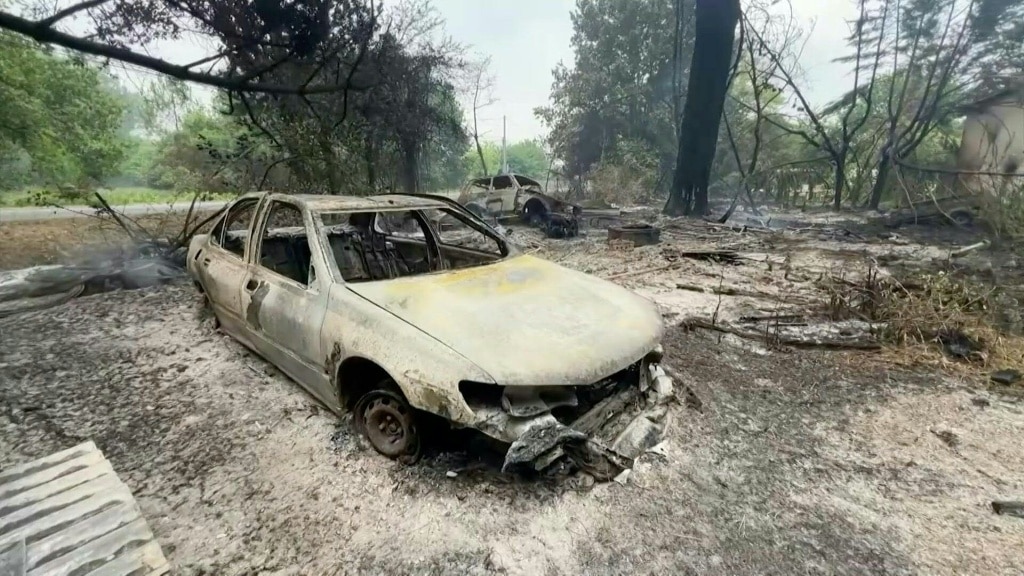
A wave of catastrophic, unpredictable wildfires sweeping across southern France and eastern and central Spain pushed exhausted firefighting crews to their breaking point on Sunday, forcing more than 300,000 people to flee their homes and critical infrastructure as blazes advanced through parched, drought-stricken landscapes.
In southwestern France, the fire crisis has grown into one of the most severe the country has faced since World War II, with the iconic wine-producing region surrounding Bordeaux facing direct threat. Key transportation links, including a major highway and regional rail lines, have been severed by advancing flames, which have already burned an area four times the size of the French capital Paris. More than 250,000 residents and tourists across high-season Atlantic coastal holiday destinations have been ordered to evacuate the danger zone.
Over 5,200 first responders, soldiers and law enforcement personnel have been mobilized to tackle the Gironde region inferno, which crept closer to Bordeaux’s city limits over the weekend. The village of Cestas, located on Bordeaux’s southwestern edge, was almost entirely evacuated; only a handful of the community’s 17,000 residents remained behind. “This fire is unpredictable and each time we think we’ve got on top of it unfortunately it surprises us in the worst possible way,” Cestas mayor Jerome Steffe told BFMTV. “Right now, it’s impossible to say where the fire will end up.”
Aerial footage from AFPTV showed entire homes in the coastal village of Le Porge reduced to ash. A second large fire in the neighboring Landes region, which displaced 30,000 people, was reported to be partially contained but not yet fully stopped. Local officials noted that shifting, turbulent winds have continuously frustrated containment efforts, keeping conditions extremely unstable across the country’s fire zones. French Interior Minister Laurent Nunez confirmed Sunday that the overall situation remains highly unfavorable for wildfire response.
French Prime Minister Sebastien Lecornu labeled the ongoing crisis a “historic situation” for the nation. Two firefighters have already died battling the blazes near Bordeaux earlier this week.
Across the border in Spain, the emergency has followed a similarly grim trajectory. A large wildfire burning west of Madrid has already forced 60,000 people from their homes; shifting winds pushed the blaze south over the weekend, moving it away from the capital for the moment but forcing additional overnight evacuations of villages in its path. To the east, a sudden new fire front erupted near the Mediterranean coastal city of Valencia, forcing an additional 15,000 evacuations just hours after it ignited. Valencia regional president Juanfran Perez Llorca told reporters that the blaze has outpaced local response capacity: “The fire is beyond our capacity to extinguish.”
One civilian has been killed in a smaller separate fire near Valencia, marking the nation’s first reported civilian fatality from this wildfire season. Spanish Prime Minister Pedro Sanchez, who visited the affected region for the second time in 24 hours on Saturday, acknowledged that “difficult hours” lie ahead, though he noted minor positive progress in containment efforts around the Madrid fire zone.
The extreme wildfire activity follows months of relentless heat and drought that have dried out woodlands across both countries, creating prime conditions for large, fast-spreading blazes. Climate scientists have repeatedly warned that human-caused global warming is increasing the frequency and intensity of extreme weather events across the globe, and Europe is warming faster than any other continent, amplifying these wildfire risks.
After three straight days of nonstop firefighting, first responders on both sides of the border are overwhelmed and suffering from severe exhaustion. To supplement stretched domestic resources, both France and Spain requested and received emergency assistance from the European Union and neighboring countries. Five aircraft and two helicopters, plus a Swiss firefighting crew, have been deployed to France, while four aircraft have been sent to support Spanish operations. France has additionally activated a modified A400M military transport plane capable of dumping up to 20 tonnes of water or fire retardant, joining 18 other aerial firefighting assets already operating over French fire zones. Spain maintains at least 29 aircraft airborne over the Madrid fire zone alone.