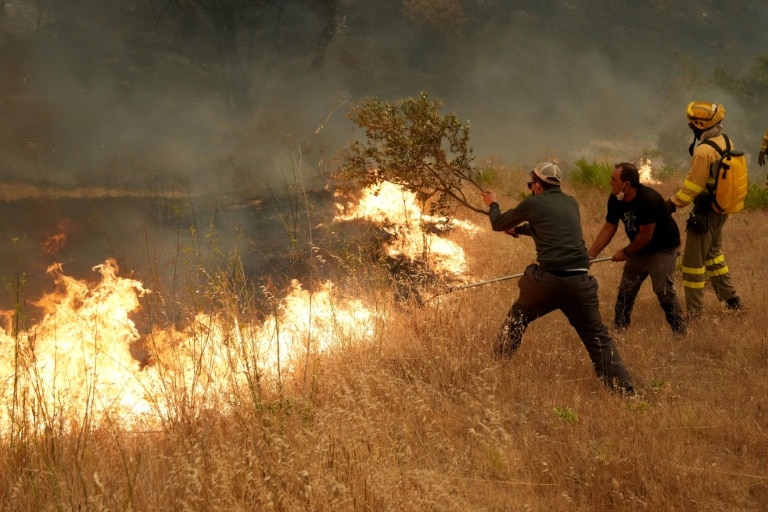
A historic, record-breaking wildfire burning across dry landscapes west of Madrid has forced 70,000 residents to evacuate their homes, pushing Spanish emergency crews into a desperate fight to contain the flames that officials describe as the worst fire the region has ever seen.
Spanish Prime Minister Pedro Sanchez traveled Saturday to the fire-hit village of Cenicientos, where he emphasized that protecting human life remains the national response’s top priority. “Our priority, our thinking, our aim is for your lives, to save your lives and protect inhabited areas,” Sanchez told reporters on site. He warned that the coming hours would remain extremely challenging, as unpredictable high winds threaten to reignite and spread the blaze even after overnight temperatures cooled. “We do not know exactly how the wind will develop, how strong it will be,” he added, noting that dropping overnight temperatures have created a narrow window of opportunity to gain ground against the fire.
Local officials have described the blaze as an unprecedented catastrophe. Brunete Mayor Mar Nicolas told AFP she was deeply concerned for displaced residents affected by the disaster. “Every year there are fires, but this one has been tremendous. It is a catastrophe,” she said.
The full scale of the disaster has become increasingly visible across the Madrid region: thick gray smoke has blanketed the skies west of the capital, with the acrid smell of burning vegetation reaching central Madrid’s city streets by Saturday morning. The smoke triggered respiratory irritation for local residents, forcing many to close windows and stay indoors. Spain’s Ministry of Health issued a public advisory via X urging people to avoid prolonged outdoor activity due to hazardous air quality.
Most evacuees have found temporary shelter in repurposed sports halls and municipal gymnasiums across Madrid’s suburbs. Jacqueline Villafranca, a 38-year-old Peruvian resident of the evacuated village Navalagamella, described the chaotic evacuation that unfolded Friday evening. When emergency alerts blared on residents’ mobile phones, she told AFP, “I thought everything was going to burn, the house and everything.” Villafranca, her husband, and their two children — ages 16 and 2 — were transported by bus to a municipal shelter in Alcobendas, a northern Madrid suburb, where the family rested after a harrowing 24 hours. She recalled her 16-year-old daughter returning from a holiday camp Thursday with smoke-related irritation, saying “Mum, I can’t open my eyes, my eyes are burning,” before evacuation orders were issued.
The blaze formed Friday when two separate wildfires burning in the Madrid region merged into one massive inferno, which is currently at risk of joining a third fire burning near Avila in the neighboring Castilla y Leon region. Overnight cool weather gave crews a much-needed reprieve: according to an update from the Madrid government delegation posted to X early Saturday, lower temperatures “greatly aided the fight against the wildfires, which advanced little and decreased in intensity.” As of Saturday, 10 villages in the Madrid region have been fully evacuated, while three additional communities have ordered residents to remain indoors to avoid smoke exposure. More than 2,000 evacuees are currently being supported across 14 dedicated emergency shelters, regional government data shows.
The historic El Escorial Monastery, a major cultural site northwest of Madrid, was found shrouded in thick smoke during an on-site visit by an AFP reporter.
Data from the European Union’s European Forest Fire Information System (EFFIS) shows this season’s wildfires have already burned more than 168,000 hectares of land across Spain in 2025. The country is already on track to see one of its most severe wildfire seasons in modern history: EFFIS records show 2022, which saw more than 393,000 hectares destroyed, currently holds the record as Spain’s worst wildfire season in recent decades.