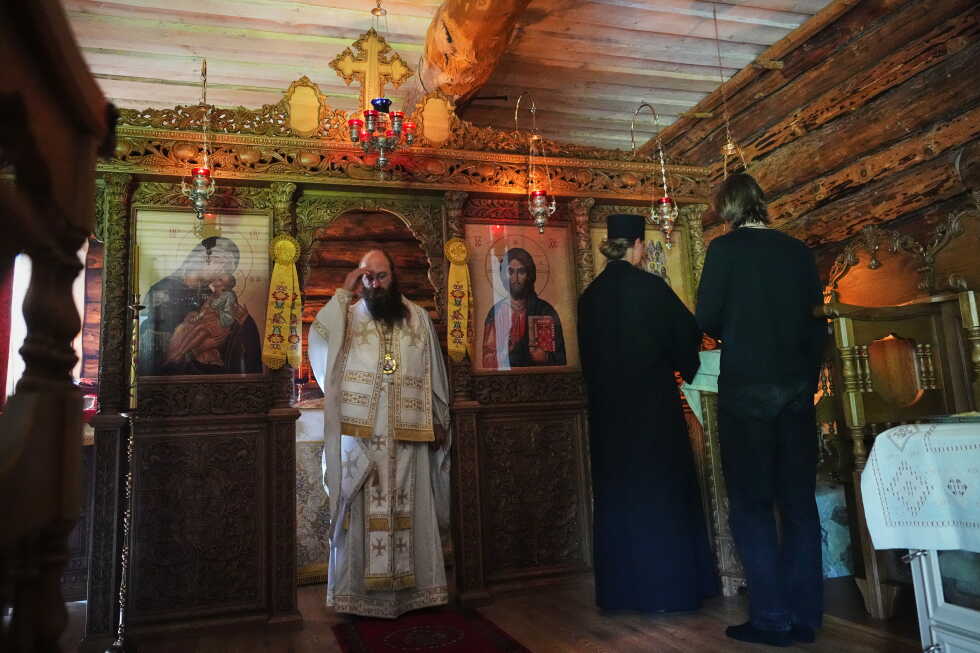
Nestled 40 kilometers outside Estonia’s capital Tallinn, a converted farmhouse holds a quiet, historic milestone for one of Europe’s most secular societies: the launch of the first male Orthodox monastery launched by the Estonian Apostolic Orthodox Church in decades. Known as Kirikla Orthodox Monastery, the community marks the return of male Orthodox monastic life to Estonia after more than 80 years, a gap that stretches back to the interwar independence period before Soviet occupation.
Inside the small, curtain-partitioned chapel, ancient words of the Divine Liturgy now ring out in the Estonian language, led by 41-year-old Bishop Damaskinos, the monastery’s founding abbot, who wears traditional flowing white and gold vestments during services. Damaskinos and 31-year-old Father Paisios are the community’s first two permanent monks, splitting their days between structured prayer, manual labor, and spiritual practice in line with traditions first honed at Greece’s Mount Athos, the 1,000-year-old global center of Orthodox monasticism.
The founding of Kirikla comes amid a longstanding split in Estonian Orthodox Christianity, dating back to the collapse of the Soviet Union. The larger of the country’s two Orthodox jurisdictions remains affiliated with the Moscow Patriarchate, while the independent Estonian Apostolic Orthodox Church has worked for decades to rebuild its own monastic institutions after Soviet authorities closed most religious communities and stigmatized faith across the Baltic region. Today, the Estonian Apostolic Orthodox Church oversees more than 60 parishes and one women’s convent across the country, but has not hosted a community of male monks since before World War II.
For Damaskinos, the monastery’s purpose extends far beyond Estonia’s borders. “The monastery’s meaning is also global in the sense that we pray for the whole world,” he explained during an interview with the Associated Press at the chapel in July 2026. The abbot emphasizes that spiritual quality of community members matters far more than raw numbers; even as only two monks currently reside at Kirikla, his focus remains on nurturing faithful commitment rather than rapid growth. “What we are worried about is the spiritual quality of the monks, that the monks actually take seriously their task of praying for the whole world,” he said.
The monastery’s daily routine follows a steady, intentional rhythm that sets it apart from the fast-paced, digitally connected world outside. Days begin at dawn with solitary prayer, followed by a communal morning service, then hours of manual labor ranging from weeding garden beds and tending potato crops to small construction work. A second evening service wraps up the day, leaving only brief evening time for rest, with almost no access to cellphones or the distractions of modern life. Despite the demanding schedule, both monks report deep fulfillment: shielded from widespread external stress, they feel rested and grounded in their routine.
This deliberate, purpose-driven way of life has struck a chord with young Estonian visitors and summer volunteers, who join the monks in their agricultural work. Religious scholars note that this growing interest in faith among young Estonians is a generational shift. Raised decades after the end of Soviet anti-religious campaigns, young Estonians carry none of the inherited prejudice against organized religion that shaped older generations. “They don’t have any bad experience with religion, they don’t have any experience with religion at all,” explained Priit Rohtmets, an associate professor of church history at the University of Tartu. “This, of course, gives a chance for religious communities.”
Unlike married Orthodox parish priests, monastic vows require lifelong celibacy, poverty, and obedience; anyone seeking to join the community must first spend up to three years as a novice living the monastic routine before taking permanent vows. While other faiths already have small monastic communities in Estonia — including a Dominican Catholic community that returned to Tallinn in 1996 and a Theravada Buddhist monastery on Aegna Island — new monastic foundations are rare across 21st-century Europe, where many existing communities are shrinking and closing as fewer people take vows. That makes Kirikla’s launch a particularly hopeful development for religious observers and faithful alike.
The monastery currently operates out of the donated farmhouse, gifted to the community by a local Estonian businessman, with no additional permanent buildings completed. Damaskinos says that while the community may eventually earn income by selling homegrown produce and handcrafted religious goods such as candles and incense, his top priority is not construction or expansion. “What interests me more, rather than finishing the buildings, is to finish building the brotherhood,” he said. “It’s a work that never finishes, but at least it creates a good basis for monastic continuation here in Estonia.”
On selected days, the community opens its gates to visitors and pilgrims, promoting open days through social media to invite people seeking a break from the chaos of modern daily life to experience their routine. “Monastic life is difficult, but through all these difficulties we find true happiness,” Damaskinos said. “So I hope that when people come here they see the happiness that we represent.”