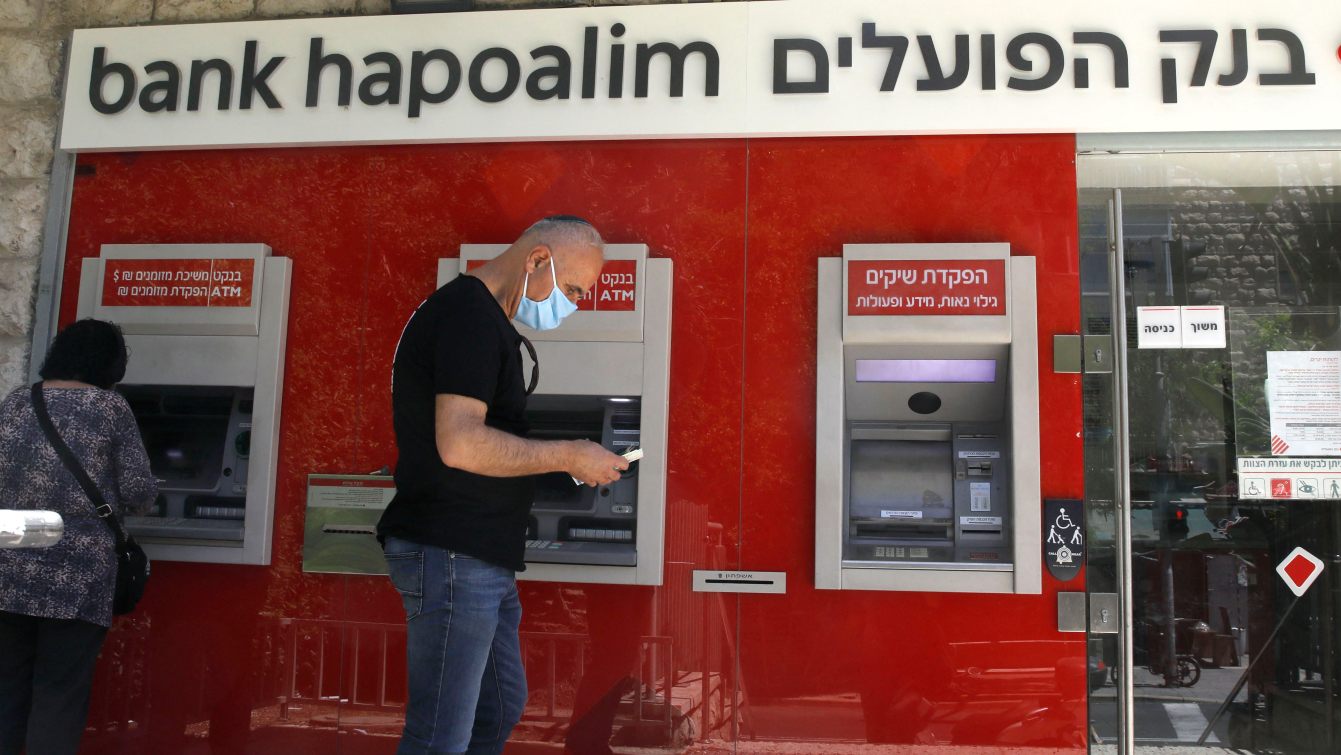
Two major Israeli financial institutions, Bank Hapoalim and Discount Bank, have notified Palestinian lenders that they will terminate critical correspondent banking relationships in the coming weeks, international news agency AFP has reported. Citing anonymous Palestinian banking officials, the report outlines a clear timeline for the cut-off: the five Palestinian banks that rely on Bank Hapoalim for cross-system financial links will lose access starting August 13, while institutions that use Discount Bank’s services will face the same disruption by September 1.
The Israeli Ministry of Finance has confirmed the pending termination, framing the decision as a response to “growing public risks and growing concerns over potential private legal action targeting Israeli banking entities.” In an official statement, the ministry added that it is currently holding negotiations with the two banks to find a pathway to maintain correspondent services “in a safe and responsible framework” that prioritizes Israel’s national security and economic interests.
Correspondent banking arrangements form the foundational operational connection between the Palestinian and Israeli financial systems, enabling a wide range of activities that are essential to daily Palestinian economic life. These ties allow for seamless shekel-denominated payments between Palestinian and Israeli lenders, clear transactions for Palestinian imports from Israel—imports that make up the overwhelming majority of the Palestinian Authority’s total trade volume—and the smooth transfer of wages for thousands of Palestinians employed in Israel and Israeli-occupied settlements. The arrangement also facilitates the repatriation of excess shekel banknotes held by Palestinian banks back to the Israeli financial system, and streamlines business transactions between Palestinian and private Israeli companies.
Economic observers and Palestinian officials warn that a complete, unmitigated severance of these ties would trigger cascading, far-reaching harm across the Palestinian economy. First, cross-border business payments between Palestinian and Israeli firms would face major disruptions. Critical imports of staple goods including food, fuel, and pharmaceutical products would also be interrupted, exacerbating existing shortages that have already strained Palestinian households. The cut-off would also deepen an ongoing crisis of accumulated shekel cash in Palestinian banks, a problem that already exists due to longstanding Israeli restrictions on moving excess currency out of Palestinian financial institutions.
The severity of the impact on the Palestinian Authority will depend on the duration of the disruption and whether a viable alternative arrangement can be negotiated. If the severing of ties becomes permanent, the Palestinian Authority could face severe challenges in covering public sector salaries, as fund transfers would be delayed or become drastically more expensive. Disruptions to cross-border trade would also erode the Palestinian Authority’s core tax revenue, increasing already extreme fiscal pressure, while widespread shekel shortages and payment delays could erode public trust in the Palestinian banking system as a whole.
Nasr Abdel Karim, an independent Palestinian economic analyst, told Middle East Eye that the decision fits into a years-long pattern of Israeli policy designed to pressure Palestinian communities. “For the past four years, the Israeli government has implemented every possible policy to subdue the Palestinians in one way or another,” Karim explained, noting that the move is explicitly politically motivated and will compound a slew of existing crises already facing Palestinians, including ongoing fuel shortages, delayed public sector salaries, a glut of excess shekels in local banks, sky-high youth unemployment, and rapidly deteriorating living standards. He added that the termination will place even more strain on Palestinian traders and the already fragile private sector.
Karim further contextualized the decision: “Banks make decisions based on minimizing risk and protecting the interests of their shareholders and depositors. The uncertainty created by [Israeli far-right Finance Minister Bezalel] Smotrich left the banks no room to maneuver, so they opted to cut the relationship. But this, without question, falls within the framework of Israel’s expansionist political agenda.”
Beyond macroeconomic harm, the Palestinian banking sector would face a growing shift toward cash-only transactions instead of electronic transfers, bringing higher operational risks and costs for local lenders. If the disruption stretches into months, Palestinian banks may also be forced to scale back access to core financial services for ordinary customers.
Palestinian political and economic officials, alongside major international bodies, have issued stark warnings that the absence of a viable alternative mechanism or an extension of the current arrangements could trigger a full-scale economic and banking collapse across the Palestinian territories.
Mohammed al-Qeeq, a prominent Palestinian political analyst, argued that the move is a deliberate step in a broader Israeli strategy to dismantle the Palestinian Authority. “Israel is deliberately seeking to cut all official ties with the Palestinian Authority to pave the way for its collapse, and instead deal with private Palestinian companies as substitutes,” al-Qeeq told Middle East Eye. This framework would allow Israel to govern the Palestinian population without engaging with a sovereign Palestinian governing body.
“Israel refers to the West Bank as Judea and Samaria, a framing that signals to the international community that it does not recognize a sovereign Palestinian state. In this view, the territory is Israeli land, and all dealings should be with private companies, not a Palestinian national authority,” he explained. In al-Qeeq’s analysis, the banking decision is a core component of Israel’s annexation agenda: it aims to dismantle the Palestinian Authority, cripple any prospect of an independent Palestinian economy, cut off access to basic necessities like fuel, and reduce Palestinians to the status of temporary residents in their own territory.