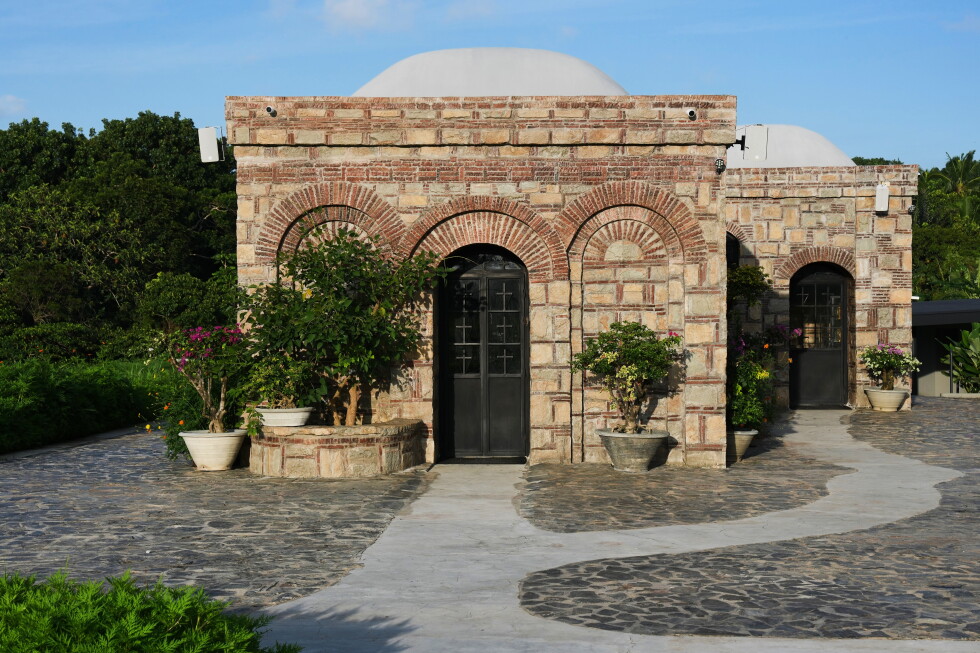
Nearly 9,000 kilometers from the original House of the Virgin Mary in Ephesus, Turkey, a full-size, exact replica of the sacred shrine has opened its doors to pilgrims in the Catholic-majority nation of the Philippines. Inaugurated in early 2024, the site sits in a quiet field outside Alfonso, a small town in Cavite province roughly 70 kilometers south of the capital Manila, offering local devotees a accessible pilgrimage destination that has long required a costly trip across continents.
The project was spearheaded by Dennis Paez, a Catholic priest and psychologist who works with vulnerable youth. From the earliest planning stages, Paez framed the replica as far more than a copy of a historic sacred site: it was conceived to be a judgment-free place of refuge for people facing hardship, grief, or uncertainty. “The idea began as a place of refuge,” Paez explained. “This is a place where no questions are asked.” For Paez, who specializes in supporting young people navigating life struggles, the space fills a unique emotional and spiritual need. “There is no therapy here. The therapist is our Mother,” he said, referring to the Virgin Mary.
Construction of the 67-square-meter structure took roughly 10 months to complete, and mirrors every architectural detail of the original Ephesus site, from its overall dimensions and shape to the appearance of each individual stone. A particularly notable element of the build was the participation of workers from multiple different faith traditions across the Philippines — a reality Paez says embodies the unifying spirit of the site, demonstrating how the Virgin Mary brings people of all backgrounds together as one community.
Per long-held Catholic tradition, the original House of the Virgin Mary in Ephesus is where Mary lived out her final years after the crucifixion of Jesus Christ. According to religious lore, the apostle John brought Mary to the region to protect her from religious persecution in Jerusalem, and she remained there until her assumption into heaven. For centuries, the site has been one of the most important Catholic pilgrimage destinations in the world, drawing millions of visitors annually from across the globe.
The new replica fits seamlessly into the deep-rooted culture of Marian devotion that has defined Filipino Catholicism for more than 500 years. The Philippines is home to roughly 113 million people, nearly 80 percent of whom identify as Roman Catholic. Devotion to the Virgin Mary, widely referred to by Filipino faithful as the Blessed Mother, has been a core part of national religious life since Spanish colonizers introduced Christianity to the archipelago in the 16th century.
Religious historian Michael Delos Reyes notes that this devotion has taken on unique national meaning through key moments of modern Philippine history. Many Filipinos credit the Virgin Mary’s intercession for the peaceful 1986 People Power Revolution that ousted authoritarian president Ferdinand Marcos. When Typhoon Haiyan, one of the most powerful tropical cyclones ever recorded, devastated the central city of Tacloban in 2013, survivors turned to the Blessed Mother as a source of hope and resilience amid overwhelming tragedy.
Deirdre de la Cruz, a professor of history and Southeast Asian studies at the University of Michigan, explains that Mary’s maternal identity is the core of her deep resonance in Filipino culture. “To Jesus through Mary” is a common phrase that sums up her central role in Filipino spiritual life, with believers turning to her to intercede on their behalf before God. “Her maternal dimension is what Filipinos find meaningful, as well as her power to intercede on believers’ behalf,” de la Cruz said. “As someone who is known to provide comfort, Mary is a very familiar figure and someone to whom one can appeal in difficult times.” This deep cultural attachment is visible across daily life: Marian images and rosaries are common fixtures in Filipino homes, private altars, vehicles, public transport, and community spaces across both urban and rural areas.
Inside the new Alfonso replica, donated Marian icons from across the country line the walls, with a statue of Mary modeled on the original Ephesus sculpture standing at the center, alongside a relic believed to be a fragment of the Virgin Mary’s veil. Most of the displayed icons were donated by Maritess Pineda, an art collector and Filipino culture advocate who had spent years building a private collection of Marian art, and welcomed the chance to give the collection a permanent public home at the new shrine.
For many local faithful who had already visited the original Ephesus site, the project felt like a calling to contribute. Rupert Suarez and his wife traveled to Turkey to visit the original House of the Virgin Mary years ago, and when they learned about plans to build a local replica, they immediately joined the project. “It’s so very blessed that we already have this replica built,” Suarez said.
Personal stories of comfort and renewal abound among early visitors. Daphne Oseña Paez, a recent pilgrim, said her devotion to Mary grew deeper in adulthood after a difficult high-risk pregnancy left her seeking spiritual refuge. “We don’t pray to Mary herself, but Mary intercedes for us,” she explained. “In my times of trouble, and I’ve had a lot, I really clung on to the love and comfort of her as a mother.”
Despite minimal public promotion since its 2024 inauguration, the shrine has already drawn a steady stream of pilgrims seeking refuge and connection. For Paez, this organic growth is no accident. “I don’t at all think that it is me bringing them,” Paez said. “It’s The Blessed Mother asking them, inviting them to come.”