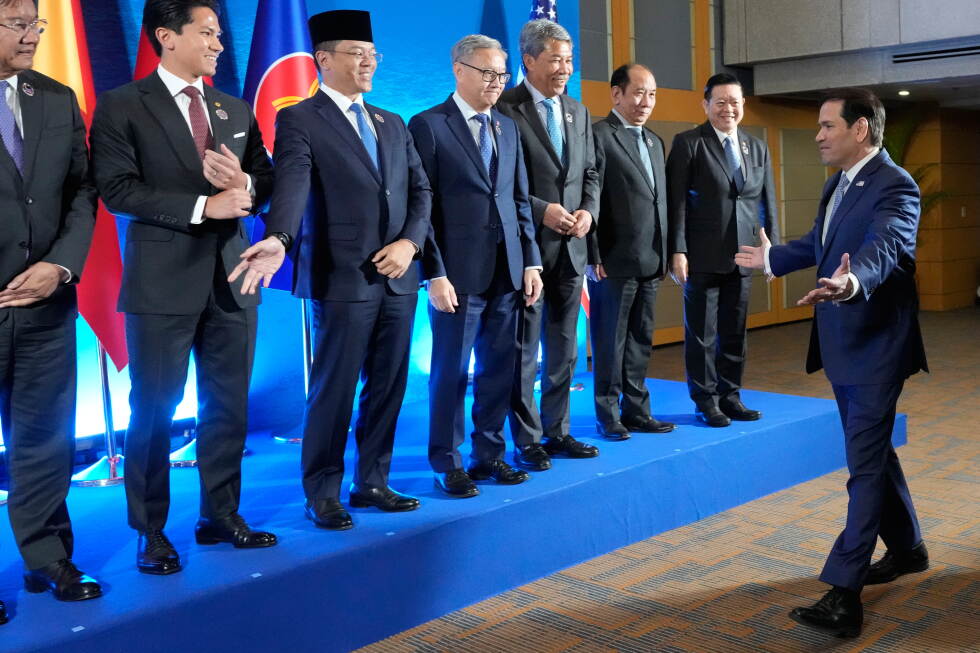
Diplomatic activity is taking center stage in Manila this week as top global foreign policy leaders gather for the annual Association of Southeast Asian Nations (ASEAN) foreign ministers’ summit, with two high-stakes bilateral meetings set to shape international conversations around conflict resolution and great power tensions.
The most anticipated encounter is the Thursday meeting between U.S. Secretary of State Marco Rubio and Russian Foreign Minister Sergey Lavrov, scheduled to take place on the sidelines of the ASEAN gathering. This discussion marks a rare high-profile engagement between the world’s two largest nuclear-armed powers at a time of deep divides over the ongoing war in Ukraine.
Speaking to reporters ahead of the meeting Wednesday, Rubio confirmed that Ukraine would be a core topic of conversation, confirming that the U.S. remains willing to facilitate negotiations to end the two-year conflict if a viable opening emerges. He acknowledged that American brokering efforts had stalled in recent months, sidelined by the escalating confrontation between Washington and Tehran following the collapse of an interim ceasefire deal that led to renewed cross strikes between the two sides. Even amid long-standing disagreements between Washington and Moscow, Rubio emphasized that maintaining open channels of communication remains a critical priority for U.S. foreign policy.
For his part, Lavrov confirmed he plans to question Rubio about recent comments from U.S. President Donald Trump indicating that a diplomatic settlement to the Ukraine war is increasingly within reach. The revival of peace talk discussions comes amid a period of internal upheaval in Kyiv: while Ukraine has notched meaningful territorial gains this year, a public rift between top defense and political leaders has forced President Volodymyr Zelenskyy to carry out a major government reshuffle that includes replacing the country’s most senior military commanders, creating uncertainty about the trajectory of Kyiv’s war effort. Beyond Ukraine, Rubio noted the meeting will also explore other potential areas of practical cooperation between the U.S. and Russia, reflecting a broader commitment to keeping channels open across multiple policy areas.
The Ukraine discussion is not the only major diplomatic event on Rubio’s Manila itinerary. On Wednesday, he held a lengthy bilateral meeting with Chinese Foreign Minister Wang Yi, where the two top diplomats addressed a fresh maritime confrontation in the disputed South China Sea. The incident, a direct altercation this week between Chinese and Filipino forces at a contested shoal, drew sharp criticism from Rubio, who labeled China’s actions as “escalatory”. Beijing claims sovereignty over nearly the entire South China Sea, a position challenged by multiple regional claimants including the Philippines — Washington’s oldest treaty ally in Asia — as well as Vietnam, Malaysia, Brunei, and Taiwan.
Rubio emphasized that miscalculations in the South China Sea carry severe global consequences, noting that any conflict, whether economic or military, between the U.S. and China would send shockwaves across the global economy. Wang, for his part, raised objections to what the Chinese Foreign Ministry described as “recent negative words and actions by the U.S. side”, a reference that comes as Trump has openly accused Beijing of interfering in the 2020 U.S. presidential election, and the Trump administration has shortened visa durations for Chinese journalists working in the United States. Despite the tensions, both sides confirmed they are continuing preparations for upcoming high-level exchanges, including Chinese President Xi Jinping’s planned state visit to the U.S. scheduled for September.
On Tuesday, ASEAN foreign ministers used their plenary session to address ongoing regional efforts to de-escalate South China Sea tensions. Delegations welcomed progress on years of negotiations with China on a proposed non-aggression code of conduct, with both sides targeting a final agreement by the end of the year. The proposed framework is designed to prevent armed confrontation in the strategically vital waterway, one of the world’s busiest global trade routes, where great power competition has long raised the risk of a conflict that could draw in the United States. In addition to his talks with Lavrov and Wang, Rubio also held separate bilateral discussions with Indian External Affairs Minister Subrahmanyam Jaishankar on Wednesday, covering a range of bilateral and regional issues.