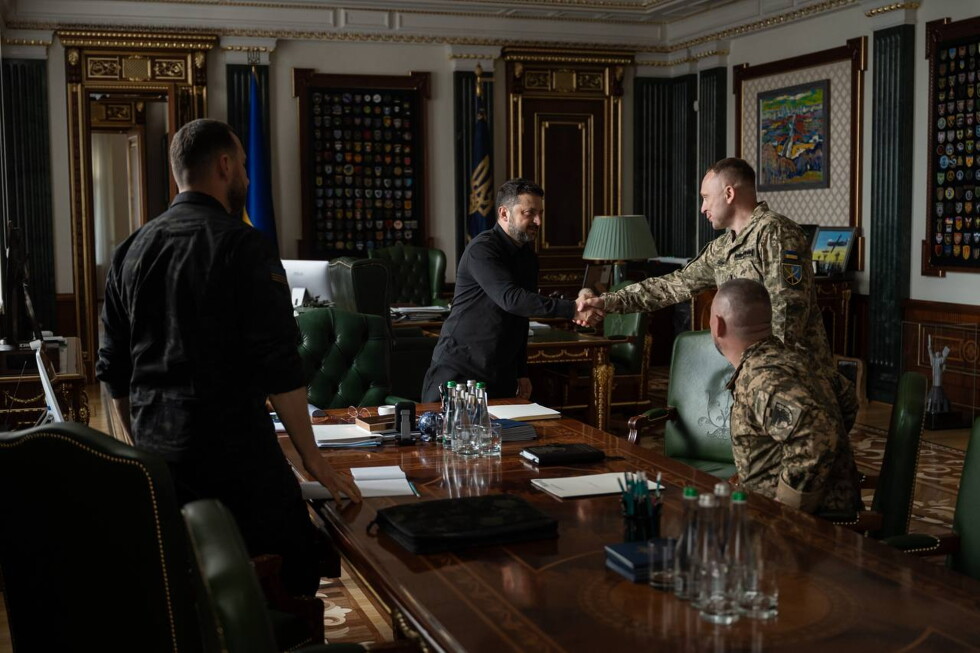
KYIV, Ukraine — Less than a week after a sweeping wartime government shakeup that sparked mass public protests and fueled open tension within Ukraine’s defense leadership, President Volodymyr Zelenskyy has installed a new top military commander to lead the country’s ongoing defense against Russia’s full-scale invasion. The leadership overhaul, finalized late Tuesday, closes a turbulent chapter of internal political friction that was widely celebrated in Moscow and threatened to distract from Ukraine’s battlefield gains this year.
The shakeup traces back to last week, when Zelenskyy removed 35-year-old tech-focused Defense Minister Mykhailo Fedorov from his post, just six months after he took on the role. Fedorov, an entrepreneur credited with rapidly building up Ukraine’s cutting-edge drone program that has delivered key battlefield advantages against Russian forces, had clashed openly with then-Commander-in-Chief Gen. Oleksandr Syrskyi, a 60-year-old Soviet-trained veteran long viewed as part of Ukraine’s old-guard military establishment. Fedorov publicly accused Syrskyi of blocking critical defense reforms, arguing a leadership change was necessary for Ukraine to avoid failure in its resistance.
Fedorov’s dismissal sparked immediate public outcry, with thousands of demonstrators gathering in Kyiv and other Ukrainian cities. Protesters framed the move as Zelenskyy siding with entrenched traditional military leadership over a popular reformer, and called for Syrskyi’s removal while demanding Fedorov be retained in a senior government role. To defuse tensions, Zelenskyy offered Fedorov a new senior position tasked with unifying the country’s entire defense technology sector; as of Wednesday, it remained unclear whether Fedorov would accept the role, and whether the latest leadership changes would satisfy protester demands.
On Tuesday, Zelenskyy officially dismissed Syrskyi and appointed 43-year-old Maj. Gen. Mykhailo Drapatyi as the new Commander-in-Chief of Ukraine’s armed forces. Drapatyi is part of a rising generation of Ukrainian commanders who cut their teeth fighting Russian forces after Moscow’s 2014 illegal annexation of Crimea, eight years before the 2022 full-scale invasion. He first earned widespread recognition for his bold, courageous leadership on the battlefield in 2014, and has steadily risen through the military ranks over the past decade of ongoing conflict.
Fedorov quickly endorsed Drapatyi’s appointment, describing the new commander as “a new hope in the fight of free people for freedom and justice” and “a voice for change that could not go unheard.” In a conciliatory gesture, Fedorov also acknowledged Syrskyi’s key wartime contributions, including the defense of the Kyiv region during the 2022 full-scale invasion and the successful 2022 Kharkiv counteroffensive, calling those achievements “already an important part of Ukraine’s history.” But he added that Ukraine “must move even faster and write new chapters, correcting all previous mistakes.”
In his first public statement since his dismissal Wednesday, Syrskyi defended his tenure as top commander, claiming Ukrainian forces had reclaimed 287 square miles of Russian-occupied territory this year under his leadership. He added that he was handing over to Drapatyi an army that is not only holding defensive lines but also carrying out active offensive operations. The Associated Press was unable to independently verify Syrskyi’s territorial claim.
Zelenskyy has laid out clear new expectations for Drapatyi and his team of senior commanders: they must deliver an updated, comprehensive defense strategy that includes accelerated reform of Ukraine’s military corps structure, faster procurement and delivery of weapons and drones, strengthened air defense networks to repel routine Russian missile and drone strikes, and a more transparent, effective national mobilization plan.
Parallel to the political upheaval in Kyiv, Ukraine continued its campaign of long-range drone strikes against Russian logistics targets Wednesday. Wildberries, Russia’s largest online retailer, confirmed that overnight drone strikes hit two of its large warehouses in Russia’s southern Krasnodar and Stavropol regions. The attacks come four days after similar strikes on Wildberries warehouses in the Moscow and Tambov regions killed eight people and wounded dozens, according to Russian officials. Zelenskyy confirmed Saturday that the targeted facilities were being used by Russian forces to store sanctioned components for Russian drone production and military navigation equipment.