In a high-stakes decision that intersects global politics and cultural exchange, the European Union announced Tuesday it is permanently revoking a €2 million ($2.3 million) grant for the Venice Biennale, the world’s largest and most prestigious contemporary art event. The move comes directly in response to the Biennale’s controversial choice to allow Russia to participate in this year’s exhibition, marking Moscow’s return to the event for the first time since its full-scale invasion of Ukraine in 2022.
European Commission spokesperson Thomas Regnier framed the cancellation as a defense of core European values, stating publicly that cultural initiatives supported by European taxpayer funding must uphold democratic ideals, promote open public dialogue, celebrate cultural diversity, and protect free expression. These principles, Regnier emphasized, are not respected by the current Russian government in the wake of its ongoing military aggression against Ukraine.
Russia was barred from the 2022 edition of the Venice Biennale as a widespread global protest against the invasion, making this year’s reversal on participation all the more contentious. When organizers confirmed Russia’s inclusion earlier this year, the decision sparked immediate, widespread backlash from the European Union and the Ukrainian government. Ukrainian Culture Minister Tetiana Berejna drew a sharp comparison at the time, arguing that allowing Russia to join the event was equivalent to “inviting a serial killer to a dinner with your friends.”
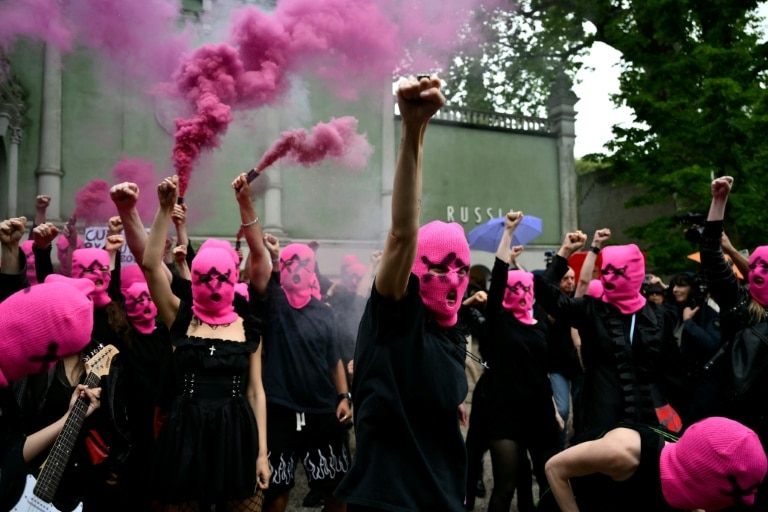
The controversy already triggered major upheaval for the event earlier this year: the entire international jury for the 2024 Biennale resigned en masse to protest the decision to welcome Russia’s national pavilion. Activist groups including the international women’s movement FEMEN and Russian protest art collective Pussy Riot also staged high-profile demonstrations against Russia’s involvement during the Biennale’s opening in May.
Biennale organizers defended their position when the controversy first erupted, arguing that the iconic event has been rooted in principles of openness, cross-cultural dialogue, and rejection of censorship and exclusionary politics. On Tuesday, the Biennale issued an official response to the EU’s grant cancellation, noting that the organization had expected the funding cut and would pursue formal action to defend its interests “in all relevant forums.”
Organizers emphasized that the revoked EU grant was earmarked to co-finance programs under the Biennale College and the Venice Production Bridge, two core initiatives that are completely separate from Russia’s participation in the main Biennale Arte exhibition. The statement also downplayed the financial impact of the cancellation, confirming that the cut in funding will not have a significant effect on the Biennale’s overall budget, balance sheet, or any planned or ongoing programming.