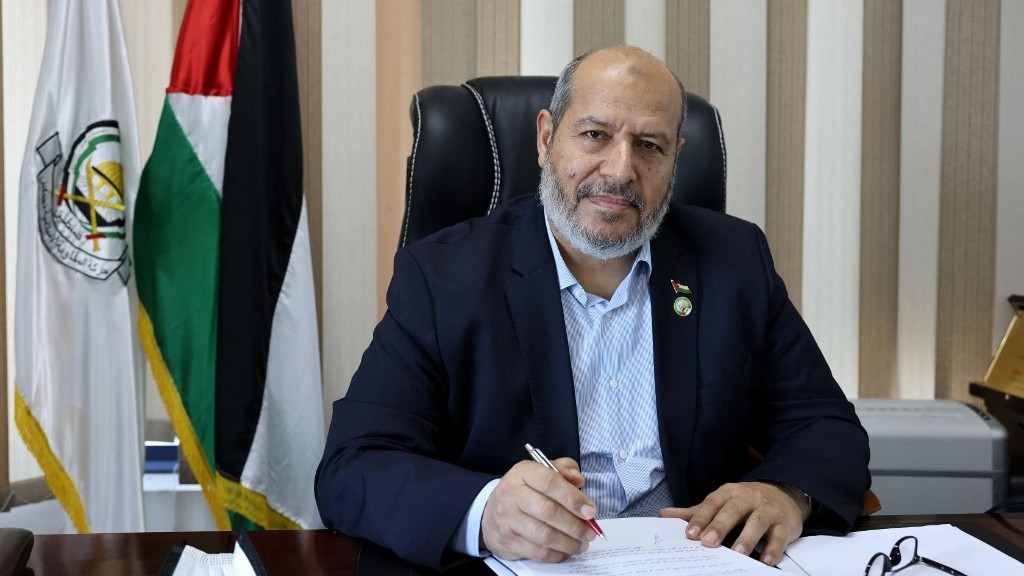
After a tightly contested internal leadership vote, the Palestinian militant and political movement Hamas has chosen veteran negotiator Khalil al-Hayya to lead its political bureau, placing a seasoned diplomatic figure at the helm of the organization at a moment of unprecedented crisis for Gaza and escalating regional conflict.
The election result was formally announced this Monday, following a runoff vote that capped a months-long leadership selection process. According to Walid Al Omari, Al Jazeera Arabic’s Palestine bureau chief, Hayya secured a narrow victory, earning 35 votes to beat out former Hamas political bureau chief and ex-external leader Khaled Meshaal, who collected 34 votes. The leadership contest was first launched in May, when the first round of voting failed to produce a clear winner, extending the process for months.
Hayya, who currently resides in Qatar, succeeds Yahya Sinwar, who took over the top role temporarily after Israel assassinated former Hamas chief Ismail Haniyeh in Tehran in July 2024. Sinwar was himself killed by Israeli forces during combat operations in Rafah just three months after assuming the position. In the intervening period, Hamas has been governed by a five-member interim council chaired by Mohammed Darwish, head of the movement’s Shura Council, which oversaw day-to-day political operations and mediated ceasefire negotiations with Israel.
Hayya’s election restores a singular, permanent leadership structure for Hamas, and stands as a testament to the movement’s resilience amid Israel’s sustained campaign to eliminate its top leadership through targeted assassinations. In September 2025, Israel attempted to assassinate Hayya alongside the entire Palestinian negotiating delegation based in Qatar, in what was widely seen as an effort to derail ongoing ceasefire talks. The brazen attack drew widespread global condemnation, with many international observers labeling it a blatant act of “gangster behaviour”.
Over the more than two years of Israel’s military campaign in Gaza, Hayya has emerged as one of Hamas’s most prominent and recognizable public faces. He has led the movement’s negotiating delegation through all major rounds of talks focused on ceasefire agreements, hostage-prisoner exchanges, and the long-term political future of the Gaza Strip. This high-stakes role has placed him at the center of regional diplomatic efforts brokered by Qatar, Egypt, Turkey and other key Middle Eastern powers.
Born in Gaza City on November 5, 1960, Hayya grew up in the occupied Palestinian territories after Israel seized control of Gaza in the 1967 Six-Day War. He pursued a background in Islamic scholarship, earning a doctorate in Hadith sciences after graduating from the Faculty of Islamic Theology at Gaza’s Islamic University — an institution that has since been destroyed by Israeli bombardment. His political journey began in 1980, when he met Hamas founder Sheikh Ahmed Yassin, and over the subsequent four decades, he steadily rose through the movement’s ranks. He has previously served on Hamas’s political bureau, acted as deputy leader for the movement’s Gaza branch, and led the organization’s outreach efforts to Arab and Muslim nations. In 2006, Palestinian voters elected Hayya to the Palestinian Legislative Council, where he went on to lead Hamas’s parliamentary bloc following the historic first national elections.
Throughout his decades of political engagement, Hayya has repeatedly faced targeting by Israeli forces: he was detained multiple times, including a prolonged prison sentence in 1991, and has survived numerous assassination attempts. The personal cost of his leadership has been steep, with Israel killing four of his sons and multiple other members of his extended family over the years. Osama, Osama’s wife, and three of their grandchildren were killed in an Israeli bombing of their home during the 2014 Gaza war. Hamza, a member of Hamas’s armed wing, died in an Israeli missile strike east of Gaza City. Hammam was killed in the September 2025 Israeli airstrike on Hamas negotiators in Doha that targeted Hayya himself. Most recently, Azzam was killed in an Israeli attack in Gaza in May 2026, an attack that also killed one other person and wounded nine. Hayya’s only surviving son, Ezzedine, was injured in an Israeli strike on Gaza City’s Tuffah neighborhood in April 2025, and one of Hayya’s grandchildren was killed in an Israeli attack on a Gaza City school that same month. A 2007 assassination attempt on Hayya killed seven of his extended family members, including two brothers, four nephews, and a cousin.
Hayya takes control of Hamas at a defining crossroads for the movement, the people of Gaza, and the broader Palestinian national struggle. Today, Gaza lies in ruins, with over 60 percent of the enclave under Israeli military occupation, and Israeli forces carry out almost daily attacks despite a ceasefire agreement that Hamas accepted and Israel has repeatedly violated. The Israeli government has openly stated its goal to ethnically cleanse the besieged population of Gaza and expand its military operations across the occupied West Bank. For now, Palestinians across the territories and the global diaspora are watching closely to see what direction Hayya will steer the movement, and what his leadership will mean for their decades-long struggle for self-determination.