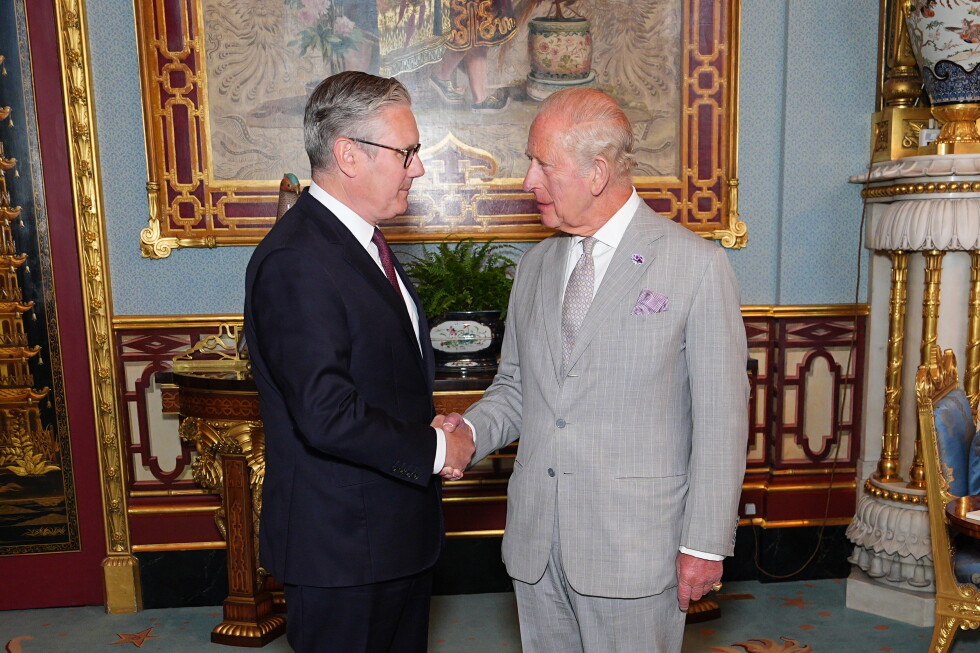
LONDON — In a carefully choreographed transfer of power that brought a temporary end to years of British political upheaval, Andy Burnham has been officially sworn in as the United Kingdom’s new prime minister, taking over from the resigning Keir Starmer in a historic transition that required no national general election.
The formal handover unfolded Monday following constitutional tradition laid out over centuries. After Starmer traveled to Buckingham Palace to formally tender his resignation to King Charles III — an offer the monarch graciously accepted — Burnham met separately with the king for the traditional “kissing hands” ceremony. A newly released official photograph captures the moment the king and Burnham shook hands, with Buckingham Palace confirming in an official statement that the monarch “received in audience the Rt. Hon. Andrew Burnham MP and requested him to form a new Administration. The Rt. Hon Andrew Burnham MP accepted The King’s offer and kissed hands upon his appointment as Prime Minister and First Lord of the Treasury.”
While the ceremony retains its historic roots, modern constitutional arrangements mean the king holds no formal political power; the invitation to form a government is automatically extended to the leader of the party that holds a majority in the House of Commons, and no actual hand-kissing is required today.
Burnham’s ascent to the top job makes him the UK’s seventh prime minister since 2016, a streak of rapid leadership turnover that the new leader openly acknowledged in his first public remarks from outside 10 Downing Street. The former Greater Manchester mayor, who was confirmed as the new leader of the governing centre-left Labour Party last Friday after running unopposed and securing the nominations of 379 out of 403 sitting Labour MPs, said he is “acutely conscious” of the revolving door of leadership the country has navigated over the past decade.
“This a moment for reflection and new resolution,” Burnham told assembled reporters and onlookers. “It requires my generation of politicians to raise our game and rise to the new challenge. Britain needs to show the world that we can regain our stability once again, and that is our challenge to make politics work, to make it work better.”
In his opening policy pledges, Burnham committed to ending street homelessness across the UK, and promised to deliver a “circuit breaker” for a national governing system he argues has taken wrong turns since the 1980s. Beyond tangible policy goals, he has positioned himself as a leader committed to rebuilding trust in public life, pledging to deliver a “new politics” that is less divisive, lifts living standards for all regions of the country, and restores hope that has faded among much of the public.
“I will work to build a new politics,” Burnham said after winning the Labour leadership last Friday. “The country is crying out for it.”
His predecessor Keir Starmer, who left Downing Street alongside his wife Victoria after delivering a short farewell address, struck a gracious tone as he stepped down. Starmer, who was forced to resign after missteps and judgment calls eroded his support among both his party and the general public, took the opportunity to highlight his achievements in office.
Starmer became Labour leader in 2020 in the wake of one of the party’s worst ever general election defeats, overhauled the party to make it electorally competitive, and led Labour to a landslide general election victory in 2024. In his two years as prime minister, he pointed to progress including strengthened protections for working people, reduced child poverty, new legislation banning official cover-ups following public tragedies, and increased defense spending, alongside steady support for Ukraine in its conflict against Russia.
“I go with good grace, I go with a smile and I go proud of everything that we have achieved,” Starmer said. “Since then, it has been the privilege of my life to serve you and this great country as prime minister. I am confident that Britain is now stronger and fairer than it was two years ago.”
Burnham has already said he will build on the policy foundation Starmer laid, but political observers across the UK are now waiting for details of how he will deliver his ambitious pledges. Joshi Herrmann, founder of Manchester-based news outlet The Mill who has followed Burnham’s political career for years, noted that all of the new prime minister’s goals depend on unlocking long-stagnant economic growth.
“Fundamentally, it only will work if you can generate significant economic growth, because it’s the lack of growth that’s really holding the country back,” Herrmann said.
All eyes are now on Burnham’s upcoming first cabinet appointments, where he is widely expected to shake up Starmer’s top team, with changes anticipated for three of the most senior roles: Chancellor of the Exchequer, Foreign Secretary, and Home Secretary. Under UK parliamentary rules, the governing party is able to replace its leader — and thus the prime minister — without holding a snap general election. The next mandatory national election is not scheduled until 2029, though Burnham retains the power to call an earlier vote if he chooses to do so.