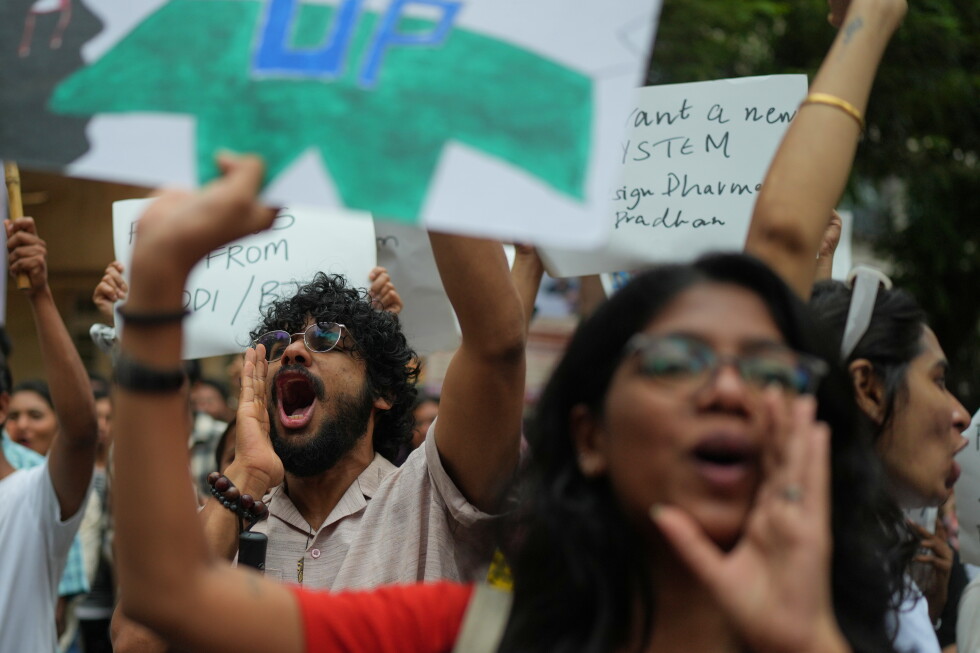
NEW DELHI — On Monday, as India’s national Parliament prepared to open its annual monsoon session, thousands of demonstrators aligned with the youth-led “Cockroach Movement” defied a formal police protest ban to push forward with a planned march to the legislative building, stepping up their demands for the resignation of the country’s top education official amid growing public fury over systemic failures in India’s examination system.
Delhi law enforcement had already rejected the organizers’ application to hold the march, citing needs to preserve public order in the vicinity of Parliament during the opening week of the session. Scores of police officers were deployed to the designated starting point of the demonstration at Jantar Mantar, a central New Delhi landmark long used for public protests, where barricades were erected to block demonstrators from moving toward the Parliament complex, located just a few kilometers away. Police repeatedly broadcast calls for the crowd to disperse over loudspeakers, raising widespread fears of potential violent confrontation if protesters pushed past the police cordon.
The diverse crowd gathered for the demonstration included university students, working professionals, and even entire families with young children. Many participants came prepared for an extended day of action, carrying backpacks stocked with bottled water and non-perishable food, while others waved national Indian flags as they marched. demonstrators chanted coordinated slogans calling for the resignation of Education Minister Dharmendra Pradhan and targeting Prime Minister Narendra Modi’s ruling government.
The satirical yet rapidly growing movement, which formally calls itself the Cockroach Janta Party, has its origins in an offhand comment from India’s Supreme Court Chief Justice back in May. During an unrelated public hearing, the chief justice compared a group of unemployed young job seekers to “cockroaches” — a dismissive remark that supporters reclaimed intentionally, turning the pejorative label into the identity of a grassroots movement that has already amassed millions of followers across major Indian social media platforms.
The movement has gathered explosive momentum in recent weeks amid a string of repeated high-profile leaks of competitive entrance exams for government jobs and medical college seats, scandals that have sparked widespread public anger. Many young people see these repeated leaks as evidence of deep-rooted corruption and systemic failure in India’s education and employment systems, which leave millions of graduates competing for a tiny pool of stable public sector positions.
Protests gained even more national attention over the weekend, when Delhi police forcibly transferred prominent activist Sonam Wangchuk, who had been leading a hunger strike at Jantar Mantar, to a local hospital on Saturday. For the past month, self-identified “cockroach” protesters have maintained a continuous encampment at Jantar Mantar, with dozens of student groups across the country joining the action and joining Wangchuk’s hunger strike. Large solidarity rallies have also been held at major universities and urban centers across India, expanding the movement’s reach far beyond the national capital.
Before the Monday march, Wangchuk set clear conditions for ending his 21-day hunger strike: either the central government must formally accept responsibility for the systemic failures that enabled the repeated exam leaks, or authorities must allow demonstrators to march unimpeded to Parliament, where lawmakers must pledge to debate the movement’s demands in both upper and lower houses of the legislature.
Alongside demanding Pradhan’s resignation, the movement is calling for sweeping structural reforms to India’s national examination system, as well as financial compensation for the families of dozens of students who have died by suicide in the wake of the repeated exam leaks, which have derailed the academic and career prospects of hundreds of thousands of young people.
The protest movement represents one of the most significant public challenges to Modi’s Hindu nationalist government since the prime minister won a third consecutive term in 2024 national elections. It has drawn cross-sector support from major national opposition parties, prominent human rights activists, and even well-known Bollywood celebrities. Protesters argue that space for public dissent has shrunk dramatically under Modi’s administration, which has faced repeated international criticism for jailing opposition activists, restricting peaceful protest, and in some cases ordering aggressive police crackdowns on dissenting gatherings.
Senior leaders from Modi’s ruling party have taken a uniformly hard line against the movement. Pradhan has publicly accused protesters of acting against national interests, while other senior government ministers have acknowledged the widespread frustration among unemployed students but have refused to open any formal negotiations with movement organizers.
Jyoti Rajput, a yoga teacher who joined the Monday demonstration, summed up the frustration shared by many participants. “This rotten system refuses to take action,” she said. “It cannot see the pain of students, and that’s why so many people have joined this movement.”