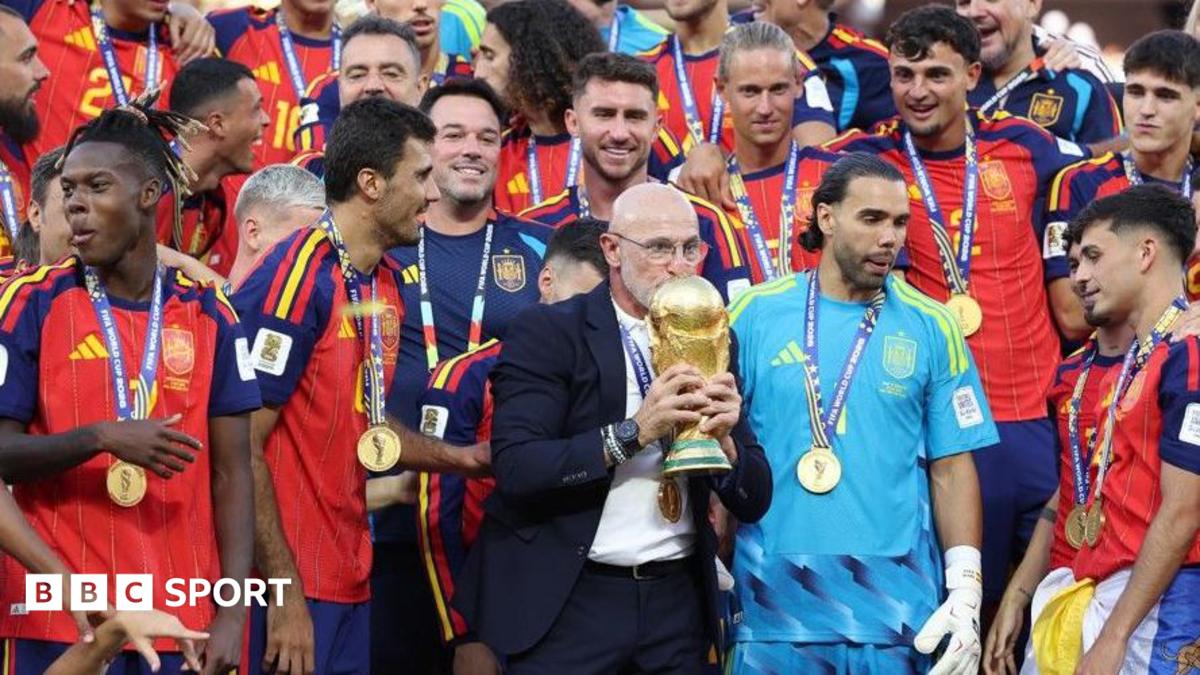
In a historic display of sustained tactical and youth development excellence, Spain has etched its name forever into football folklore, claiming the 2026 Men’s World Cup title with a hard-fought 1-0 extra-time victory over Argentina in New Jersey on Sunday. This triumph mirrors the nation’s iconic 2010 World Cup win, which came two years after claiming the European Championship crown — a feat La Roja has now repeated for a second time, following their 2024 European title in Berlin. This latest success cements Spain’s status as the first nation in history to simultaneously hold both the men’s and women’s World Cup trophies, following the women’s senior World Cup victory in 2023, and caps off an unparalleled run of international success across every age and gender category.
Over the past five years, Spanish football has amassed an extraordinary 16 combined World Cup and European titles, ranging from under-17 age-group competitions through to senior national teams. Breakdowns of this dominant run show 11 titles claimed by Spanish women’s sides between 2022 and 2026, including the 2023 senior World Cup, back-to-back Nations League crowns in 2024 and 2025, a 2022 under-20 World Cup, five consecutive under-19 European championships, and a 2022 under-17 World Cup alongside the 2024 under-17 European title. For the men, five major titles have been claimed in the same period: the 2026 senior World Cup, 2024 European Championship, 2023 Nations League, 2024 Olympic gold medal, and the 2026 under-19 European Championship.
Leading this extraordinary senior men’s run is head coach Luis de la Fuente, whose appointment in December 2022 following Spain’s disappointing 2022 Qatar World Cup round-of-16 exit to Morocco was widely viewed as a high-risk gamble. Having never managed a top-tier European club, de la Fuente spent 15 years working in lower-league men’s football and Spanish youth national team setups after retiring as a player in 1994, giving him intimate familiarity with the talent coming through the country’s famed academy system. In just over three years, he has delivered three consecutive major trophies: the 2023 Nations League, 2024 European Championship, and now the 2026 World Cup. “It was a very risky decision – I don’t think anyone thought he would be so successful,” Spanish football expert Guillem Balague told BBC Sport, adding that de la Fuente’s deep understanding of Spain’s long-established playing philosophy has been key to unlocking sustained success.
Former Spanish midfielder Juan Mata echoed that assessment, noting de la Fuente’s connection to the nation’s youth pipeline has created a squad built for both immediate and long-term success. “De la Fuente knew most of these players from the academies and they are growing as a team,” Mata said. “This is not only a team for the present, but also a team for the future.” Under de la Fuente’s leadership, the senior side has also cultivated a culture of consistent improvement, rejecting complacency even after claiming every possible major trophy. “Once we finished the game, there were footballers who said ‘coach, now what else is there to win as we have won everything in all the categories’,” de la Fuente told reporters ahead of the final. “We came to the conclusion that what remains is the next match in September because this team are relentless.”
This sustained success at the international level has been decades in the making, with dramatic transformation in the women’s game over the past 10 years laying the groundwork for recent titles. When former player Maria Garrido was competing for FC Barcelona a decade ago, there was no dedicated girls’ academy at the club’s famed La Masia facility, players covered their own travel costs, and earned no salary. Today, the landscape is unrecognizable: targeted investment has expanded youth categories, upgraded training facilities and working conditions, and established dedicated girls’ academies across the country. “This transformation has not only revolutionised the sport but also elevated the respect for women’s football in Spain,” Garrido explained in a 2024 interview.
The depth of Spain’s youth talent pipeline was on full display in the 2026 World Cup final, where 19-year-old stars Lamine Yamal and Pau Cubarsi became the first two teenagers to start a men’s World Cup final in history. Yamal entered the record books as the third-youngest player to ever feature in a men’s World Cup final, trailing only Pele (1958) and Giuseppe Bergomi (1982), and both players walked away with winner’s medals in their first World Cup appearance. The women’s side boasts similarly elite young talent: 19-year-old Vicky Lopez already has three Champions League titles with Barcelona to her name, while forward Salma Paralluelo earned more than 50 senior caps for Spain before turning 23.
Former England goalkeeper Joe Hart lauded Spain’s defensive and tactical dominance throughout the 2026 tournament, noting the side conceded only 10 total shots on target across their entire World Cup run. “Spain have got a way of playing that no one in the world has proven they can get anywhere near,” Hart said. 1998 World Cup winner Thierry Henry echoed that praise, telling Fox Sports that Spain’s systemic investment across all levels puts them in position to dominate global football for years to come. “I want to give credit to the system and what they put in place,” Henry said. “Because Spain never used to win like that. And now they win at every level.”
Heading into the next international cycle, Spain holds another historic record: an unbeaten streak of 38 consecutive matches across all competitions, the longest run ever recorded by any European or South American national team. This success has also spilled over into club football, with Spanish coaches holding at least a quarter of all head coaching roles in the 2026-27 Premier League season, even after Pep Guardiola’s departure from Manchester City after a decade of trophy-laden success. For fans and analysts alike, all signs point to this era of Spanish dominance only continuing to grow in the years ahead.