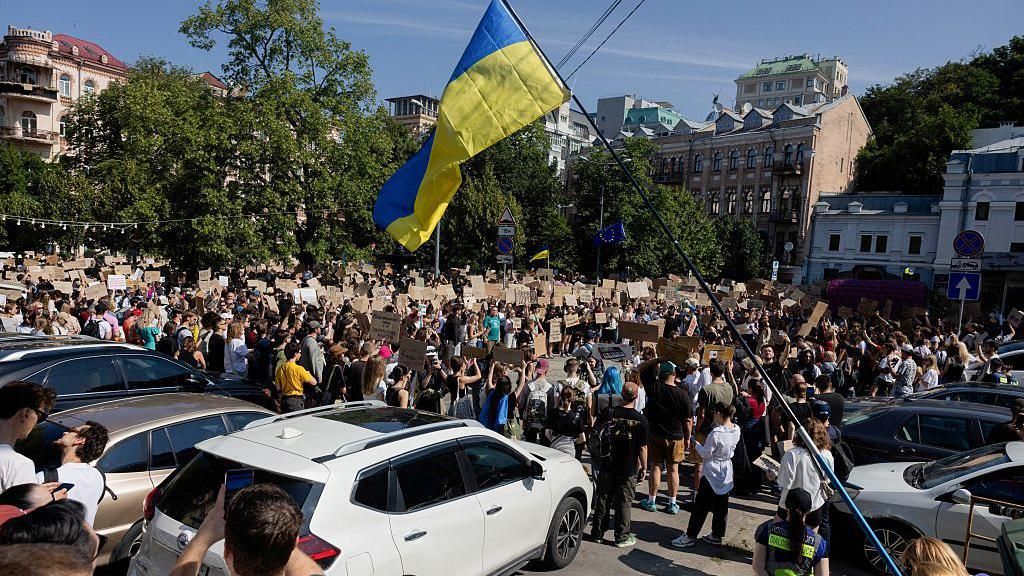
On a Thursday morning, thousands of mostly young demonstrators packed central Kyiv’s Ivan Franko Square, voicing fierce public pushback against Ukrainian President Volodymyr Zelensky’s unexpected dismissal of the widely popular Defense Minister Mykhailo Fedorov. The demonstrations, which have spread to multiple major Ukrainian cities, mark one of the most significant public displays of dissent against Zelensky’s administration since Russia’s full-scale invasion in 2022.
Protesters held hand-painted signs reading “Hands off Fedorov” and “Stop sabotaging victory,” while chanting calls of “Shame” toward the presidential office. Some demonstrators carried blunt messages, including one that read “What are you doing, idiot?” held by two young protesters, with a second sign noting the demonstration was “for all of those who couldn’t be here” — a reference to troops deployed on the front lines who cannot participate in public protests.
Fedorov, 35, only stepped into the defense minister role in January 2026, but in his six months in office he earned broad acclaim from military personnel, civilian commentators, and segments of Ukrainian civil society for his aggressive anti-corruption reforms, data-driven approach to frontline operations, and focus on modernizing Ukraine’s military through high-tech innovation. A former digital transformation minister, Fedorov had long been a key figure in Ukraine’s war effort: in the opening weeks of Russia’s 2022 full-scale invasion, he organized the volunteer “IT Army of Ukraine,” a network of global hackers that launched coordinated cyberattacks against Russian government and military targets. He later led the groundbreaking “Army of Drones” fundraising initiative that sourced thousands of unmanned aerial vehicles for Ukrainian forces, and pioneered a gamified incentive system that awarded units credits for destroying Russian military assets.
After taking the defense ministry post, Fedorov doubled down on his modernization agenda, pushing to cut through layers of entrenched bureaucracy and root out lingering Soviet-era institutional mindsets that many Ukrainians blame for slowing military progress. His tenure included a high-profile request to SpaceX founder Elon Musk to restrict Russian access to Starlink satellite services, a move that severely disrupted Russian frontline drone operations and advances. Just last month, Fedorov led Ukrainian defense efforts in a series of devastating mid-range drone strikes on Russian-occupied Crimea, publicly vowing to fully cut the peninsula off from Russian control.
To date, Zelensky has offered no public explanation for his decision to remove Fedorov, a silence that has amplified public and elite frustration with the sacking. Lawmakers were scheduled to hold a confirmation vote later Thursday on Zelensky’s nominee to replace Fedorov: Ihor Klymenko, the current head of Ukraine’s interior ministry.
Multiple unconfirmed theories have emerged to explain the dismissal. Some Ukrainian political and military observers point to growing tensions between Fedorov, a young reformer focused on asymmetric high-tech warfare, and Ukraine’s more traditionally minded Commander-in-Chief Oleksandr Syrskyi. Others suggest the move stems from criticism that Fedorov moved too slowly to implement sweeping overhauls of Ukraine’s military mobilization system, a deeply contentious issue in the country amid ongoing heavy frontline casualties.
The sacking has already drawn sharp condemnation across Ukrainian society, particularly among active-duty military personnel. “This is the worst mistake Zelensky has made during his entire presidency,” an active-duty Ukrainian soldier named Oleksandr told the BBC. Oleksandr, who enlisted earlier this year specifically because he trusted Fedorov’s leadership and vision, added: “I don’t know anyone who supports the decision to replace him. Not within the army, not in society.”
Maria Lavrynets, 31, a protester in central Kyiv, framed the demonstration as a defense of Ukraine’s war progress and frontline troops. “I have lots of friends in the military. Lots of them died. I don’t want this to go on,” she said. “We see [Fedorov’s] results. We see the motivation of the soldiers, we should stand for them.”
Senior military figures have also joined the backlash. Pavlo Yelizarov, a respected commander of one of Ukraine’s most effective drone units, resigned from his post as deputy commander of the Ukrainian Air Force in protest. He called Fedorov’s sacking “a great evil for the country’s defence capability.”
Prominent blogger Serhii Sternenko, who was brought into the defense ministry as an advisor by Fedorov, hailed his former boss as “the best minister of defence in our entire history.” In a public statement, Sternenko bemoaned the “bureaucratic obstacles and artificial delays” that had blocked Fedorov from implementing deeper institutional reforms, implying that old-guard opposition had led to his ouster.
In a brief Facebook post published hours after his dismissal, Fedorov did not criticize Zelensky or the presidential administration, instead highlighting his tenure’s achievements and reaffirming his commitment to the war effort. “I will continue… to defeat the enemy through asymmetry, speed of innovation, and organisational strength,” he wrote.