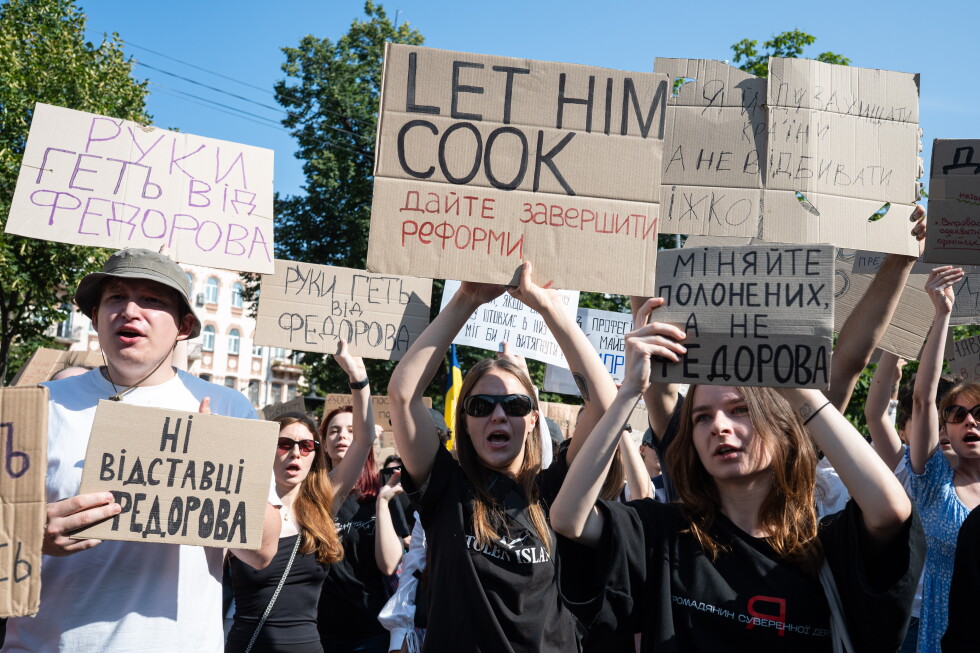
KYIV, Ukraine – As Ukraine’s prolonged defense against Russia’s full-scale invasion nears its four-and-a-half year mark, a sweeping government reshuffle initiated by President Volodymyr Zelenskyy has sparked public unrest and emerged as an unexpected test of the president’s political authority. On Thursday, hundreds of demonstrators assembled in central Kyiv, the same day Ukraine’s parliament, the Verkhovna Rada, gathered to vote on a new prime minister as part of the restructuring.
At the center of the controversy is the impending departure of 35-year-old Defense Minister Mykhailo Fedorov, a reformist leader widely credited with leveraging his technological expertise to drive measurable improvements in Ukraine’s military performance against Russia’s larger, better-resourced armed forces over recent months. Fedorov has only held the defense minister post since January this year, just six months before his anticipated exit.
Zelenskyy has not publicly shared any official explanation for Fedorov’s removal. Unconfirmed reporting from Ukrainian media has pointed to escalating friction between Fedorov and Gen. Oleksandr Syrskyi, Ukraine’s 60-year-old armed forces commander. Syrskyi, a veteran military leader who organized Kyiv’s successful initial defense shortly after Russia’s 2022 invasion and later led a game-changing 2022 counteroffensive that reclaimed large swathes of the Kharkiv region, has been a polarizing figure among segments of the Ukrainian public.
Protesters, most of whom were young Ukrainians, gathered in downtown Kyiv chanting Fedorov’s name in a show of public support, while directing sharp criticism toward Syrskyi. Demonstrators called for Syrskyi’s resignation and chanted slogans demanding a NATO-aligned, modern military for Ukraine. The protest spread beyond the capital, with demonstrations also organized in the central Ukrainian city of Dnipro and the southern Black Sea port of Odesa.
Bohdan Huryak, a Kyiv resident who attended the downtown protest, told the Associated Press he was deeply shocked and angered by the decision to remove Fedorov. “I’m not deeply invested in the internal political debates, but this is a person who shows results on the battlefield, we see results, we feel the fighting spirit and confidence in victory rising,” Huryak said. “And then, six months later, he is removed from office? Come on.”
This is not the first time public protests have forced a course correction from Zelenskyy since the 2022 full-scale invasion. In July 2023, large-scale street demonstrations broke out over a controversial draft law that would have restricted the independence of Ukraine’s anti-corruption watchdog bodies. At the time, the public outcry marked the first major threat to Zelenskyy’s leadership stability, prompting the president to quickly reverse the policy.
Long before taking over the defense portfolio, Fedorov built a reputation as a progressive modernizer leading Ukraine’s digital transformation agenda. He gained widespread public popularity for spearheading the rapid development and deployment of innovative drone technology that has become a critical asset on the front lines, as well as rolling out widely praised e-government platforms that streamlined public services.
After taking the defense minister post, Fedorov launched ambitious plans for sweeping military reform. In his opening remarks, he publicly disclosed the scale of long-standing challenges within the military, acknowledging roughly 200,000 troop desertions and an estimated 2 million cases of draft dodging that had weakened Ukraine’s fighting capacity.
In a series of social media posts confirming his dismissal late Wednesday, following days of unconfirmed media speculation about his exit, Fedorov laid out his key achievements during his short tenure. He wrote that he made the risky decision to reallocate budget funds originally earmarked for military salaries toward expanding mid-range strike capabilities, long-range fiber-optic drones, advanced reconnaissance systems and other critical battlefield technologies.
Fedorov also highlighted progress on expanding domestic and international drone procurement, finalizing contracts for additional Patriot air defense systems, completing Ukraine’s first successful domestically developed ballistic missile tests, and overhauling the country’s opaque and inefficient military procurement system.
Even as he celebrated his progress, Fedorov admitted he had been unable to complete all of his planned reforms. He wrote that he failed to finish the full organizational restructuring of the Defense Ministry to align with NATO standards, shift all military procurement to open competitive bidding processes, and embed a widespread culture of accountability across the department. He added that while he had removed dozens of obstructive officials from their posts during his tenure, “it was necessary to dismiss even more people who were hindering the changes.”
As part of the broader government reshuffle, Zelenskyy has nominated Serhii Koretskyi, the current chief executive of Ukraine’s state-owned energy giant Naftogaz, to take over as prime minister, parliament speaker Ruslan Stefanchuk confirmed in a Wednesday social media post. Zelenskyy argued Wednesday that Koretskyi is the best fit for the role because the government’s top priority ahead of the coming season is preparing Ukraine for another difficult winter of potential Russian energy infrastructure attacks, citing Koretskyi’s decades of experience in the energy sector.
Ukrainian lawmakers began debating the full slate of cabinet changes this week, ahead of parliament’s scheduled summer recess set to begin Saturday. The outcome of the reshuffle and the public response to Fedorov’s dismissal will serve as a key indicator of Zelenskyy’s political standing as Ukraine enters a new phase of its war with Russia.
Dan Bashakov and Dmytro Zhyhinas contributed reporting to this article.