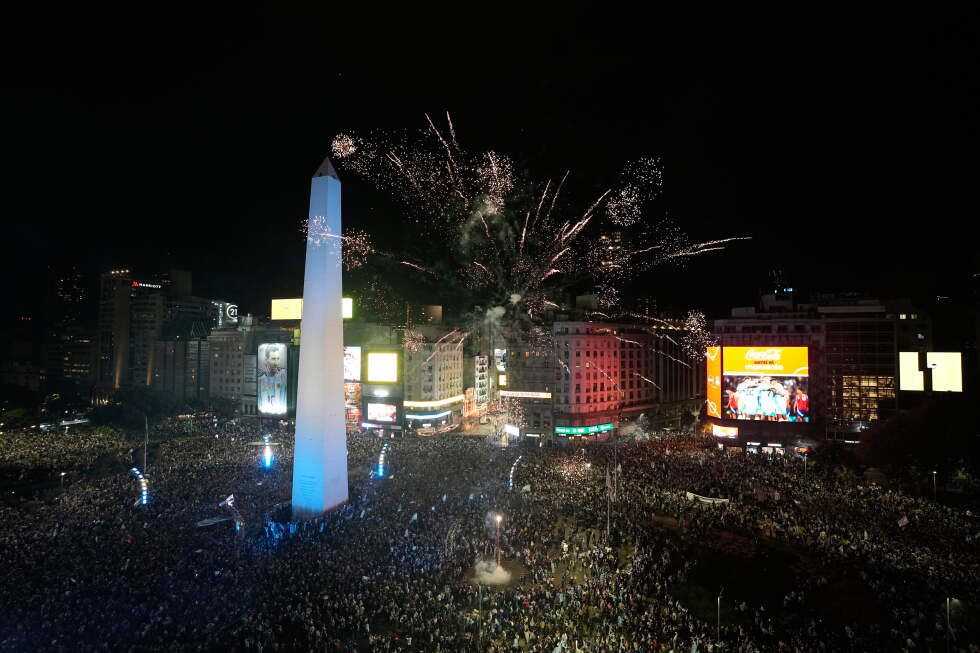
BUENOS AIRES, Argentina – As the final whistle blew on a heart-stopping 2-1 World Cup semi-final victory over England in Atlanta on Wednesday, waves of ecstatic Argentine soccer fans poured into the capital’s downtown streets, turning a cold winter evening into a collective outpouring of national joy decades in the making.
From the towering Obelisk monument to downtown plazas, fans turned the city into a sea of the iconic light blue and white of Argentina’s flag. Screams of celebration mixed with tears of emotion, as the most fervent revelers sprinted shirtless through steady rain, while young fans climbed lamp posts and traffic signals to wave national banners high. The party, fans confirmed, would rage long into the night, undeterred by the dropping winter temperatures.
The match’s deciding moment came two minutes into stoppage time, when Lautaro Martinez slotted home the winning goal, punching the defending 2022 World Cup champions’ ticket to Sunday’s final against Spain. For many of the thousands gathered at the Obelisk, the win meant far more than a spot in the sport’s biggest match. The rivalry between Argentina and England extends far beyond the soccer pitch, rooted in the decades-long dispute over the Falkland Islands – called the Malvinas by Argentina, which claims the territory as its own sovereign land – and the 1982 Falklands War, where an Argentine military dictatorship’s failed attempt to retake the islands left 649 Argentine soldiers, most of them young, under-resourced conscripts, dead.
“This is not just about football, it’s about beating the country that broke our hearts,” said 40-year-old Maria Bertero. “My heart still aches for all the young boys who were sent to their deaths.” As she spoke, the pain of history softened into unbridled joy for Wednesday’s result: “It’s tremendous. It’s magic. It makes me proud to be Argentine.”
Even a 48-year-old Catholic nun, Rosana Beto Cruz, joined the throng of strangers jumping and dancing together around the Obelisk. “The World Cup, our national team, it makes this happen,” she said, marveling at the spontaneous unity of the crowd.
The result has not been without controversy online, where unsubstantiated conspiracy theories have circulated claiming FIFA and match referees colluded to advance superstar Lionel Messi and Argentina to the final, fueled by several contentious in-game decisions. But the baseless claims did nothing to dampen the euphoria on Buenos Aires’ streets.
Jorge Luis Lema, 38, who watched the match at a downtown bar, recalled the crowd’s somber mood through most of the game, until Enzo Fernandez’s unstoppable 85th-minute strike turned tension into pure celebration. “All this talk about it being fixed, about FIFA being involved, have they even looked at what’s happening on the field? How much we’ve suffered? It’s a lie. Football is football. Whoever wins, wins. And Argentina won once again,” Lema said.
The soccer rivalry between the two nations dates back to the 1986 World Cup, when Diego Maradona’s infamous “Hand of God” goal and his iconic “Goal of the Century” carried Argentina to a legendary quarter-final victory over England, cementing the match-up as a symbolic clash beyond sport. Now, 39-year-old Messi – who spent years bearing the weight of Maradona’s legacy before claiming Argentina’s first World Cup title in 36 years at the 2022 Qatar tournament – has once again exceeded the nation’s sky-high expectations, fans said.
“Seeing Messi playing football like this, at his age, it just leaves me speechless,” said Matías Adorno, 28, wearing a Messi jersey in central Buenos Aires’ main fan gathering plaza. “As Argentines, we’ve always put so much pressure on him. But he’s achieved everything I could imagine.”
Chants of “For the Malvinas, for Diego, for Leo’s last tournament” echoed through the crowds, with fans bouncing in unison to the decades-old war-era chant “El que no salta es un ingles” – “Whoever doesn’t jump is an Englishman.”
Beyond soccer and historical rivalry, the night of celebration served as a rare moment of national unity for a country deeply polarized by the radical libertarian presidency of Javier Milei, and wearied by repeated cycles of crippling economic crisis that have sent living costs soaring.
“It is just pure joy, especially given the really bad moment we’re going through now, with life being so expensive, with this president who’s dividing us,” said Yanina Quinteros, celebrating with her 6-year-old daughter perched on her shoulders. “Tonight, we’re together. All of us, grandparents, children, mothers, fathers, we’re all just here to celebrate tonight.”