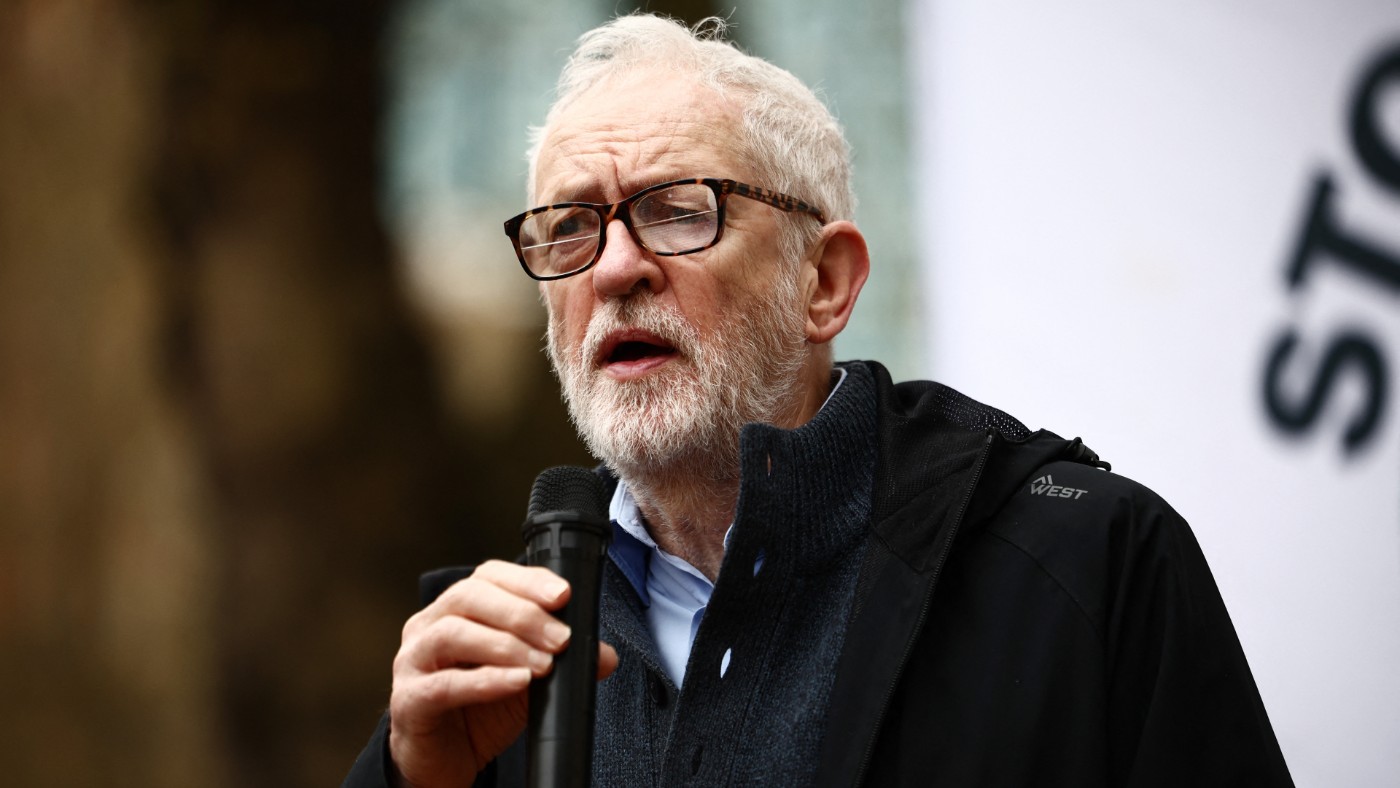
As outgoing United Kingdom Prime Minister Keir Starmer prepares to leave Downing Street, his predecessor as Labour Party leader, Jeremy Corbyn, has publicly condemned Starmer for repeating a long-debunked false claim that Labour was “institutionally antisemitic” during Corbyn’s tenure at the party’s helm.
The controversy erupted during Starmer’s final appearance at Prime Minister’s Questions (PMQs) on Wednesday, where he reflected on his political journey from opposition leader to the country’s top office. Recounting the aftermath of Labour’s 2019 general election defeat to Boris Johnson’s Conservative Party, Starmer claimed the loss “nearly broke my party” before adding: “We were found to be institutionally antisemitic. I picked up our party. I turned it round. I made a promise to rip antisemitism out of my party and I did.”
In an immediate response to Starmer’s comments given exclusively to Middle East Eye (MEE), Corbyn pushed back forcefully against the inaccurate assertion. “The prime minister today falsely claimed that Labour was found to be ‘institutionally antisemitic’ under my leadership. There was no such finding, and Keir Starmer should have the decency to correct the record,” Corbyn said.
The former Labour leader emphasized that this false allegation is not an isolated misstatement, but part of a repeated pattern of political distortion. “This is the second time in recent weeks he has made a false allegation about the Labour Party under my leadership (last time about an invented financial bankruptcy) to bolster his own dismal record,” he added.
Corbyn, who now serves as parliamentary leader of the Your Party, argued that misleading claims and broken campaign promises have defined Starmer’s tenure as Labour leader, ultimately eroding public trust and leading directly to the premature end of his premiership. With Starmer already on track to leave office, Corbyn made clear his own political agenda will not slow down: “But I will continue to campaign for social justice, human rights and peace. That includes uncovering the true scale of this government’s institutional complicity in genocide.”
Corbyn, a long-standing advocate for Palestinian rights, stepped down as Labour leader in 2019 following the party’s decisive general election loss. His four-and-a-half-year tenure was repeatedly marred by public allegations of widespread antisemitism within the party, a narrative that was amplified by internal factional infighting as rival groups battled for control of the party and establishment-aligned factions worked to undermine his left-wing leadership.
Fact-checking Starmer’s recent claim confirms that the 2020 investigation into Labour antisemitism conducted by the UK’s equality watchdog, the Equality and Human Rights Commission (EHRC), never used the phrase “institutionally antisemitic” to describe Corbyn’s leadership. The EHRC report did document specific cases of harassment, unlawful discrimination, and inappropriate political interference in antisemitism complaint processes, and it concluded that Labour could have addressed the issue far more effectively if Corbyn’s leadership had prioritized reform. The “institutionally antisemitic” characterization actually originated from Alan Johnson, a figure affiliated with the pro-Israel lobbying group Britain Israel Communications and Research Centre (Bicom), not from the official regulator’s findings.
Long before the report’s 2020 publication, Corbyn had already questioned the EHRC’s institutional independence, telling MEE the body had been absorbed into the “government machine” and its autonomy stripped away by the then-governing Conservative Party for political purposes. Following the report’s release, Corbyn acknowledged that when he took party leadership in 2015, Labour’s internal processes for handling antisemitism complaints were outdated and unfit for purpose, adding that reform efforts had been intentionally blocked by obstructive senior party bureaucracy.
That claim of internal obstruction was later vindicated by the 2022 Forde Report, which found that Labour staff members openly hostile to Corbyn’s leadership carried out deliberate efforts to undermine his agenda, including running a “secret operation” to divert 2019 general election campaign funds away from candidates loyal to Corbyn.
In his 2020 statement following the EHRC report, Corbyn struck a balanced tone on the issue of antisemitism in Labour: “Anyone claiming there is no antisemitism in the Labour Party is wrong. Of course there is, as there is throughout society, and sometimes it is voiced by people who think of themselves as on the left. One antisemite is one too many, but the scale of the problem was also dramatically overstated for political reasons by our opponents inside and outside the party, as well as by much of the media. That combination hurt Jewish people and must never be repeated.”