Six decades after the iconic US-Soviet race to the moon that ended with American astronauts planting their flag on lunar soil, a new chapter of lunar exploration competition is unfolding – and this time, it bears little resemblance to the mid-20th century contest. Where the original 1960s race focused on Cold War prestige and short-term exploratory milestones, with no long-term plan for sustained human presence, the 21st-century lunar contest, led by the United States on one side and a China-Russia partnership on the other, centers on securing access to critical natural resources and establishing permanent outposts.
The focal point of all modern lunar efforts is the moon’s south pole, a region that holds vast, unevenly distributed deposits of water ice. This resource is far more than a scientific curiosity: it can be processed for drinking water and breathable air to sustain long-term human habitation, and split into hydrogen and oxygen to produce rocket fuel, turning the moon into a potential refueling hub for deep space missions. With only a limited number of geologically stable, ice-rich sites suitable for building outposts, competition to claim the most valuable locations has raised questions of whether this new race will devolve into a scramble for lunar territory.
Today’s lunar exploration landscape also looks dramatically different from the closed, two-superpower system of the Cold War era. Three decades ago, human spaceflight was almost exclusively the domain of the US and the Soviet Union (later Russia), with other major space entities like the European Space Agency focusing on robotic science missions and commercial satellite launches. Today, space activity has globalized dramatically: roughly 20 countries now possess independent orbital launch capabilities, and privately funded robotic lunar missions, backed by government partnerships, have become commonplace. Even so, human spaceflight remains a uniquely high-barrier achievement, with only three countries – the US, Russia, and China – currently capable of launching crewed missions on their own rockets. The unforgiving nature of space leaves no room for error; human crews require constant life support, and backup rescue options are extremely limited, requiring exhaustive testing of every system.
Despite entering the human spaceflight sector decades later than the US and Russia, China has rapidly closed the gap in technological and exploratory achievements. Since 2021, China has operated Tiangong, a modular permanently crewed space station that leaves significant room for future expansion. Its landmark Chang’e lunar program has achieved multiple historic firsts, including returning samples from the moon’s far side, deploying communications relay satellites, and conducting extensive terrain surveys with robotic rovers. These successes have positioned China and its partner Russia as the primary competitors to the US-led Artemis program in the new lunar race. China is currently testing its Mengzhou crew capsule and Lanyue lunar lander, targeting its first crewed lunar landing around 2030, with construction of the joint International Lunar Research Station at the south pole slated to begin by 2035.
On the US side, the Artemis program has already marked a major milestone with the Artemis II mission, the first crewed lunar flyby in more than 50 years. NASA’s medium-term goal is to establish a permanent crewed outpost at the lunar south pole, modeled after the rotating-crew structure of the International Space Station and Antarctic research bases. Unlike the original Apollo program, which focused on short sorties, Artemis is built for long-term habitation. NASA uses the Orion capsule to transport crews from Earth to lunar orbit, but is relying on private sector partners Blue Origin and SpaceX to develop the specialized lunar landers required to descend to the surface. A key docking test for the Artemis III mission is scheduled for next year in low Earth orbit. In the coming years, a fleet of robotic craft, many led by private companies, will scout landing sites, deliver cargo, and deploy preliminary science experiments.
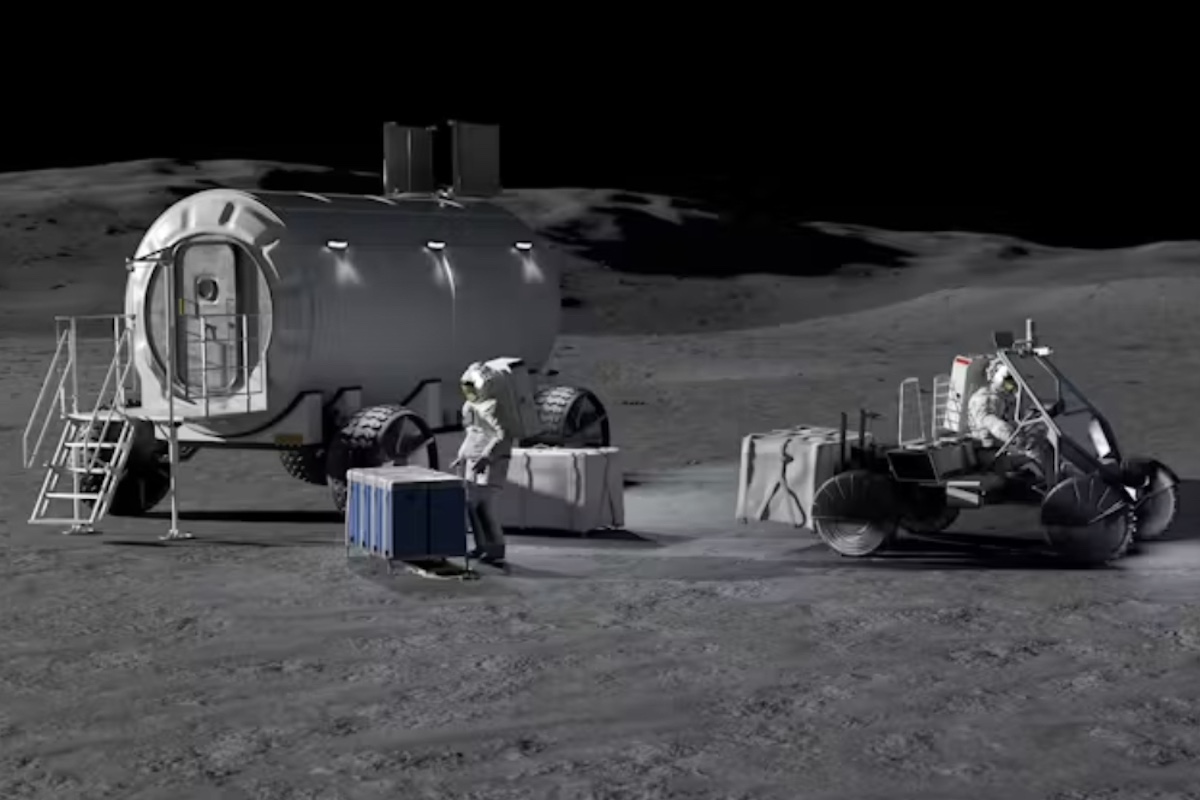
Operating outposts at the lunar south pole presents unique engineering challenges that teams are working to address. The most ice-rich deposits sit in permanently shadowed crater floors, where temperatures drop below -200°C. While nearby polar mountaintops enjoy nearly constant line-of-sight to Earth, communications blackouts require dedicated relay satellites in lunar orbit. The sun sits barely above the horizon for most of the year, with extended periods of total darkness eliminating consistent solar power generation, requiring alternative energy sources such as nuclear fission to keep life support and equipment operational. Between 2029 and 2032, NASA plans to lay core infrastructure including power and communications systems, conduct exploratory drilling, and deploy a sophisticated pressurized rover developed jointly with Japan that will allow astronauts to work without bulky space suits. From 2032 onward, the program aims to expand the modular base, enable year-round habitation, and begin in-situ resource processing to produce water, oxygen, and building materials from lunar resources.
Beyond establishing a permanent human foothold, modern lunar exploration opens a host of groundbreaking scientific opportunities. Researchers hope to use permanent lunar bases to answer longstanding questions about the moon’s formation and geologic history, as well as conduct novel medical and materials research that cannot be done on Earth. Building radio telescopes on the moon’s far side, which is shielded from Earth’s dense radio interference, would allow astronomers to detect faint cosmic signals that are invisible to ground-based observatories. The moon’s low gravity also makes it an ideal staging ground for deep space missions: assembling large spacecraft in lunar orbit instead of launching fully assembled vehicles from Earth would reduce launch costs and enable far more ambitious crewed missions to Mars and other destinations across the solar system.
Economically, a sustained lunar presence also creates new commercial opportunities, from private sector development of landers, rovers, and infrastructure to cargo transport services for science experiments and commercial payloads. In-situ production of rocket fuel would drastically cut the cost of deep space exploration by eliminating the need to launch all required fuel from Earth, and could even enable refueling services for satellites in Earth orbit.
Despite these promising opportunities, questions remain about the governance of lunar resources. The 1979 United Nations Moon Agreement enshrines the principle that no nation can claim sovereignty over the moon and requires all actors to use its resources responsibly. However, nearly all major countries involved in the Artemis program, including the United States, have not ratified the agreement. As exploration efforts move forward, space scientists and policy experts hold out hope that competition will not devolve into an unregulated scramble for the most valuable lunar territory.