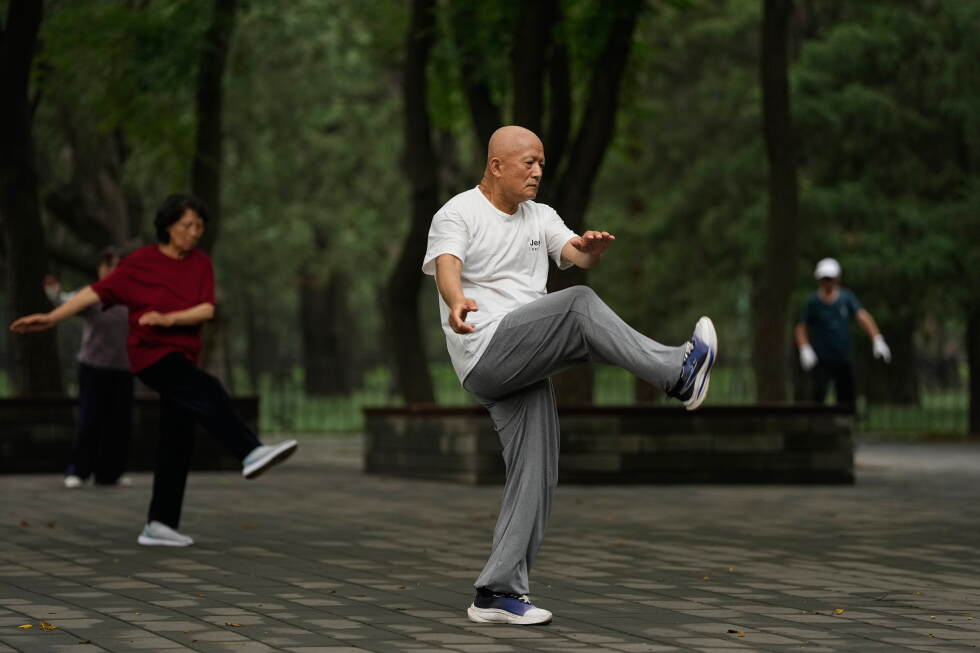
On crisp Beijing mornings, beneath the sprawling ancient pines that fill the grounds of the Temple of Heaven, hundreds of people move in synchronized, gentle harmony. One arm arcs slowly upward while the other lowers to the side — the iconic posture “White Crane Spreads Its Wings” — a core movement of tai chi, a 300-year-old mind-body practice that remains deeply woven into modern Chinese daily life.
For 64-year-old Ye Guirong, who now leads a 30-member local tai chi group named Cypress Grove on the temple’s grounds, this open-air space provides an unmatched setting for daily practice. “The environment is great and the air is good too,” she says. “You can see we’re surrounded by trees.” A retiree who discovered the group while exploring the city on post-retirement walks in 2010, Ye recalls being drawn to the practice immediately. “I thought it looked good, so I started practicing,” she says. Today, she carries forward the tradition of passing down tai chi movements from instructor to student: when newcomers join, she teaches foundational forms, then reviews and corrects progress over time until practitioners master each level before advancing.
Most of the regulars gathering at the Temple of Heaven are retirees in their 60s and older, split between small groups practicing to soft, relaxing background music from portable speakers and solo practitioners moving in quiet solitude. Ye’s group has continued to draw new participants: 59-year-old Zu Hong, the group’s newest member, mastered a 24-movement routine in just one month and is already preparing to begin her second sequence. “I thought tai chi looked very beautiful,” Zu says. “I wanted to exercise, so I came here to the Temple of Heaven.”
The practice holds deep roots at the Temple of Heaven, a 15th-century architectural complex commissioned by a Ming Dynasty emperor. Designed to serve as a ceremonial site where emperors acted as intermediaries between humanity and heaven, offering sacrifices and prayers for abundant harvests, its iconic Hall of Prayer for Good Harvests remains one of China’s most recognizable cultural landmarks. Today, while the complex draws millions of tourists annually, its surrounding public gardens remain open space for local residents to carry on daily traditions like tai chi.
Beyond its gentle physical movements, tai chi is rooted in ancient Chinese philosophy, holding dual meaning as both a martial art (formally called Taijiquan) and a school of thought rooted in traditional understandings of the body and wellness. A core concept tying tai chi to Chinese philosophy is qi, the vital life energy believed to flow through all living things and the natural world. In traditional Chinese medicine, long-term health depends on the unobstructed flow of qi through a network of pathways called meridians that connect the body’s organs and limbs. Traditional treatments from acupuncture to movement practices like tai chi aim to regulate and strengthen this flow.
“Practices like tai chi and qigong are all about activating, regulating or improving the flow of qi in the body,” explains James Miller, a professor of Humanities at Duke Kunshan University in Jiangsu province. “That’s something very key to Daoism, but it’s also part of the broader Chinese conception of the body and of the world.” Beyond the human body, qi is also believed to animate natural landscapes — which, Miller notes, is one reason traditional Chinese culture favors building temples in mountain settings: they are valued not only for their natural beauty, but for their close connection to the qi of the natural world, a benefit practitioners say amplifies the benefits of outdoor tai chi practice.
Today, multiple distinct styles of tai chi are practiced across China and around the world, each with its own specific forms and techniques. Ye’s group gathers promptly at 7:40 every morning to practice the widely popular Yang-style tai chi for an hour and a half, rotating through sequences ranging from 24 to 48 movements, and occasionally incorporating traditional props like swords or folding fans. For the group’s regulars, the benefits speak for themselves: “Through exercising, everyone’s health has improved,” Ye says. “Our spirits are especially good.”
The oldest widely recognized form of the practice is Chen-style tai chi, developed in the 17th century by Chen Wangting, a former military commander who turned to spiritual cultivation later in life. “He practiced Daoist methods of self-cultivation including meditation,” explains Chen Haitao, a fifth-generation Chen-style tai chi master. “Then one day he experienced a sudden awakening: the meridians throughout his body all opened, his mind became enlightened, and wisdom suddenly emerged.” Transformed by this experience, Chen Wangting developed structured movement forms to share this state of balanced wellness with others, binding together the practice’s physical and philosophical roots.
For modern practitioners, that dual focus remains intact: the movements provide a accessible path to practice, while the underlying philosophy gives that practice purpose. “One of the great benefits of Taijiquan is that it is suitable for everyone,” Chen Haitao says. “As long as you learn the basic principles correctly and maintain proper alignment, whoever practices it will benefit from it.”
This report was compiled with contributions from AP video journalist Wu Jia. The Associated Press’ religion coverage receives support through collaboration with The Conversation US, with funding from Lilly Endowment Inc. The AP retains sole responsibility for this content.