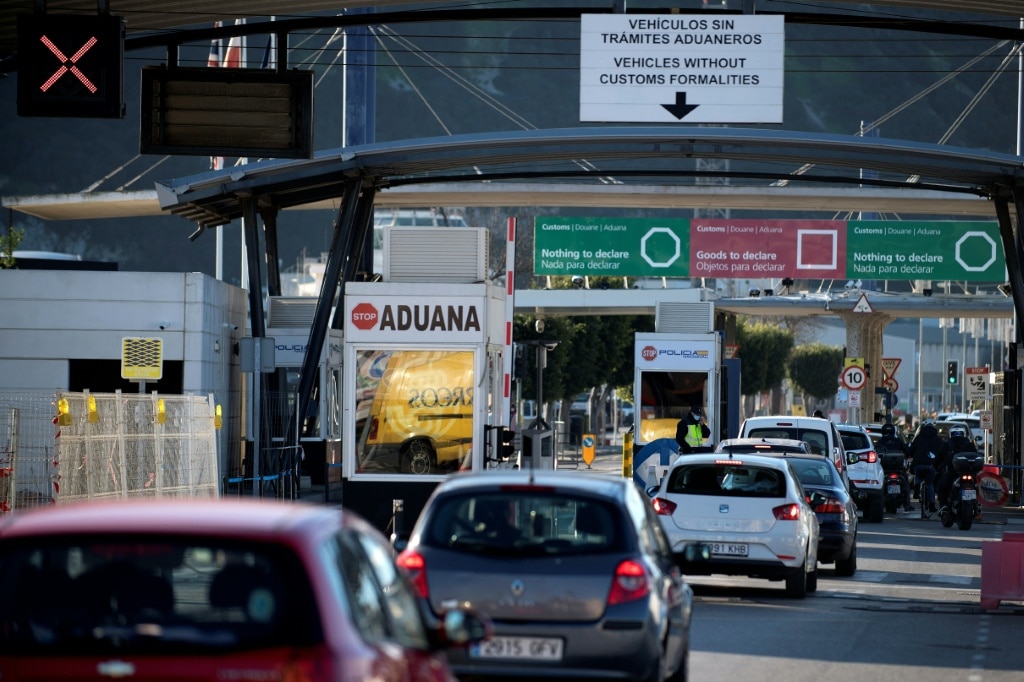
Decades of cross-border tension and daily commuter frustration formally came to an end this Wednesday, as Spain and the British Overseas Territory of Gibraltar lifted all routine land border controls between the two territories under a landmark post-Brexit agreement reached with the European Union and United Kingdom.
Moments after midnight, an Agence France-Presse reporter on site witnessed dozens of pedestrians and vehicles cross the frontier from Spain into Gibraltar without undergoing mandatory customs or identity checks, marking the first unimpeded crossing in modern history. Hundreds of gathered celebrants waved Spanish flags at the opening, while Gibraltar’s Chief Minister Fabian Picardo declared to the crowd that “Europe is back.”
Situated on the southernmost tip of the Iberian Peninsula, Gibraltar—commonly nicknamed “The Rock”—is a self-governing British territory covering just under 7 square kilometers, with a permanent population of only 40,000. Despite its small size, it depends heavily on a daily workforce of roughly 15,500 people who commute from neighboring Spanish towns. For generations, rush-hour queues stretching for kilometers were a ubiquitous fixture at the border, with delays worsening dramatically during periodic spikes in diplomatic tension over Madrid’s longstanding sovereignty claim to the territory.
The change follows a formal treaty signed Tuesday in Brussels by EU trade commissioner Maros Sefcovic, alongside ministers from the UK, Spain, and Gibraltar’s Chief Minister Picardo. Negotiated over four years of intensive talks following Britain’s 2020 exit from the European Union, the agreement aligns Gibraltar with Europe’s Schengen Area, the continent’s passport-free travel zone. Routine identity checks will only remain in place for travelers arriving at Gibraltar’s airport and seaport from non-Schengen destinations.
Spanish Foreign Minister Jose Manuel Albares framed the deal in a pre-signing radio interview, noting it “opens a new era” for Gibraltar and its surrounding Spanish region that will unlock “enormous opportunities.” Spanish Prime Minister Pedro Sanchez plans to visit the border region Wednesday, where crews have already begun removing the old chain-link fencing that long separated the two sides. Sanchez has called the new arrangements the tearing down of “the last wall” inside the EU, laying the groundwork for a zone of shared cross-border prosperity.
Picardo echoed the sentiment, describing the agreement as a step that eliminates “the physical barriers of a bygone era of friction” while preserving Gibraltar’s autonomy, stating the territory retains “the keys to our own front door.”
Business and labor leaders across the region have widely praised the move, saying it will resolve longstanding problems that held back economic opportunity on both sides of the border. Owen Smith, head of the Gibraltar Federation of Small Businesses, explained that the daily hassle of border delays has long been a major barrier to recruiting and retaining cross-border workers who choose to live in more affordable Spanish communities. “It’s been a big factor in retention, and certainly a fluid border is going to make life much easier,” Smith told AFP, calling the reform “very, very positive.”
Manuel Triano Paulete, secretary general of the CCOO trade union for Spain’s Campo de Gibraltar region surrounding the territory, framed the end of arbitrary controls as the removal of a persistent “Sword of Damocles” hanging over cross-border workers, who for decades never knew how long their daily commute would take due to politically motivated delays.
The border has been a flashpoint in Anglo-Spanish relations for more than three centuries. Spain ceded Gibraltar to Britain under the 1713 Treaty of Utrecht, and Madrid has maintained a formal sovereignty claim over the territory ever since. The most severe disruption came in 1969, when Spanish dictator Francisco Franco ordered the full closure of the border in response to Gibraltar’s overwhelming public vote in a referendum to remain a British territory. That closure lasted 13 years, cutting off thousands of workers from their jobs and splitting hundreds of families apart. Since the border reopened in 1982, periodic diplomatic tensions have repeatedly led to sudden tightening of controls and crippling daily queues.
For the surrounding region, the economic stakes of the reform are high. Gibraltar’s economy, built on financial services and online gaming, boasts one of the highest per capita incomes in the world, and it has long served as an economic lifeline for Campo de Gibraltar, a region that has historically recorded one of Spain’s highest unemployment rates.