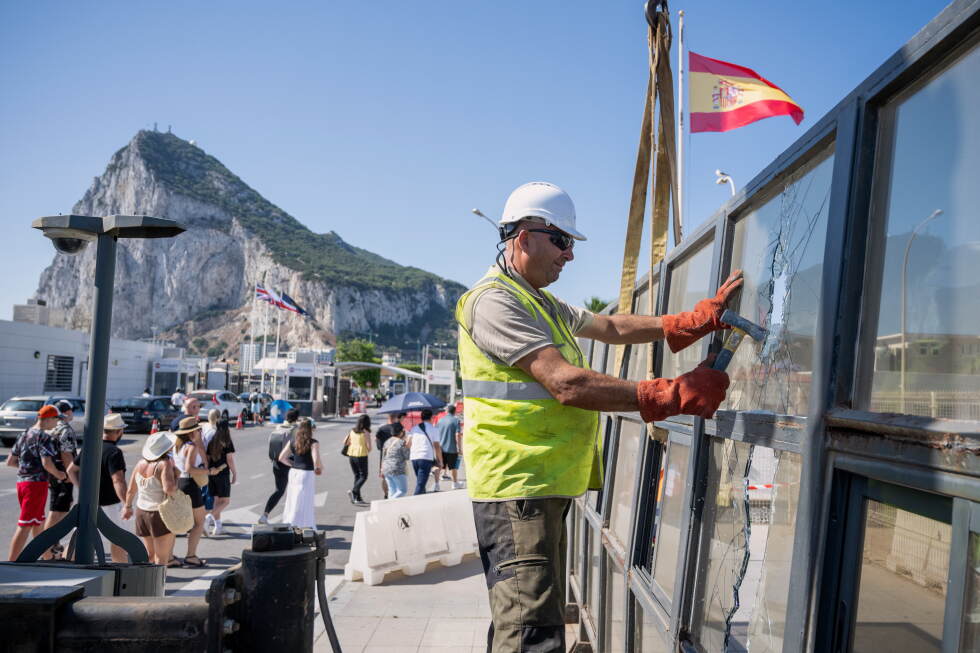
MADRID – Starting Wednesday, thousands of daily commuters crossing between southern Spain and the British Overseas Territory of Gibraltar will experience seamless, unobstructed travel after a physical border fence was fully removed at midnight. This milestone delivers on a landmark EU-UK treaty years in the making, resolving a long-running post-Brexit dispute that threatened economic and social disruption on both sides of the frontier.
Nestled on the southern tip of the Iberian Peninsula, where the Atlantic Ocean meets the Mediterranean Sea just miles off the coast of Morocco, Gibraltar has been a contested territory for more than three centuries. Ceded to Britain in the 1713 Treaty of Utrecht, Spain has never dropped its sovereignty claim over the 6.5-square-kilometer territory home to 38,000 residents. When Britain completed its withdrawal from the European Union in 2020, the future of Gibraltar’s border relationship with the bloc was left unresolved, dragging out years of slow, halting negotiations before a breakthrough was reached in 2025. On Tuesday, the EU, UK, and Gibraltar’s local government formalized the breakthrough with an official treaty signing designed to eliminate cross-border delays.
Without this agreement, Gibraltar faced the prospect of a hard border with mandatory full passport checks for all crossings – a outcome that would have delivered severe economic harm to the territory. Gibraltar’s economy relies heavily on the roughly 15,000 Spanish workers who cross the frontier daily to work, accounting for nearly half of the territory’s entire workforce. Leisure travel, cross-border family visits, and youth activities would also have faced major disruptions from long queues and new screening requirements. Officials from both the EU and UK have hailed the deal as a major win for all parties.
“ It has taken four years of patient, complex negotiation, but the outcome speaks for itself, ” said Maroš Šefčovič, the European Union’s trade representative. “ It is a very special feeling to see a fence come down. ” UK Foreign Office Minister Stephen Doughty emphasized Tuesday that the agreement protects Gibraltar’s long-term economic stability and core national interests. For Gibraltar’s Chief Minister Fabian Picardo, the deal unlocks everyday freedoms that residents have missed since Brexit took effect.
“ People who are visiting family in Spain, or whose Spanish family is visiting them in Gibraltar. Children who are going to football matches and extracurricular activities, either in Spain or in Gibraltar. They will be able to do that without having to worry about frontier queues, ” Picardo told the Associated Press in an interview.
In practice, the agreement integrates Gibraltar into the EU’s Schengen Area free travel zone, a unique arrangement tailored to the territory’s status. Joint entry and exit checks at Gibraltar’s airport and seaport will be conducted by both UK and Spanish authorities, mirroring the existing model used at Eurostar terminals in London and Paris, where both countries’ border officials operate on-site. For travelers entering Gibraltar from non-Schengen countries, the EU’s new Entry-Exit System (EES) will apply – the digital biometric system launched across Europe in April that replaces physical passport stamps with digital photographs and fingerprint records. Notably, the 2016 Brexit referendum saw 96% of Gibraltar voters back remaining in the EU, reflecting the territory’s deep economic and social ties to the bloc.
While the physical border fence is gone, the territory’s long-disputed sovereignty status remains unresolved, as the new treaty does not address competing Spanish and UK claims to Gibraltar. To replace the physical border security, Gibraltar has shifted to a digital surveillance model: live facial recognition cameras have been installed at entry points and across the territory, alongside expanded CCTV coverage, increased police patrols, and additional resources for customs and coast guard operations.
“ The fortress has become a digital fortress now, ” Picardo said.