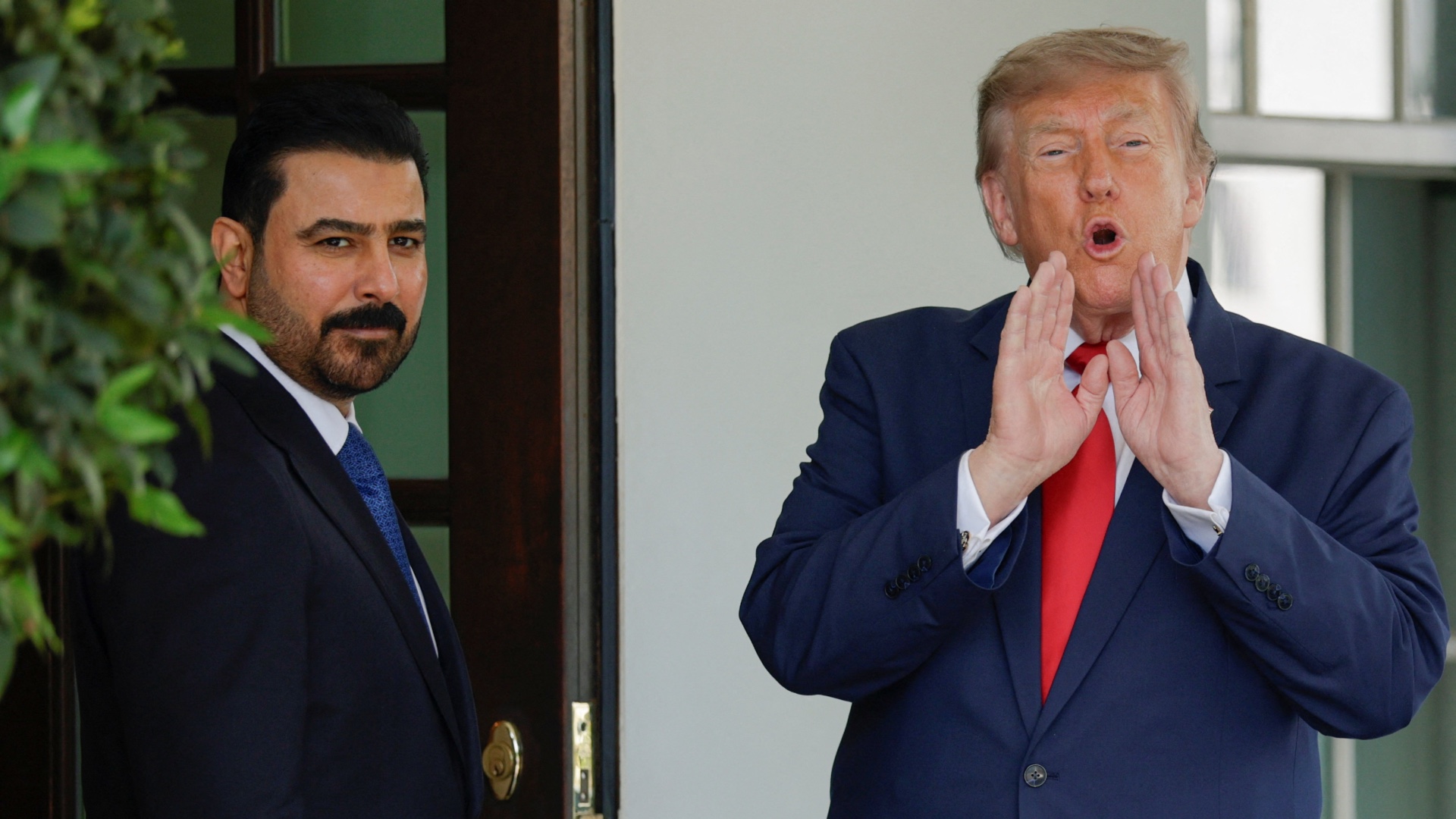
Exactly two months after his surprise appointment as Iraq’s prime minister, political outsider and former banker Ali al-Zaidi stood in the White House Oval Office on Tuesday, receiving public praise from the U.S. president who backed his rise to power.
Speaking to reporters in the room, former U.S. President Donald Trump made clear his active role in Zaidi’s ascent, noting he had thrown his full support behind the Iraqi leader after saying he was dissatisfied with the election’s expected frontrunner. “I think he’s going to end up being a great leader,” Trump told assembled media, adding that Zaidi has long been a friend to the United States. The president closed his introductory remarks with a lighthearted jab: “He’s young and he’s handsome, which I don’t like,” drawing laughter from Zaidi in attendance.
Beyond the ceremonial pleasantries, the meeting served as a platform for the Trump administration to lay out its core agenda for Iraq: moving Baghdad fully out from under Tehran’s sphere of influence, with the top priority being the full disarmament of Iran-aligned militias that operate under the umbrella of the Popular Mobilisation Forces (PMF) within Iraq’s state structure.
For his part, Zaidi reaffirmed his commitment to disarmament, telling reporters that his September 30 deadline for all unauthorized armed factions to surrender their weapons remains non-negotiable. “Whoever surrenders his weapons… We will cooperate with them,” he said via a translator, adding, “Factions are a need, not a profession” — a comment signaling his view that armed groups should integrate into formal state institutions rather than operate independently.
U.S. opposition to Iranian influence in Iraq is not a new policy, but current tensions have pushed Washington to ramp up pressure dramatically in recent months. In April, amid escalating tit-for-tat hostilities between the Trump administration and Tehran in the Strait of Hormuz, the U.S. froze dollar shipments to Iraq and suspended security cooperation to pressure the Iraqi government ahead of Zaidi’s appointment. Within days of Zaidi’s confirmation as prime minister, the funds were immediately unfrozen, a clear signal of U.S. backing for the new leader.
The structure of Iraq’s economy gives Washington significant leverage over Iraqi politics: since the 2003 U.S.-led invasion, nearly 90% of Iraq’s state revenue — almost all drawn from oil exports — is held in the Federal Reserve Bank of New York, and the Iraqi government requires explicit U.S. approval for cash reserves to be airlifted back to Baghdad for domestic use.
Unlike many previous Iraqi political leaders, Zaidi built his career in finance rather than partisan factional politics, and his core agenda centers on rebranding Iraq as a stable, economically attractive destination for foreign direct investment. Analysts note he is also positioning himself as a committed anti-corruption reformer to win over international investors. “He wants to portray himself as someone who’s leading a campaign against corruption within his country, and I think his approach is to kind of convince, in this case, U.S. investors that Iraq will be a country where the rule of law is honoured,” explained Gordon Gray, a former senior adviser to the U.S. ambassador in Iraq from 2008 to 2009, in an interview with Middle East Eye.
To his credit, Zaidi has already launched an unprecedented anti-corruption crackdown that has resulted in the arrest of two former Iraqi oil ministers alongside dozens of other high-profile figures, with authorities seizing millions of dollars in untraceable cash and gold bars from the suspects.
Still, critical questions linger over Iraq’s ability to exercise full sovereignty over its own affairs. How can a country be fully self-determining when it cannot access its own oil revenue for domestic development without U.S. approval? And how can it act independently when Tehran continues to interfere in key policy projects, from energy development to security? Former U.S. ambassador to Iraq Stuart Jones argued that Iraq’s vast natural resources should make it one of the wealthiest countries in the Middle East. “They should be richer than Saudi Arabia. They should be richer than Qatar,” Jones told Middle East Eye. “But they have not created the platform for themselves that allows them to enjoy that wealth, and that’s going to require investment in infrastructure, and it means making independent decisions from Iran.”
Many regional analysts point out that the Trump administration’s own maximum pressure campaign against Iran has itself been a major source of economic and political instability for Iraq. Giorgio Cafiero, CEO of Gulf State Analytics, noted that the closure of the Strait of Hormuz amid escalating U.S.-Iran tensions plunged Iraq’s already fragile economy into a deep crisis, costing the country tens of billions of dollars in lost revenue. Early in the standoff, media reports also emerged that the CIA was working to arm Iraqi Kurdish groups to destabilize Tehran, a move that Kurdish officials publicly distanced themselves from, warning that involvement in U.S.-Iran hostilities would plunge their autonomous region into chaos. Cafiero summed up the country’s precarious position: “Iraq seems to be a victim of chaos in the region.”
Trump offered a far more optimistic framing during the meeting. When asked about relations between Baghdad and Iraq’s semi-autonomous Kurdistan Region, Trump claimed the Middle East was moving toward unprecedented unity. “We are getting rid of the bully of the Middle East. Iran was the bully of the Middle East. They bullied Iraq. They bullied every country,” he said. “There’s no fear anymore because their military capability has been knocked to hell.” Tehran has repeatedly rejected claims that its military capabilities have been severely degraded, and has little incentive to agree to the disarmament of its allied militias in Iraq, which give it critical strategic leverage in the region.
Cafiero says he remains skeptical that the Iraqi state will be able to establish a full monopoly on the use of force by disarming Iran-aligned groups. “I am quite sceptical about this idea that the Iraqi state will be able to assert its monopoly” on Iranian-backed factions, he said. “I have a rather tough time imagining that.”
If there is a path to tangible progress under Zaidi, analysts say it likely stems from the personal rapport he has built with Trump, a leader who has openly prioritized personal relationships over institutional diplomatic norms. Both men are political outsiders with backgrounds in business, a shared identity that makes them open to cutting high-stakes deals.
Zaidi’s first official visit to the U.S. includes more than just the White House meeting. After leaving Washington, his next stop is Houston, where he will meet with senior executives from major U.S. energy companies to discuss investment opportunities. A key item on the agenda is a proposed deal with Chevron to build a new oil pipeline, a project that would give Iraq an alternative export route and reduce its vulnerability to disruptions in the Strait of Hormuz. The visit will conclude back in Washington on Friday, where Zaidi will address the Iraqi American Chamber of Commerce to pitch Iraq as a viable investment destination to U.S. business leaders.