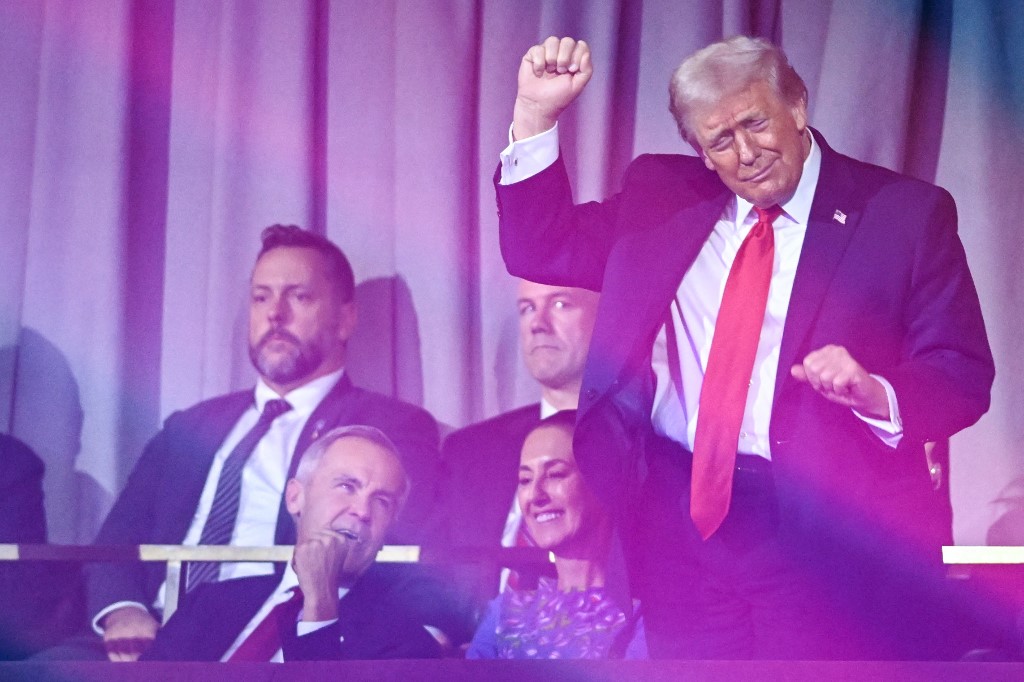
Billed as the most ambitious World Cup in history – expanded to 48 teams, hosted across three North American nations, and projected to deliver a record-breaking $9 billion in revenue for FIFA – the 2026 tournament will likely be remembered not for on-pitch drama, but for pervasive political meddling, systemic bias, and overt corruption that have tainted the global game’s flagship event. At the center of the turmoil stand two figures: former US president Donald Trump, who leveraged the tournament to advance his political agenda, and FIFA president Gianni Infantino, who repeatedly bent the governing body’s rules to accommodate the whims of the Trump administration.
Beyond widely criticized issues including exorbitant ticket prices, logistical chaos from cross-country travel between host cities, and dangerous heat at matches, critics have labeled the 2026 tournament an ‘imperial World Cup,’ shaped entirely by the priorities of a heavily politicized US presidency. The level of influence-peddling surrounding the event has even led some long-time football fans to look back wistfully at the tenure of Sepp Blatter, Infantino’s disgraced predecessor who was forced out of FIFA over a sweeping corruption scandal and is banned from football activities through 2027. Blatter himself weighed in on the controversy last week, posting on social media platform X that ‘football must never become a playground for political power’ – a remark that sparked ironic calls from fans for Blatter to return, with supporters joking that he would ‘make corruption classy again.’ Other observers have summed up the current mood by noting that ‘Infantino and FIFA are so corrupt that even Sepp Blatter, the former chief of corruption, is shocked.’
The controversies began long before the opening kickoff. In December 2025, during the 2026 World Cup draw ceremony, Infantino presented Trump with FIFA’s first, and what many believe will be its only, ‘FIFA Peace Prize’ – an honor awarded just months before the US and Israel launched a planned military attack on Iran in February 2026. The award came as the culmination of a series of honors for Trump, who had previously renamed the John F. Kennedy Center for the Performing Arts to add his own name, a change later reversed by US courts. In his remarks presenting the prize, Infantino told Trump: ‘We want to see hope, we want to see unity, we want to see a future. This is what we want to see from a leader and you definitely deserve the first Fifa Peace Prize.’ In the months after the award, the Trump administration has taken a series of aggressive international actions: abducting Venezuela’s sitting head of state, threatening to invade Greenland, intensifying the decades-long US blockade on Cuba, and plunging the region into open war with Iran.
The Trump administration’s restrictive and discriminatory policies have directly disrupted the tournament for teams, officials, and fans from targeted nations. The most high-profile incident involved Omar Artan, a Somali referee set to make history as the first official from Somalia to work a World Cup. US authorities denied Artan entry at Miami International Airport, detained and interrogated him for 11 hours, then deported him over unsubstantiated ‘vetting concerns.’ A White House official later claimed Artan had been ‘talking to some very bad people,’ but the US government never released any evidence to back the assertion. The deportation was no random mistake: it aligned with the Trump administration’s longstanding hostile approach to Somalia, which is included in Trump’s controversial travel ban, and to Somali communities within the US. Trump has repeatedly insulted Somali Americans, publicly telling members of the community to ‘go back to where they came from.’
The travel ban has locked thousands of fans out of the tournament entirely. Supporters from Iran, Haiti, Ivory Coast, Senegal and dozens of other nations have been unable to secure entry to the US to watch their teams play. A separate controversial visa bond scheme, which briefly required fans from Algeria, Cape Verde, Ivory Coast, Senegal and Tunisia to pay deposits of up to $15,000 to enter the country, was only suspended after widespread public and international pressure.
Iran, the target of the ongoing US-Israeli war that began in early 2026, has faced the harshest barriers to competing in the tournament. Even before the war, Trump pushed FIFA to eject Iran from the World Cup entirely and replace the nation with Italy. After the war began, the US forced Iran to move its pre-tournament training base from Tucson, Arizona to Tijuana, Mexico, just miles from the US border. Just days before the tournament’s opening match, US officials revoked the entire ticket allocation for Iranian fans, leaving thousands who had already booked travel and accommodation stranded. Iranian players only received entry visas 10 days before their first match, while most of the team’s coaching staff, media personnel, and federation leaders – including federation president Mehdi Taj – were barred from entering the US entirely. For Iran’s first two group stage matches, the team was required to enter the US less than 24 hours before kickoff and leave immediately after the final whistle, eliminating critical training time and denying players the chance to rest and recover between matches. Iran’s head coach Amir Ghalenoei has described his side as the ‘most oppressed’ team in World Cup history, saying the US has done everything in its power to wear the team down and force it out of the competition.
Political interference has extended even to disciplinary decisions for star players and host nation teams. Before the tournament began, FIFA’s disciplinary committee cut a three-match ban for violent conduct against Portuguese superstar Cristiano Ronaldo to a one-game suspension, allowing him to play from the tournament’s opening match – a decision that many viewed as a favor driven by marketing and political pressures. The most blatant example of political meddling, however, involved US striker Folarin Balogun, who received a red card in the US Round of 32 win over Bosnia and Herzegovina, which carried an automatic one-match suspension under FIFA’s official rules. Just days after the decision, Trump personally called Infantino to demand a ‘review’ of the call, claiming the foul had never occurred. FIFA subsequently and quietly lifted the suspension, clearing Balogun to play in the Round of 16 match against Belgium. Trump’s public confirmation that he pressured FIFA to reverse the decision was unprecedented in international football, drawing immediate backlash from fans and governing bodies across the globe. UEFA, the European governing body for football, issued a scathing public statement accusing FIFA of crossing ‘a red line’ by making an ‘incomprehensible and unjustifiable’ decision to cave to political pressure. Despite the favorable ruling, the US team was soundly defeated by Belgium in the match.
While political interference has dominated headlines, controversial on-pitch officiating, most notably decisions from the Video Assistant Referee (VAR) system, has also sparked widespread anger. One of the most controversial matches of the knockout stage was Argentina’s chaotic 3-2 comeback win over Egypt in the Round of 16. Egypt held a 2-0 lead late in the match and appeared set to advance to the quarter-finals before conceding three late goals, but the result was immediately overshadowed by widespread anger over officiating calls: a legitimate Egyptian goal was ruled out after VAR review, late penalty appeals for Egypt were ignored, and Egyptian officials protested intensely before Argentina’s stoppage-time winning goal. Online, millions of football fans argued that biased officiating had denied Egypt a fair chance to advance, making the match one of the most debated knockout games in modern World Cup history.
Systemic racism has also emerged as a persistent blight on the tournament, with incidents recorded at stadium entrances, inside venues, online, and at security checkpoints. In the lead-up to the Argentina-Egypt match, a viral video showed an Egyptian fan asking an American security guard if she was only conducting extra pat-down searches of Egyptian fans, to which the guard replied: ‘Yeah, because these are the orders coming in right now.’ Inside the stadium, tensions boiled over after Argentina’s comeback win, with videos showing Argentine fans attacking Egyptian supporters. Other footage showed Argentine fans waving Israeli flags toward Egypt’s coaching staff as they left the pitch – a deliberate provocation, as Egypt head coach Hossam Hassan has been an outspoken advocate for Palestinian people, who have faced a genocidal Israeli military campaign in Gaza since 2023. Hassan dedicated Egypt’s knockout win over Australia to Palestine, telling reporters: ‘I’m dedicating this victory to the Egyptian people and the Palestinian people.’
Multiple high-profile racist incidents have marred the tournament beyond the Argentina-Egypt match. FIFA is currently investigating a confrontation between popular streamer IShowSpeed, who is Black, and an Argentine fan during a match between Argentina and Cape Verde. During a live stream, the fan reportedly told IShowSpeed to ‘go cry to the zoo’ in a racist slur. In another incident, French star Kylian Mbappé publicly condemned Paraguayan senator Celeste Amarilla after she posted racist remarks about Mbappé following Paraguay’s defeat to France, calling Mbappé a ‘colonised Cameroonian, desperately trying to pass himself off as French’ and a ‘brute’ who could not read or write. FIFA officials acknowledged the growing crisis in a public statement in early July, admitting that ‘racial abuse is growing and has become a persistent threat to the wellbeing of players.’ The governing body confirmed it had identified more than 89,000 abusive posts on social media related to the tournament, 11 percent of which contained explicit racial abuse.
As the tournament progresses, the controversies continue to overshadow the on-pitch action, leaving fans and analysts questioning the future of football’s most iconic global event amid rising political interference and systemic bias.