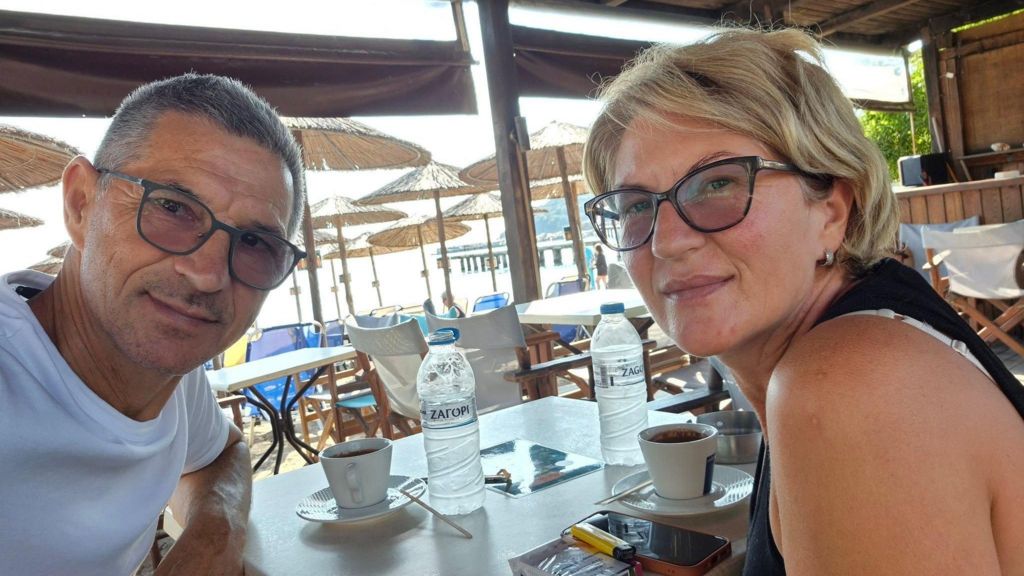
A terrifying mid-air incident on a European Ryanair flight has left a 61-year-old Serbian passenger seriously injured, after he was nearly pulled head-first out of a dislodged cabin window just minutes after takeoff last Friday. The harrowing experience, which unfolded during a scheduled trip from Thessaloniki, Greece to Memmingen, Germany, highlights extraordinary acts of quick thinking from the man’s wife and other passengers that saved his life.
Ljubisa Karović and his wife Svetlana Grković were heading home from a vacation in northern Greece when the emergency unfolded, according to Serbian media reports. Grković, who was seated beside her husband, shared her account of the chaos that struck roughly 10 minutes after departure. In comments to Serbian broadcaster Nova, she recalled that by the time she reacted, half of Karović’s body was already outside the aircraft—from the chest up, he hung outside the plane for two full minutes. “I immediately grabbed his legs. I thought, if we die, we die together,” Grković said, describing her split-second decision to hold on.
Multiple passengers reported hearing a sudden blast just before decompression hit the cabin. Grković said her initial assessment pointed to broken debris from the plane’s right engine smashing the adjacent window. A technical expert consulting for the family has backed this preliminary theory, suggesting an engine failure sent fragments flying to shatter the window, triggering rapid cabin pressure loss. This assessment has not yet been validated by official investigators, however. Crucially, Karović had kept his seatbelt fastened throughout the flight, a small precaution that gave rescuers extra purchase as they fought to pull him back inside. Grković, working alongside two other traveling passengers, managed to haul the unconscious man back into the cabin. Karović lost consciousness three times during the ordeal, his wife said.
Fellow passenger Christina told Radio Thessaloniki that the cabin erupted into screams the moment pressure dropped. “For a moment I thought someone had accidentally opened the emergency door,” she recalled. Another passenger, Sofia, described extreme difficulty breathing as decompression spread through the aircraft. “We thought the plane was going down,” she said, adding that Karović was bleeding and repeatedly lost consciousness, likely from oxygen deprivation and extreme shock.
Flight tracking data confirms the aircraft, operated by Ryanair’s subsidiary Malta Air, dropped 9,000 feet (2,700 meters) abruptly after the incident, before turning around to make an emergency landing back at Thessaloniki. In a public statement following the event, Ryanair confirmed that flight returned to the departure airport shortly after takeoff after a passenger window became dislodged. The Irish budget carrier added that the plane landed without further incident, and all passengers returned safely to the terminal, with only Karović requiring on-site medical attention before being transferred to hospital.
Grković updated the public on her husband’s condition, saying he remains seriously injured, is in severe shock, and has not been able to recount the event. “It’s important to me that he’s alive,” she said, noting that his hand suffered particularly severe damage including burns, and he is currently unable to communicate. Local media reports confirm Karović remains hospitalized as of the latest updates.
The aircraft involved in the incident was an 18-year-old Boeing 737-800, a widely used workhorse for short-haul European flights. Because the incident occurred over North Macedonian airspace, and the plane is U.S.-built, multiple international agencies have joined the ongoing probe led by Greece’s Hellenic Air and Rail Safety Investigation Authority. Participating bodies include aircraft manufacturer Boeing, the U.S. Federal Aviation Administration, and the European Union Aviation Safety Agency. Thessaloniki airport operator Fraport Greece confirmed the investigation remains active, with no preliminary findings released to date.
Additional reporting for the original story was contributed by Nikos Papanikolaou.