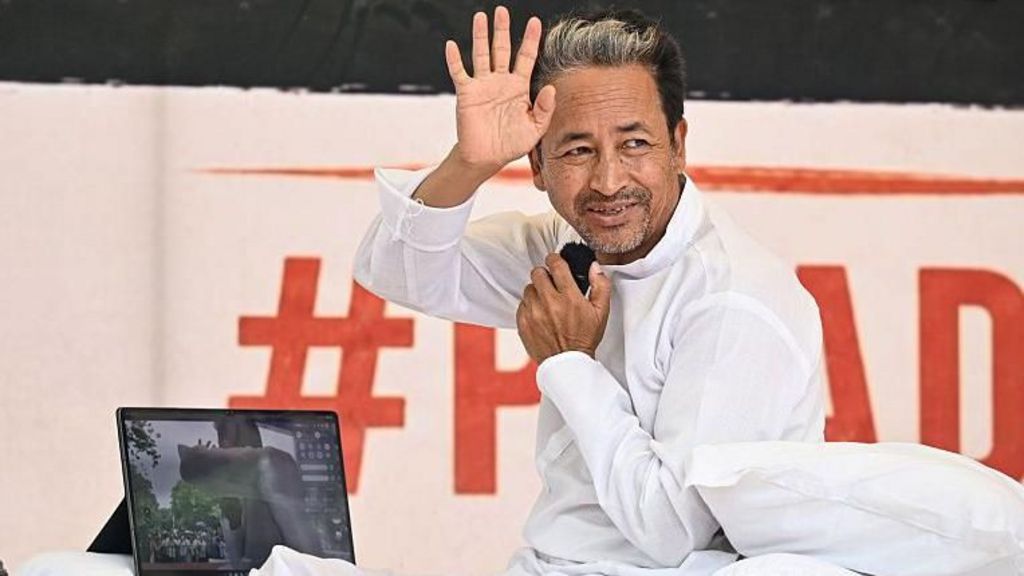
In the heart of India’s capital New Delhi, at the historic Jantar Mantar protest ground, 59-year-old Sonam Wangchuk – an award-winning educationist, climate innovator and revered public figure – has entered the 16th day of an indefinite hunger strike, his resolve unshaken even as his health deteriorates to alarming levels.
Wangchuk, who traces his protest philosophy to Mahatma Gandhi’s principles of nonviolent resistance, told the BBC on Monday: “I’m weak from the outside, but I’m strong from inside.” A Monday morning health bulletin confirms the activist has lost 8.2 kilograms (18 pounds) since beginning his fast, with his blood pressure registering at 107/70 and blood sugar dropping to a dangerously low 67. Thousands of supporters across the country have pleaded with him to end his fast, but Wangchuk says he will see his protest through to its conclusion: “I have to take what I’ve begun to its logical conclusion.”
The hunger strike is part of a broader protest organized by the online satirical activist group Cockroach Janta Party (CJP), which is demanding sweeping accountability and reform in India’s education sector. The movement’s immediate demand is the resignation of Union Education Minister Dharmendra Pradhan, following the cancellation of a major national medical entrance exam in early May after a widespread paper leak scandal. Protesters argue Pradhan must accept moral responsibility for the systemic failure that led to the leak. The minister has rejected the call, dismissing CJP and its allies as “the B-team of disruptive elements” who oppose the country’s progress.
A native of the remote Himalayan region of Ladakh, Wangchuk is far more than a protest figure. A trained mechanical engineer, he has earned international acclaim for his work in both education innovation and climate adaptation. His most famous invention, the ice stupa – an artificial cone-shaped glacier modeled after Buddhist religious structures – stores glacial meltwater during winter and releases it in late spring, when mountain communities and farmers face critical water shortages. The innovation has transformed water access for Ladakhi communities, earning Wangchuk the 2018 Ramon Magsaysay Award, widely recognized as Asia’s highest honor. He also gained nationwide fame as the inspiration for the lead character in Aamir Khan’s 2009 Bollywood blockbuster *Three Idiots*, and has been a household name across India for decades. This is not his first run-in with authorities: last October, he was arrested on charges of inciting unrest, which he denied. He spent 170 days in detention before authorities dropped all charges and released him.
Even amid soaring Delhi summer temperatures that hit 38 degrees Celsius on Monday, with a “real feel” of 46 degrees, hundreds of supporters have maintained a continuous vigil at Jantar Mantar to stand in solidarity with Wangchuk and the CJP’s demands. CJP founder Abhijeet Dipke, who has led the movement from its start, says organizers are gravely concerned about Wangchuk’s declining condition. “Today is the 16th day of his hunger strike and his blood sugar level and blood pressure have dropped and whenever he tries to sit or stand, he feels very dizzy,” Dipke told the BBC. “He’s finding it difficult to even walk to the washroom. He’s really struggling. He’s in a lot of pain but whenever I try to tell him to end his hunger strike, he scolds me and says that ‘don’t you worry about me’.”
Medical teams have warned Wangchuk that continuing the fast poses severe risks to his life, and Dipke says he receives thousands of messages daily from people urging him to convince the activist to end his fast. Even fellow protesters and supporters are increasingly calling on Wangchuk to stop. Animesh Sahu, a 29-year-old engineer from Hyderabad who traveled to Delhi to join the vigil, said: “I’ve grown up watching his videos and I have an emotional connect with him. I’m feeling very concerned about his health. The government must pay attention to him.” Satyaprakash Bharadwaj, a farmer who joined the protest, called Wangchuk “a diamond” sacrificing himself for India’s younger generation: “I’m praying that he will call off his hunger strike. He can fight for our children only when he’s strong.”
Prominent educationist Professor Nandita Narain echoed those concerns, saying it is tragic that a figure of Wangchuk’s standing has to resort to extreme hunger strike to force government action. “It’s very sad that someone like Wangchuk, who has made such outstanding contribution to public life has to resort to a hunger strike to get the government to act,” she said. “I would also appeal to Wangchuk to end his fast because his life is in danger. We have a battle to fight which will go on for much longer. We need a sustained protest and the movement has to be sustained. It’s important that he lives to fight the battle.”
Since Wangchuk began his fast, dozens of opposition lawmakers, prominent activists and social media influencers have visited the protest site to express support. But Dipke says no representatives from the ruling Bharatiya Janata Party (BJP) have reached out or agreed to enter dialogue over the protesters’ demands. “I don’t know why the government is so dismissive of the citizens of this country. We have been simply asking for accountability,” Dipke said. “We are not saying make us or Sonam Wangchuk the education minister. All we are asking for is to fix accountability and to change the person who has failed to conduct exams properly as an education minister.”
With no government response forthcoming, protesters have announced their next step: a mass march to India’s Parliament on July 20, when the next monsoon session of the legislature is set to begin. “We have been sitting here for the last 24 days and Sonam sir has been on hunger strike for 16 days. Despite that, the government has not intervened, they have not even initiated a dialogue with us,” Dipke said. “So we thought maybe it’s time to go to the government, go to the parliament of India and keep our demands there.”