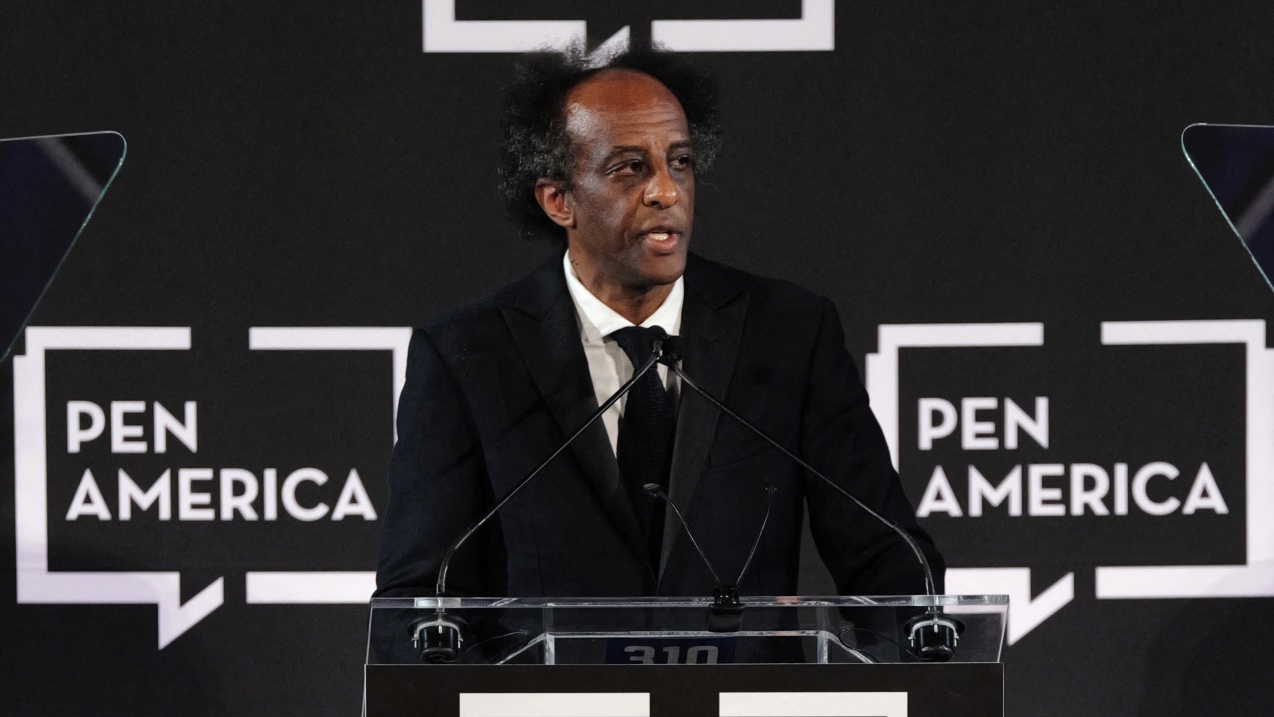
Seven months after taking on the presidency of PEN America, one of the United States’ most prominent literary organizations dedicated to defending free speech, award-winning Ethiopian-American novelist Dinaw Mengestu has stepped down from his post. His departure, announced last week, stems from long-simmering frustration over what he calls systemic unfair treatment of Palestinians at the organization, in contrast to its positioning toward Israelis and Jewish Americans.
Mengestu’s resignation came in the wake of PEN America’s release of a new report documenting the professional and emotional harm faced by Israeli and Jewish-American writers in the aftermath of Israel’s ongoing military campaign in Gaza, now stretching nearly three years. The report detailed multiple accounts of writers losing employment, speaking opportunities and career advancement due to their positions on the conflict. But for Mengestu, the report was just the latest example of the organization’s long-standing failure to uphold its core mission of defending free expression fairly and equitably across all sides of the conflict.
In an Instagram statement posted Sunday, Mengestu clarified that his departure was not a dispute over differing personal perspectives or experiences. Instead, he argued that PEN America’s ongoing institutional choices produce work that enables suppression through bigotry and deliberate indifference toward Palestinian voices. At the center of this disagreement is the organization’s long-standing stance on the Palestinian-led Boycott, Divestment, Sanctions (BDS) movement, a global nonviolent campaign launched in 2005 to end Israeli occupation, racial segregation and the blockade of Gaza, modeled on the anti-apartheid pressure campaign that helped end white minority rule in South Africa. Mengestu emphasized that BDS activity constitutes protected free speech under the First Amendment of the U.S. Constitution, a right PEN America has consistently failed to uphold.
For years, Mengestu noted, PEN America has framed BDS as a direct assault on the identity of Jewish students, while systematically diminishing Palestinian experiences of violence and dispossession to the point of near erasure. “What PEN America fails to understand is that a boycott is a form of dialogue,” he wrote. He added that the hundreds of writers who boycotted PEN America in 2024 did so to push for meaningful institutional change, and many only returned to the organization after being promised reform.
Many of those boycotting writers are affiliated with Writers Against The War on Gaza (WAWOG), a prominent collective that labeled Israel’s military campaign in Gaza a genocide just two weeks after it launched in October 2023 – a classification that has since been endorsed by the United Nations, leading historians and leading genocide scholars. WAWOG’s website documents more than 400 successful cultural boycott outcomes across North America since the start of the conflict. The group declined to share its full membership size or demographic breakdown with Middle East Eye, but an anonymous representative praised Mengestu’s decision to step down.
“We understand and commend [Mengestu] for not wanting to be associated with an institution that would… equate BDS as discriminatory,” the representative told Middle East Eye Monday. “For a lot of us, principles are the only thing we have.” The representative added that PEN America consistently draws false equivalence between material genocidal violence against Palestinians and the semantic disagreements raised by Zionist Israelis and Jewish Americans. “The desecration of cultural spaces in Gaza, wiping out the universities, killing scholars and writers and arresting them, it just doesn’t even compare,” they said.
When contacted for comment by Middle East Eye, PEN America offered only a brief, measured statement acknowledging Mengestu’s departure. “We are grateful for Dinaw Mengestu’s leadership and we respect that he’s made a decision he believes in,” the organization said. “We recognize people can disagree about how best to apply free expression principles in this extraordinarily difficult environment.” The 100-year-old institution, which centers its public mission on defending free expression in all its forms, outlined its formal stance on boycotts in the 9 July report on Israeli and Jewish writers: the organization opposes cultural and academic boycotts that inhibit the international exchange of art, literature and knowledge, but will defend the right of writers who choose to participate in such boycotts against professional retaliation.
PEN America confirmed to Middle East Eye that this caveat, affirming BDS participation as protected free speech, was only added to the organization’s public position in the past week. Prior to this update, the organization’s 2007-era stance on boycotts did not acknowledge that participating in or advocating for boycotts qualifies as protected free expression. Mengestu has characterized this last-minute adjustment as a hollow attempt to appease all sides amid mounting pressure for reform, though the organization has not publicly explained why it chose to update its position now after years of escalating criticism.
The 9 July report did acknowledge that no organized BDS campaign has called for targeting writers solely on the basis of their Jewish identity. It did, however, note that many Jewish writers have reported losing access to agents, publishers and public events since 7 October 2023, due to their Jewish identity, support for Zionism, or sympathy for Israel.
As of Monday, Gaza’s Ministry of Health has confirmed at least 73,231 Palestinians killed in Israeli military operations since the 7 October 2023 Hamas attacks that killed roughly 1,200 people in southern Israel. Independent experts estimate an additional 10,000 Palestinians remain buried under rubble across the blockaded enclave, with hundreds of thousands more sustaining injuries. Even after a recently announced ceasefire brokered by former U.S. President Donald Trump on 10 October, 1,108 Palestinians have been killed in Israeli airstrikes and sniper fire across Gaza.