The Middle East has been plunged back into widespread conflict this week, with the largest exchange of military strikes between the United States and Iran taking place since a bilateral ceasefire was agreed in April. The resumption of active hostilities centered around the strategically critical Strait of Hormuz, a chokepoint for nearly a fifth of the world’s daily oil trade, has thrown years of diplomatic efforts to lock in a permanent end to conflict into serious jeopardy.
After a second consecutive day of U.S. airstrikes against Iranian targets on Monday, Iranian officials issued a stark warning: Tehran will formally withdraw from its compliance with the June ceasefire framework agreement if Washington continues to fail to uphold its own commitments under the deal. Foreign Ministry spokesperson Esmaeil Baqaei confirmed the breakdown in the agreement, noting that Iran has repeatedly matched U.S. non-compliance with reciprocal action, and will continue to do so. “There is no doubt that this document is in crisis,” Baqaei stated. “Each time that the other party has failed to meet its obligations, we did not uphold ours. We will continue to act in this manner.” Despite the escalating tensions, Baqaei added that Tehran remains engaged in diplomatic talks with mediators from Qatar, Pakistan and Oman to prevent further regional escalation.
Shortly after Iran’s threat, the Islamic Revolutionary Guard Corps (IRGC), Iran’s most powerful military force, announced retaliatory strikes targeting four U.S.-aligned Gulf nations: Bahrain, Jordan, Kuwait and Oman. The strikes triggered air raid warnings across Bahrain, while military forces in Jordan intercepted four Iranian missiles and Kuwaiti troops intercepted multiple “hostile aerial targets.” Bahrain’s military condemned the action as “heinous attacks with missiles and drones that target civilians,” confirming it had shot down a number of Iranian projectiles by Monday morning. Iranian state media reported two civilian casualties from the latest wave of U.S. strikes, including one fatality and four injuries at a water pumping station in the southwestern city of Mahshahr. Fresh unexplained blasts were also reported near the coastal city of Bandar Abbas in southern Iran at midday Monday, according to Iran’s Mehr News Agency.
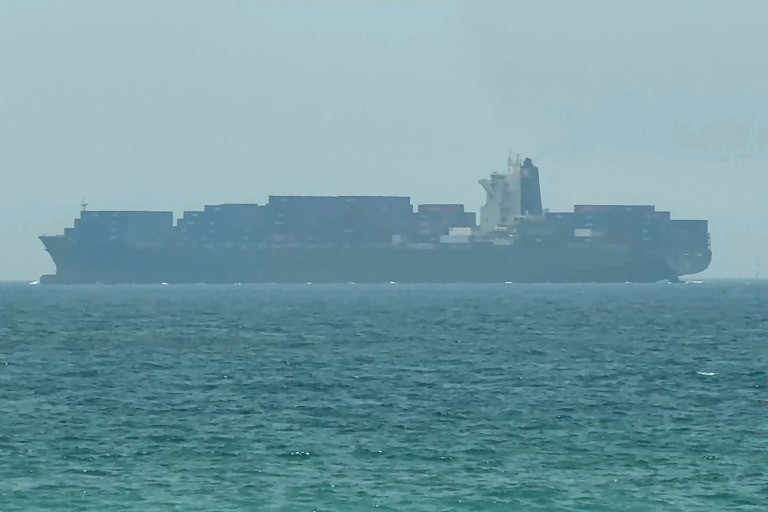
U.S. Central Command (CENTCOM) confirmed it had completed a new round of overnight airstrikes targeting dozens of Iranian positions across multiple locations. The U.S. military said the strikes used precision munitions launched from aircraft, naval vessels and drones, with the explicit goal of degrading Iran’s capability to attack commercial shipping transiting the Strait of Hormuz. The new round of fighting began early Sunday, when Iran launched an attack on a commercial cargo vessel in the strait that forced the entire crew to abandon ship after the vessel caught fire. Following that attack, the IRGC announced via Iran’s official IRNA news agency that “the Strait of Hormuz will be closed until further notice and until the end of American interventions in this region.” CENTCOM pushed back against that claim in a post on X, asserting that the waterway remained “open to all vessels seeking to lawfully transit.”
The competing claims over access to the strait have roiled global energy markets, as fears of disrupted supply pushed oil prices up by as much as 4.5% in trading on Monday. U.S. West Texas Intermediate crude climbed to nearly $74 per barrel, reversing the sharp drop in prices that followed the announcement of the June framework agreement.
Diplomatic efforts to de-escalate gained momentum after President Donald Trump declared the April ceasefire over earlier this week, but mediators have struggled to reverse the breakdown in talks. Pakistan, one of the key intermediaries in the negotiations, issued a statement expressing “deep concern at escalation in regional tensions.” Iran’s foreign ministry said the U.S. strikes had “caused the return of insecurity in the Strait of Hormuz” and “rendered futile all efforts” at establishing lasting regional peace.
Independent analysts largely view the current escalation as a temporary phase in long-running negotiations, rather than a precursor to full-scale permanent war. Bader Al-Saif, an associate fellow at the London-based Chatham House think tank, noted that both Washington and Tehran want to reach a negotiated settlement that favors their own strategic priorities, and have turned back to large-scale attacks to gain leverage ahead of final talks. “Both sides want to end the impasse on their own terms, and they are increasingly finding it difficult to do so. Hence the return to and increase in the scale of attacks,” Al-Saif explained. “That only prolongs what will eventually happen: a negotiated settlement.”