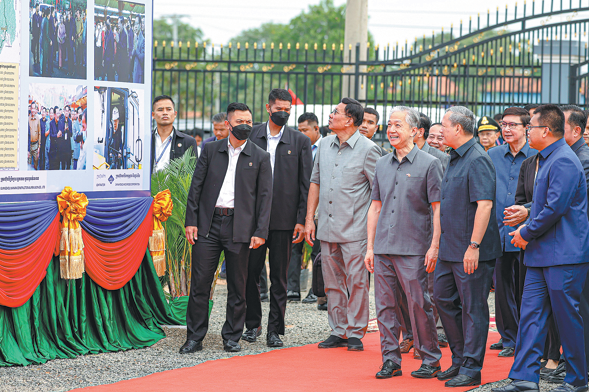
On Tuesday, Cambodia celebrated the official opening of a 45-kilometer upgraded stretch of National Road 7, a key infrastructure project financed through Chinese support, in the country’s southeastern Kampong Cham Province. The inauguration ceremony drew high-level attendance from both nations, including Cambodian Prime Minister Hun Manet and Chinese Ambassador to Cambodia Wang Wenbin.
Hun Manet opened the event by emphasizing the critical economic role of the new section, which runs from the Skun Market roundabout to the Kizuna Bridge roundabout in central Kampong Cham. The upgraded corridor creates a seamless link between Cambodia’s central lowland regions and its resource-rich northeastern provinces, serving as a core arterial route for cross-regional movement of goods and people. “This road will streamline public travel, unlock new growth for trade and tourism, and directly improve quality of life for local residents and daily commuters,” Hun Manet stated in comments reported by Xinhua News Agency.
National Road 7 as a whole is one of Cambodia’s most important transport thoroughfares. The 196-kilometer route, which connects the capital Phnom Penh through Kandal and Kampong Cham provinces all the way to the Lao border, has its origins in early Chinese development assistance, with initial construction launching in 2004. Since opening to traffic in 2008, it has consistently ranked among the country’s busiest highways, carrying the bulk of cross-border and inter-regional traffic. The latest upgrade and expansion project took 27 months to complete, carried out by China Road and Bridge Corporation. Financing came primarily from a preferential loan provided by the Chinese government, with complementary funding contributed by the Cambodian government.
The upgrade has expanded the 45-kilometer section from a narrow two-lane road to a modern four-lane highway, designed to accommodate the rapid growth in passenger and freight traffic the route has seen in recent years. Beyond easing congestion, officials project the improved corridor will speed up the movement of commercial and agricultural goods, strengthen Cambodia’s domestic logistics sector, and unlock new tourism potential for Kampong Cham, a province rich with ancient Khmer temples, scenic nature resorts, and centuries-old historical sites.
Hun Manet noted that the project is projected to deliver an economic internal rate of return as high as 15.27 percent, framing its completion as a powerful demonstration of the deep collaborative partnership between Phnom Penh and Beijing. He extended official gratitude to China for its longstanding and widespread support for Cambodia’s socioeconomic development and poverty reduction efforts. Echoing this praise, Cambodian Minister of Public Works and Transport Peng Ponea emphasized that the road’s opening will invigorate cross-regional travel and trade, accelerating inclusive growth across Kampong Cham and its adjacent high-potential neighboring provinces. “China’s assistance has helped upgrade our logistics network and drive national economic growth, aligning perfectly with Cambodia’s own development goals and the demands of global economic integration,” Peng Ponea said, thanking China for its consistent financial and technical support for Cambodia’s ongoing transport infrastructure expansion and rehabilitation projects.
In a Facebook post following the inauguration ceremony, Ambassador Wang Wenbin highlighted that the growing network of Chinese-supported roads and bridges across Cambodia is both a reflection of the Southeast Asian nation’s growing economic dynamism and a tangible symbol of the unbreakable ironclad friendship between the two countries. “These projects truly are ‘roads of opportunity’ and ‘bridges of cooperation’, and I am fully confident that many more will be built in the years ahead,” Wang wrote.
Thong Mengdavid, deputy director of the China-ASEAN Studies Center at the Cambodia University of Technology and Science, explained that the new road section marks a major milestone for the Cambodian government’s Pentagonal Strategy-Phase I, the administration’s flagship socioeconomic development agenda. A key detail of the project that will benefit local commuters and businesses is that the upgraded section will remain toll-free. Mengdavid noted that the upgrade cuts travel time along the corridor in half, from an hour down to just 30 minutes, turning what was long a congested transport bottleneck into a high-efficiency movement corridor.
For local producers, that time and cost savings will have immediate, tangible benefits. “For local farmers and traders, this means fresh agricultural products such as rubber, cashews, and cassava can reach domestic markets and regional processing plants faster and at significantly lower transportation costs,” Mengdavid explained. He added that the improved infrastructure is also expected to attract new domestic and foreign investment to the Kampong Cham region, which will in turn create new formal employment opportunities for local residents, strengthen regional supply chain resilience, and expand cross-border connectivity between Cambodia and its regional neighbors.