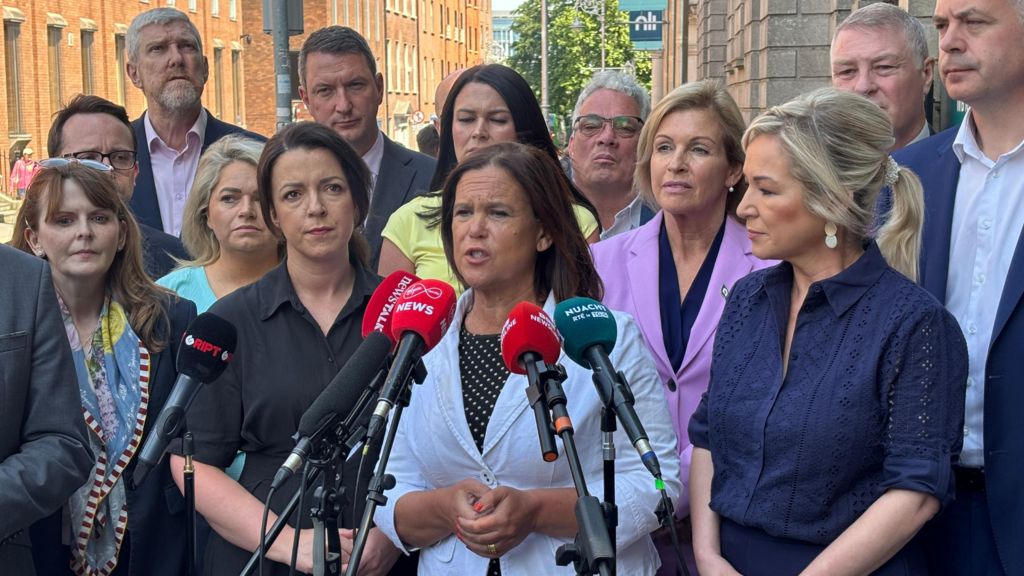
On Tuesday, a broad delegation of Sinn Féin politicians from both the Republic of Ireland and Northern Ireland gathered at Dublin’s Leinster House to rally behind groundbreaking new legislation that would establish a Citizens’ Assembly focused on planning for Irish unification.
Under the framework of Sinn Féin’s proposed bill, the Citizens’ Assembly would be composed of 99 randomly selected Irish citizens and chaired by an independent expert moderator. This model, already tested by previous Irish citizens’ assemblies that examined abortion legislation and the future of Ireland’s drug policy, is designed to facilitate in-depth, deliberative public discussion on the highly consequential issue of unification before recommendations are submitted to the Irish government.
The bill does not stop at creating the assembly: it also mandates the Irish government to publish a comprehensive Green Paper outlining preparations for constitutional change, covering policy areas ranging from national economic governance to public healthcare and housing. Additionally, it requires the taoiseach (Irish prime minister) to conduct structured consultations with a broad set of stakeholders, including Northern Ireland’s unionist and Protestant representatives, cross-sector civil society groups, all political traditions across the island, subject-matter experts, and historically underrepresented communities.
Sinn Féin party leader Mary Lou McDonald framed the push for planning as an urgent matter of timing, telling reporters that a border poll on unification is a question of when, not if, and that the Irish government must begin logistical and policy preparations immediately. She argued the current political context is uniquely favorable for forward planning, noting that all devolved first minister roles in Northern Ireland, Scotland and Wales are currently held by nationalist leaders. “We ask the government to prepare for opportunity, we have the space now, we have the time, we’re about halfway through the electoral cycle in this jurisdiction,” McDonald said, adding that lawmakers across parties from Fianna Fáil to Fine Gael have privately acknowledged the common sense of advancing planning work.
In a last-minute shift, the sitting Irish government has confirmed it will oppose the Sinn Féin bill in a Dáil vote, abandoning an earlier plan to table a counter-motion. While the bill will proceed to a vote, political observers widely expect it to fail to pass. Government officials, who made the decision to oppose the legislation during a virtual cabinet meeting on Tuesday, cited existing work to strengthen cross-border ties through the Shared Island initiative and ongoing diplomatic engagement with the British government as reasons for their concerns over the bill’s timing.
Notably, the push for unification planning is already gaining traction across Ireland’s political mainstream. In recent weeks, Fine Gael, one of the governing parties, has announced it will develop its own separate blueprint for Irish unity, with a final report scheduled for completion by November. Tuesday’s gathering at Leinster House included Northern Ireland First Minister Michelle O’Neill alongside serving Stormont ministers and assembly members, a sign of the cross-border coordination driving Sinn Féin’s unification agenda.