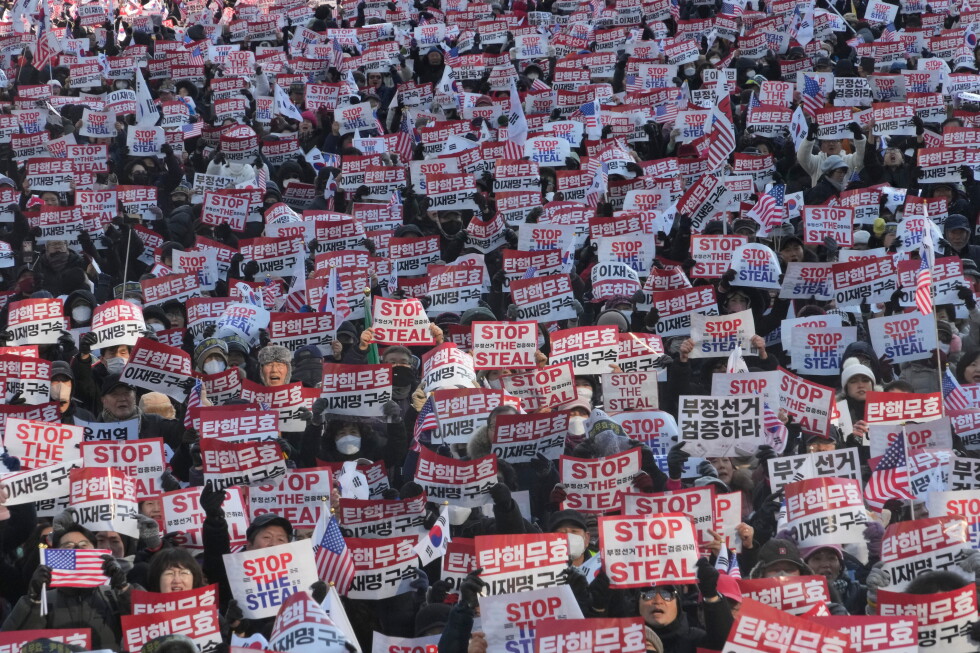
South Korea’s controversial new anti-disinformation law entered into force on Tuesday, triggering fierce debate over press freedom and the risk of state censorship, as journalists and civil liberty advocates warn the vaguely drafted legislation could stifle open public discourse and discourage critical reporting. The legislation, which allows for harsh punitive damage claims against news outlets and social media influencers that spread false information, was championed by President Lee Jae Myung’s ruling liberal Democratic Party and passed by the National Assembly in December, despite a full boycott from the conservative opposition bloc. The current push for tighter regulations on false information follows a period of deep political upheaval in South Korea, sparked by former President Yoon Suk Yeol’s short-lived 2024 declaration of martial law, which ultimately led to his impeachment, removal from office, and a life sentence for rebellion that he is currently appealing. In the wake of that crisis, Lee’s administration has framed the law as a critical defense against harmful disinformation, which proponents argue is eroding democratic norms by stoking societal division and amplifying hate speech. Critics note Yoon, who remains politically active while facing multiple ongoing criminal cases, has spread unsubstantiated claims of election fraud through right-wing YouTube channels to rally his conservative base, deepening the country’s already sharp political polarization and making compromise on key issues all but impossible. Under the terms of the new law, courts can award punitive damages of up to five times the proven harm caused to individuals or entities by news organizations and large social media creators that distribute illegal, false, or manipulated content for profit or to cause damage. Repeat offenders — those who continue to share content after a court has ruled it false or manipulated — face fines as high as 1 billion South Korean won, equal to roughly $656,000, from the national media regulator. Major social media platforms with more than 1 million daily active users in South Korea are also legally required to implement proactive measures, including removing flagged content and suspending offending user accounts, after receiving reports of false or fabricated information. The Korea Media and Communications Commission, the country’s top media regulator, has sought to downplay widespread concerns that the law will be abused as a tool for political censorship. Regulators emphasize that private platform operators, not government officials, will make initial calls on whether reported content qualifies as disinformation, and that the legislation explicitly exempts public interest reporting from punitive damage claims. But these assurances have done little to ease fears from media groups and independent analysts, who warn the law’s vague language leaves dangerous room for misuse. The Journalists Association of Korea argued in a formal statement that the constant threat of massive damage claims and protracted legal disputes will create an inevitable chilling effect across the media landscape. “Even if a law’s objective is legitimate, it could erode the foundations of democracy if it’s enforced in a way that discourages the media and ordinary citizens from freely criticizing and scrutinizing those in power,” the group said. The Seoul Foreign Correspondents’ Club has also echoed these concerns, warning the law could disrupt the free flow of information both within South Korea and to global audiences. Independent analysts share these worries. Kim Hong-yeol, a media studies professor at Seoul’s Duksung Women’s University, argued in an analysis for Korean news outlet Medius that the law will almost certainly push journalists and ordinary social media users toward widespread self-censorship, discouraging open discussion of politically sensitive or controversial issues. Kim added that large social media platforms, seeking to avoid potential legal liability, are likely to adopt overly aggressive content moderation policies that will result in the removal of legitimate, newsworthy content alongside confirmed disinformation. Domestic South Korean internet giants including Naver and Kakao have confirmed they are updating their content moderation systems to align with new regulatory guidelines, but it remains unclear how major foreign platforms — most notably Google-owned YouTube, which is a major hub for political content in the country — will comply. Google has not yet issued a public response to requests for comment on its plans. The law has also drawn international criticism. Shortly after its passage in December, U.S. Under Secretary of State Sarah B. Rogers publicly condemned the legislation in a post on X, warning the law threatens bilateral tech cooperation and argued that “it’s better to give victims civil remedies than give regulators invasive license for viewpoint-based censorship.”
South Korean law targeting ‘fake news’ takes effect as journalists’ groups raise concerns