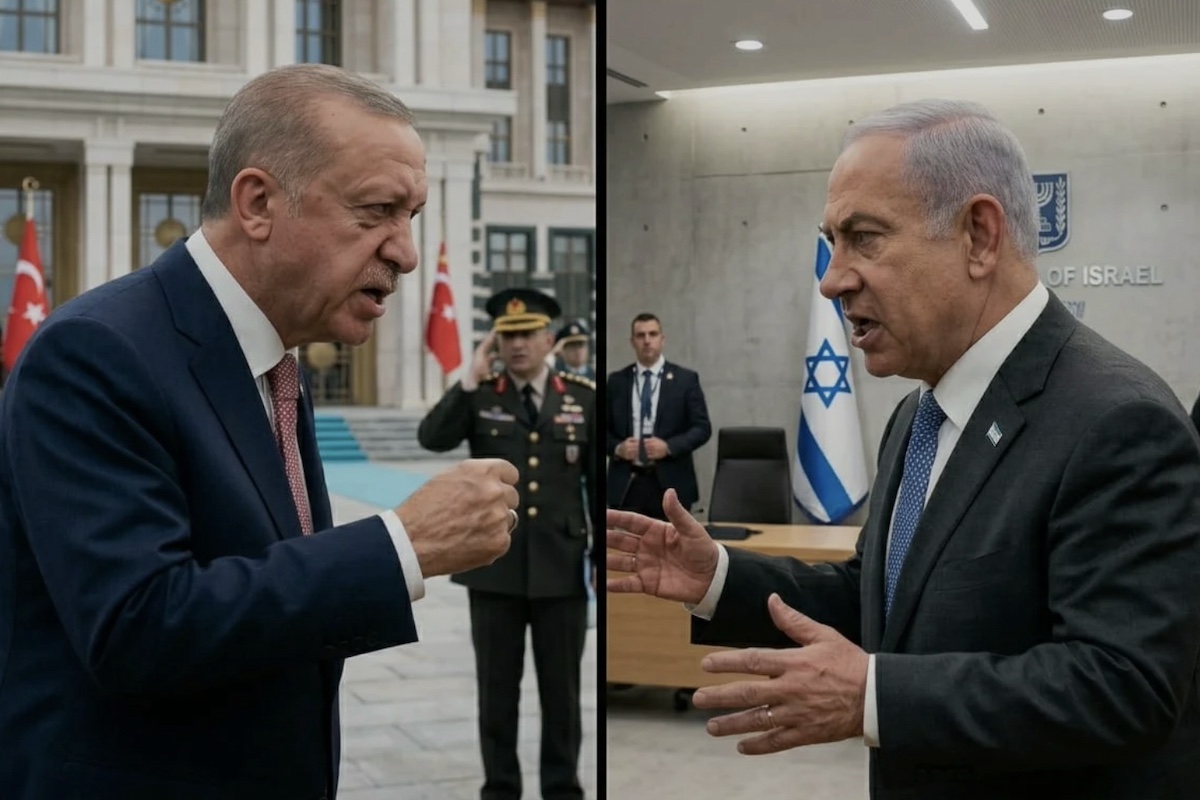
When two major regional powers trade harsh public accusations of genocide and authoritarianism, it is easy to frame the moment as an epic collision of irreconcilable cultural values or clashing civilizational identities. The increasingly public breakdown in relations between Turkey and Israel over recent weeks has encouraged exactly this simplistic framing: Turkish President Recep Tayyip Erdogan has drawn inflammatory comparisons between Israeli Prime Minister Benjamin Netanyahu and Nazi leader Adolf Hitler, while senior Israeli ministers have publicly labeled Turkey an enemy state in every sense of the phrase. Most notably, Israel has reversed a century of deliberate diplomatic policy to suddenly claim a moral obligation to recognize the 1915 Armenian genocide carried out by the Ottoman Empire.
A pragmatic realist analysis, however, paints a far less dramatic and far more familiar portrait of the conflict. What looks like a clash of values on the surface is actually a competition for regional influence between two overextended middle powers, both operating in a region where the old order that once kept their rivalries contained has collapsed. Both sides are leveraging every tool at their disposal – including long-dormant historical memory – to advance immediate, concrete strategic goals.
### Genocide Recognition as Strategic Statecraft, Not Moral Awakening
Israel’s sudden shift on Armenian genocide recognition offers the clearest example of how historical narrative is being deployed for contemporary political gain. For more than a century, every Israeli government across the ideological spectrum refused to formally label the Ottoman-era mass killings of Armenians as genocide. This choice was never rooted in historical disagreement: the global scholarly consensus on the reality of the genocide has long been settled. Instead, the decision was driven by pragmatic geopolitics: Turkey was a critical military and diplomatic partner for decades, and in more recent years, Azerbaijan – a key energy supplier to Israel and an intelligence ally against Iranian ambitions – has vigorously opposed any international recognition of the genocide.
This century-old political calculus shifted completely in a matter of weeks in June 2026. This change was not triggered by the discovery of new historical archives or a sudden national reckoning with moral principle. It came as Turkey and Israel have emerged as open rivals across multiple hotspots, from Syrian territory to the Eastern Mediterranean and even the halls of power in Washington D.C. The timing of the announcement reveals its true purpose: it is not a belated act of conscience for Armenian people, but a calculated message aimed directly at the Turkish government, and more specifically at the U.S. Congress, where an organized and influential Armenian-American lobby can create significant barriers to Turkey’s defense industry goals and its push to rebuild warm relations with the United States.
Realist scholars have long argued that seemingly moral foreign policy gestures require close scrutiny to uncover the underlying strategic interests they serve, and this case is one of the clearest examples in modern diplomacy. This does not erase the reality of the historical event: the Armenian genocide is an established historical fact, and that truth has never been in credible dispute. But observers should be deeply skeptical of the narrative that Israel uncovered a moral truth in 2026 that it was unable to recognize in 1996 or 2016. The historical fact has not changed – only the strategic utility of publicly acknowledging it has shifted.
Turkey’s response to the announcement has been equally instrumental. Turkish officials have framed Israel’s recognition as a cynical distraction from international scrutiny of Israel’s own military actions in Gaza, rather than treating it as a moment of legitimate historical reckoning. Put simply, both governments are wielding a century-old atrocity as a rhetorical weapon in a contemporary regional power struggle, and the current stated positions of both sides should not be confused with the long-held factual stances they have maintained for decades.
### Deeper Drivers: Geopolitical Balance, Not Ideological Conflict
When one strips away the heated public rhetoric, the structural sources of friction between the two countries are mundane and entirely predictable from a traditional balance-of-power perspective, playing out across three key flashpoints:
First, the power vacuum in post-Assad Syria. With former President Bashar al-Assad removed from power and Iranian-aligned militias significantly weakened, both Ankara and Jerusalem are rushing to fill the resulting empty space, and their preferred local allies have no overlap. Turkey backs the new interim government in Damascus and is actively arming and training its new military. Israel, by contrast, has carried out repeated airstrikes on Syrian military assets and supports Druze communities, and more cautiously, Kurdish groups that Turkey views as an existential security threat due to the long-running insurgency by the Kurdistan Workers’ Party (PKK). This is a textbook example of the classic security dilemma: every defensive move one side makes to shore up its own position is read as an offensive threat by the other.
Second, competing claims in the Eastern Mediterranean. A deepening defense and energy partnership between Israel, Greece, and Cyprus – which includes joint military exercises, an Israeli sale of advanced air defense systems to Cyprus, and plans for a new U.S.-backed regional energy hub – directly contradicts Turkey’s expansive “Blue Homeland” maritime claims and its decades-old dispute over the status of Cyprus. From Ankara’s perspective, this partnership looks like deliberate encirclement by hostile powers; from Jerusalem’s perspective, it is a logical diversification of alliances away from a Turkey it can no longer trust. Both readings are rational from each government’s vantage point, which is exactly what makes this dynamic so difficult to de-escalate through simple goodwill gestures alone.
Third, the awkward position of the NATO alliance. Turkey’s NATO membership adds an unusual layer of complexity to the rivalry. It gives Ankara access to the alliance’s security umbrella, which it increasingly resents depending on, while creating a persistent diplomatic headache for Washington: an alliance originally built to deter Russian aggression now has to manage an open rivalry between one of its own members and America’s closest non-NATO partner in the Middle East.
Any U.S. administration that wants to prevent a full-blown military crisis in the Eastern Mediterranean has a clear interest in keeping this rivalry confined to rhetorical exchanges rather than open kinetic conflict. But Washington currently has very little bandwidth available to carry out the quiet, behind-the-scenes mediation that would be required to de-escalate tensions.
### The Case for Pragmatic Restraint
This analysis does not argue that the rising confrontation between Ankara and Jerusalem is an insignificant development: a slide toward open conflict between a NATO member and a nuclear-armed U.S. partner is a major development with global consequences. But it does make the case that observers should not take either government’s public framing at face value.
Erdogan’s fiery rhetoric about “liberating Jerusalem” is aimed as much at his domestic political base and pan-Islamist audiences across the region as it is at Israel. For Israeli officials, labeling Turkey “the new Iran” helps justify deeper Israeli military entrenchment in Syria and closer strategic alignment with Greece and Cyprus – moves that carry their own significant risks of escalation.
Israel’s decision to recognize the Armenian genocide now, rather than at any point in the 40 years it could have taken that step, is clearly intended to win support for its regional agenda in Washington at Turkey’s expense.
The realist approach does not dismiss the moral weight of any of the claims being made: the Armenian genocide is a historical fact, Turkey’s slide toward authoritarian rule in recent years is well documented, and Israel’s military campaign in Gaza has drawn widespread and serious international criticism. Instead, it calls for separating the underlying truth of these claims from the timing of their public deployment, and resisting the urge to frame this regional rivalry as a broader debate about competing civilizational values.
What is unfolding between Ankara and Jerusalem is a classic example of how unconstrained middle powers act when the influence of a regional hegemon – in this case, a stretched thin United States whose long-standing security guarantee no longer shapes regional order as it once did – recedes. They shore up their positions through tactical hedging, posture for domestic and international audiences, and reach for the nearest historical or moral tool that can advance their immediate goals.
For outside observers, and particularly for policymakers in Washington, the responsible approach is to see this dynamic clearly rather than rushing to pick a side in what is, beneath all the heated rhetoric, a traditional contest for regional power and influence.