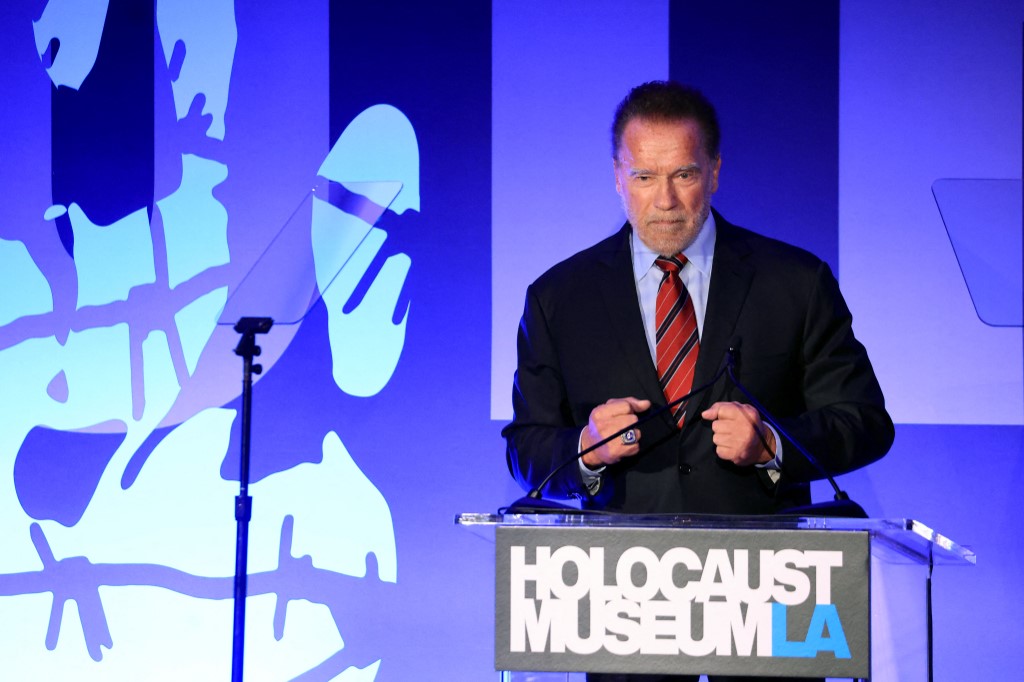
A controversial social media post from Holocaust Museum LA that expanded the meaning of the iconic phrase “Never Again” beyond the Holocaust has been removed just days after publication, sparking fierce debate over free expression, the legacy of the Holocaust, and global discourse around the ongoing crisis in Gaza.
The original post, shared Saturday on the museum’s social channels, featured an illustrated graphic of interlocking arms of diverse skin tones with bold text reading: “‘Never again’ can’t only mean never again for Jews.” A follow-up slide added, “Standing with humanity does not betray our people. It honours them.” The messaging was crafted as part of a pre-planned outreach campaign focused on advancing inclusivity and cross-community solidarity, but quickly drew sharp pushback from pro-Israel groups and audiences who interpreted the post as an implicit critique of Israel’s military campaign in Gaza, framing it as an inappropriate political statement.
Within 24 hours of going live, the museum pulled the post and issued a public apology, promising to improve its content review processes moving forward. “We recently posted an item on social media that was part of a pre-planned campaign intended to promote inclusivity and community that was easily open to misinterpretation by some to be a political statement reflecting the ongoing situation in the Middle East. That was not our intent,” the museum said in a follow-up statement. “It has been removed to avoid any further confusion. We promise to do better.”
A screenshot of the original deleted post was captured and shared widely on X by Ryan Grim, co-founder of Dropsite News, who condemned the museum’s decision to remove the content. “Speechless. No words for this,” Grim wrote in his caption. “Think about how many people must have complained about this first message to get them to delete it and even issue an apology. If you denounce genocide, some might think you’re being critical of Israel and we can’t have that.”
The debate touches on a longstanding divide within Jewish and global activist communities over how the phrase “Never Again” – coined to memorialize the six million Jews murdered by the Nazi regime in the Holocaust – should be applied to other mass atrocities. As Jewish American news outlet The Forward notes, many Jewish activists have previously invoked the phrase to advocate against gun violence in the U.S. and human rights abuses against Uyghur communities in China, while others insist it should remain exclusively tied to the World War II genocide.
The controversy comes amid heightened global tensions over Israel’s 22-month military operation in Gaza, which multiple historians, human rights groups, and international officials have labeled a genocide. According to Gaza’s health authorities, more than 64,000 Palestinians have been killed, 160,000 more injured, and the entire 2.2 million-person population of the enclave faces widespread starvation, displacement, and catastrophic humanitarian conditions. Images of overcrowded unsanitary displacement camps, mass graves, and starving Palestinian civilians have drawn repeated comparisons to the historical imagery of Nazi concentration camps displayed in Holocaust memorial institutions worldwide.
Martin Griffiths, the former United Nations humanitarian aid chief, has publicly called Israel’s assault on Gaza the “worst crime of the 21st century.” Despite widespread evidence of mass civilian harm, pro-Israel voices – including hardline American Evangelical Christian groups – have fiercely pushed back against any characterization of the campaign as genocide, and reject any extension of anti-genocide messaging to include Palestinian victims.
Critics of the museum’s decision to remove the post argue that current discourse around the Gaza crisis has created a lopsided climate of censorship, where acknowledging Palestinian suffering is punished even in spaces dedicated to commemorating genocide. Political analyst Mouin Rabbani wrote in an opinion piece for Middle East Eye that “in many of the same states that have criminalised Holocaust denial, it is opposition to, rather than open denial of, the Gaza Genocide that is criminalised and punished. People have been fired from jobs, lost business, forfeited careers and educational opportunities, and literally been imprisoned for speaking out against it.”
Historian and media critic Assal Rad argued that the incident reflects a broader dehumanization of Palestinians that excludes them from universal anti-genocide principles. Writer Reem al-Harmi condemned the museum’s framing of the crisis as a vague “ongoing situation in the Middle East,” saying: “All this killing over the past 700 days – the photos of starving children, civilians torn to pieces, and the world’s first live-streamed genocide – yet the LA Holocaust Museum described it as an ‘ongoing situation in the Middle East. This is next-level gaslighting.’”
Holocaust Museum LA, located in Los Angeles, California, is currently closed to the public for major renovations and is scheduled to reopen in June 2026.