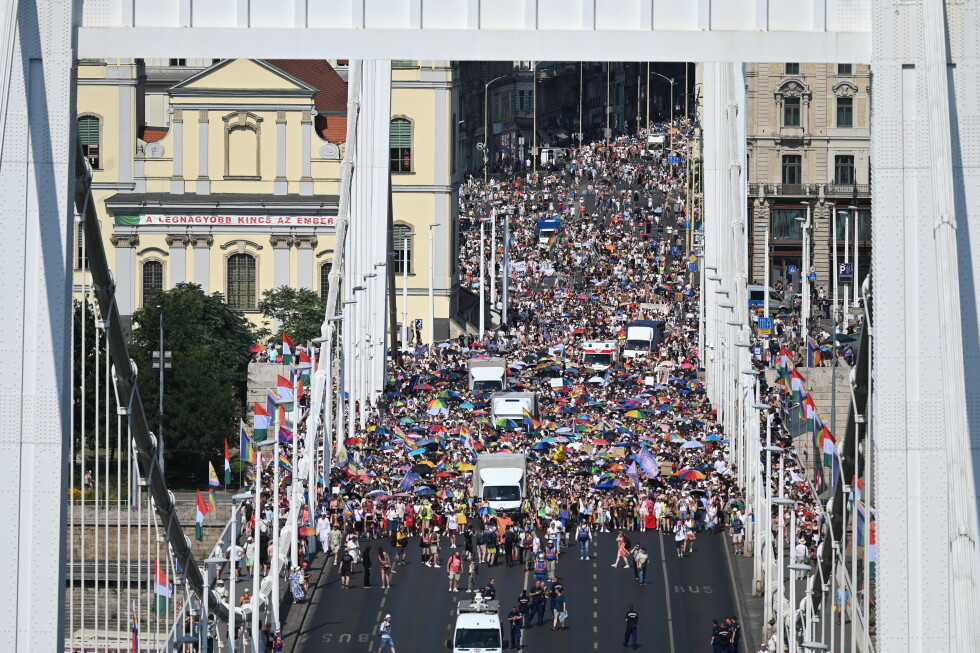
BUDAPEST, Hungary — Tens of thousands of Hungarians and their allies defied a record-breaking European heat wave to gather in the nation’s capital Saturday, marking the 31st annual Budapest Pride parade — the first fully authorized demonstration of its kind since populist former Prime Minister Viktor Orbán, who spent 16 years pushing anti-LGBTQ+ policies and attempted to ban the event entirely, was removed from power in April’s general election.
As temperatures climbed to a sweltering 38 degrees Celsius (100 Fahrenheit) amid the ongoing heat dome sweeping across most of the continent, event organizers made sure attendees stayed safe by distributing free bottled water, while Budapest’s public water utility activated additional public fountains along the entire parade route to offer constant access to cool water.
The procession kicked off at Budapest’s world-famous Hungarian State Opera House, winding through the bustling central streets of the capital before crossing the iconic Erzsébet Bridge spanning the Danube River that cuts through the heart of the city. LGBTQ+ Hungarians and their supporters danced to upbeat music, cheered, and waved vibrant rainbow flags as they marched, creating a mood of celebration and cautious optimism not seen at recent Pride events in the country.
Luca Új, a participant attending her third Budapest Pride march, noted a palpable shift in atmosphere compared to events held under Orbán’s administration. “There used to be a lot of tension when we marched. But now I see people as being somehow happier, and there are more older people joining too, which is a really nice change,” she shared.
Saturday’s event comes just over a year after Orbán’s nationalist-populist government pushed through both formal legislation and a constitutional amendment to outlaw Pride parades entirely, a move that sparked widespread condemnation from global human rights organizations and political leaders across the European Union. Even with the ban in place, 2024’s Pride event went forward as scheduled in open defiance of the government, drawing a record 350,000 attendees to become the largest demonstration in the event’s history. That massive turnout, which came despite months of government insistence the march would never be permitted, was widely seen as a major rebuke that weakened Orbán’s political standing ahead of the April election.
Orbán and his Fidesz party were handily defeated in the April vote by center-right challenger Prime Minister Péter Magyar and his opposition Tisza party. While Hungary’s new governing coalition has not yet formally repealed the Orbán-era ban on Pride events, national police granted full official authorization for this year’s march and deployed uniformed officers to provide security along the entire route.
Kristóf Györgyi, a first-time Pride attendee who traveled to the capital from the southern Hungarian city of Szeged, said he holds significant hope that the new government will move to expand equal rights for LGBTQ+ Hungarians, bringing the country into line with protections common across most of the European Union.
He pointed to ongoing parliamentary debate over adoption rights for same-sex couples — a debate that would have been unthinkable under the previous administration, which implemented a full ban on same-sex adoption and same-sex marriage. “The fact that there’s already a debate in Parliament about whether an orphaned child is better off with a loving same-sex couple or in an orphanage is a positive sign,” he explained. “Obviously, the laws haven’t changed yet, but there are already many signs of hope for our community.”
For more than a decade, Orbán’s government framed Pride celebrations — which are held globally to honor LGBTQ+ visibility and advance demands for equal legal and social rights — as a threat to children’s moral and spiritual development, a claim that has been repeatedly rejected by independent human rights groups and child development experts across the continent.
Just months before the election, in April 2025, the European Court of Justice — the EU’s highest judicial body — ruled that a 2021 Orbán-era law banning access to LGBTQ+ inclusive content for minors violates core European Union law, and breaches the bloc’s foundational treaty guarantees for human rights and legal equality.