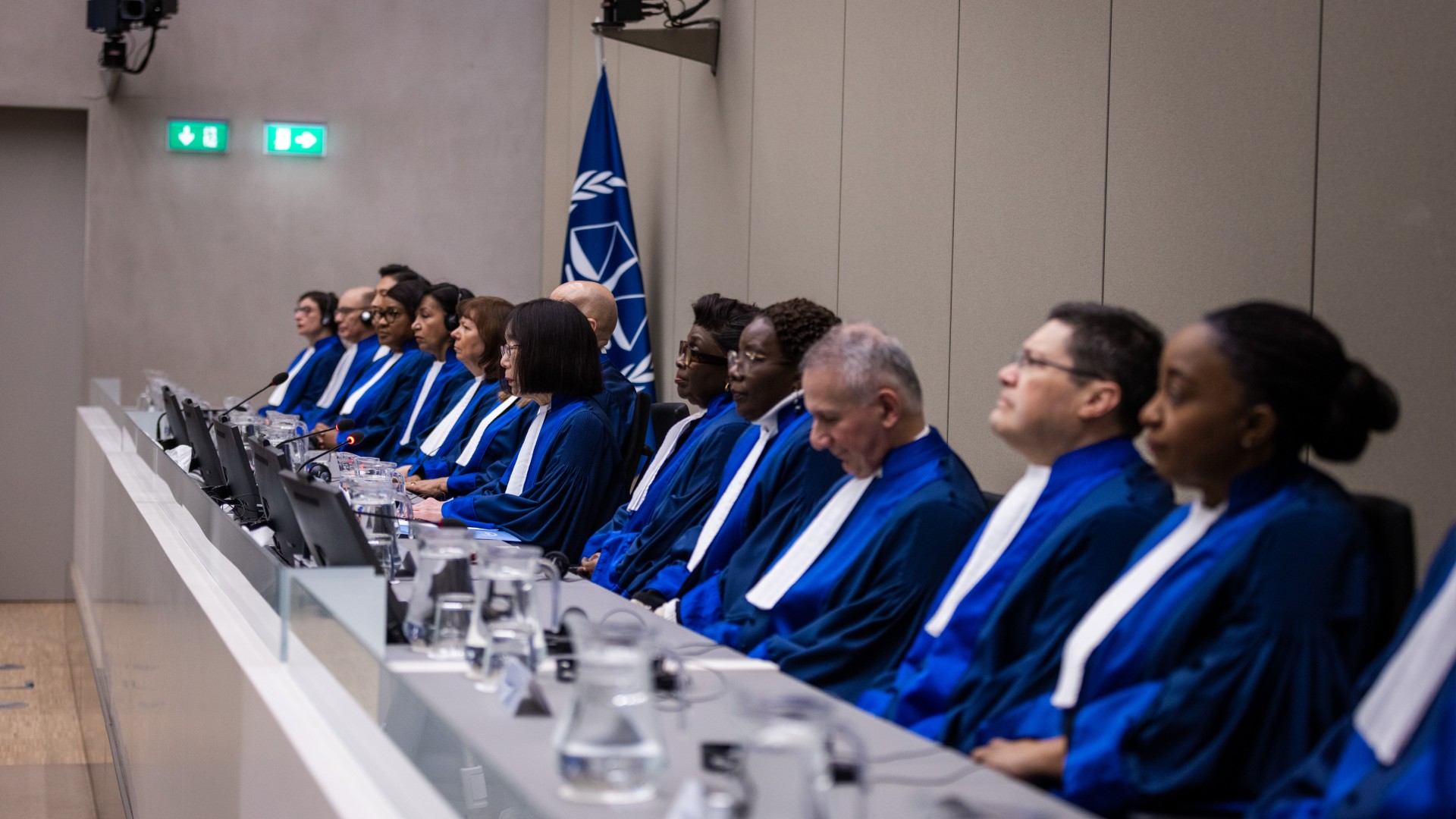
In a landmark legal challenge that has sparked global debate about judicial independence and the power of unilateral U.S. sanctions, three sitting International Criminal Court judges have detailed the devastating personal and professional harm inflicted by restrictions imposed by the former Trump administration, in a complaint filed last month in a New York federal court.
The penalties were enacted under Executive Order 14203, signed by then-President Donald Trump in February 2025, targeting the three jurists for official judicial rulings that ran counter to U.S. and Israeli political interests. All three judges—Kimberly Prost of Canada, Solomy Balungi Bossa of Uganda, and Reine Alapini-Gansou of Benin—have served on the ICC bench since March 2018. They are asking the court to strike down the sanctions, which they describe in their filing as “tantamount to a financial death penalty.”
Prost and Bossa were sanctioned for their participation in a 2020 Appeals Chamber decision that approved an ICC investigation into allegations of war crimes committed in Afghanistan, including claims of abuses by U.S. military and intelligence personnel. Alapini-Gansou was targeted for her role on Pre-Trial Chamber I, which issued widely publicized arrest warrants in November 2024 for Israeli Prime Minister Benjamin Netanyahu and former Defense Minister Yoav Gallant on charges of war crimes and crimes against humanity during the Gaza conflict.
The complaint, filed June 24 with the U.S. District Court for the Southern District of New York, lays out granular harms that have upended nearly every aspect of the judges’ daily lives, far beyond their professional work at the court based in The Hague. James Goldston, executive director of the Open Society Justice Initiative and co-counsel representing Prost, called the sanctions an “unprecedented attack on judicial independence.”
“They are trying to induce judges to refrain from deciding on the basis of facts and law, and instead take into account their own personal interests—that is the threats to their own financial and personal wellbeing imposed by these sanctions,” Goldston told Middle East Eye in an interview.
For Prost, the sanctions have dismantled nearly every ordinary financial service she relied on for decades. Her primary HSBC account in Midtown Manhattan has been frozen, leaving her unable to use credit cards even from institutions based outside the United States. While she retains limited banking access in parts of Europe and Canada, even routine domestic transfers within the European Union are regularly rejected or blocked by financial institutions complying with U.S. rules. When she travels outside the EU or Canada, she is forced to rely entirely on cash, as any currency conversion transaction that passes through the U.S. financial system is barred. Access to mainstream digital services has also been cut off: her accounts with Amazon, Google, and Expedia have been restricted or shut down entirely, turning routine tasks such as booking a hotel, ordering groceries online, hailing a rideshare, or purchasing public transit tickets into difficult or impossible undertakings. Most critically, Prost has lost access to health insurance; her existing provider has refused to pay out on any of her medical claims despite collecting her premium payments, and no other insurer will offer her coverage.
The harm to Bossa mirrors that of Prost: her account at the UN Federal Credit Union in New York, which she has held since 2003, has been frozen, locking away her personal savings. She is also barred from using credit cards, converting currencies through the U.S. financial system, paying dollar-denominated bills, or transferring funds between dollar accounts. Booking international travel and accommodation has become nearly impossible, and she has lost access to her personal Google email account, cutting off a critical line of professional and personal communication.
For Alapini-Gansou, who holds no U.S. bank accounts, the impact of the sanctions has still crossed borders, disrupting her life in Europe and West Africa. Her personal account in France has been restricted, and her French-issued credit card no longer works, leaving her unable to cover even basic daily expenses. Like the other two judges, she is barred from conducting any U.S. dollar transactions through the global financial system, making travel planning a major logistical barrier. She has also lost her health insurance coverage, with no alternative provider willing to take on her policy.
Beyond financial harm, Alapini-Gansou now faces direct threats to her physical security and freedom of movement. The complaint notes that she can no longer walk freely to the ICC’s headquarters in The Hague, and must now be transported by armed security detail for her own safety. She has reduced the frequency of visits to her home country of Benin out of caution, and even routine travel across Europe requires her to notify local law enforcement and arrange dedicated security protection, turning simple professional trips into complicated, stressful ordeals.
The sanctions have also forced Alapini-Gansou to step back entirely from her longstanding outreach work with African civil society. She has canceled all planned seminars and workshops for non-governmental organizations across the continent, fearing that any collaboration would expose the groups and their staff to severe legal penalties under the U.S. sanctions regime, which allows for up to 20 years of criminal imprisonment for U.S. citizens who provide services to designated individuals. In multiple instances, event organizers have asked her to withdraw from public participation entirely to avoid regulatory repercussions.
Professionally, the sanctions have isolated all three judges from longstanding professional communities. Prost, who has deep ties to the U.S. academic and legal community, has been barred from entering the U.S. to speak at engagements, and even virtual participation has been blocked. Last October, she was scheduled to deliver the opening keynote address at Fordham University’s annual International Law Weekend, hosted by the American Branch of the International Law Association, but was unable to attend in person or join remotely. She has indefinitely postponed a planned visiting trip to Vanderbilt University and abandoned plans to attend the 2026 annual conference of the American Society of International Law in Washington, D.C. At the December 2025 meeting of the ICC’s Assembly of States Parties, U.S.-based human rights NGOs reportedly received informal guidance to limit interactions with Prost, cutting her off from a professional network she engaged with freely for years. Bossa faces identical professional isolation, barred from U.S. speaking engagements and cut off from collaboration with U.S.-based human rights groups.
The harm of the sanctions has extended beyond the judges themselves to their immediate family members. Prost’s relatives in Canada, many of whom travel to the U.S. routinely for leisure and work, now avoid trips to the country out of fear of legal repercussions simply for being related to a sanctioned individual. Alapini-Gansou’s son abandoned his plans to attend law school in the U.S., a decision that will permanently alter his career trajectory, and one of her daughters, who works for an international NGO, has been forced to cancel all work-related trips to the U.S., disrupting her own professional progress.
Despite the severe personal and professional cost of the sanctions, all three judges have continued to fulfill their judicial obligations in line with their oaths of office. “Judges Prost, Bossa, and Alapini-Gansou have resisted this immense pressure because they are committed to upholding the rule of law, including by discharging their judicial duties faithfully and independently, despite the great personal cost,” the complaint states.