WARSAW, Poland — For 70-year-old Ewa Lutka-Krawczyk, a grim gallbladder cancer diagnosis brought not just fear for her own future, but overwhelming worry for the sweet shelter dog she had welcomed into her home three years prior. When she first received the diagnosis, her greatest plea to her care team was for just a few more years of life — enough time to ensure her deeply bonded dog Gaja would never be abandoned or left alone after her death.
This month, Lutka-Krawczyk was admitted to the palliative care ward of a Warsaw hospital, her prognosis progressing as expected. Left at home with the patient’s husband, Gaja has pined so deeply for her owner that she has barely touched her food. From her hospital bed, where Lutka-Krawczyk rests with an abdominal draining tube, she puts it simply: Gaja is just waiting for her.
A new piece of draft legislation moving through Poland’s parliament could soon change the situation for Lutka-Krawczyk and hundreds of other terminally ill patients across the country. If passed, the law would enshrine a universal legal right for palliative care and hospice patients to receive visits from their own companion animals. While many Polish clinics already allow pet visits on an informal, case-by-case basis, no nationwide legal protection for this practice currently exists.
The proposal was spearheaded by Dr. Tomasz Dzierżanowski, director of the Palliative Medicine Clinic at the Medical University of Warsaw — the facility where Lutka-Krawczyk is currently receiving care — and introduced to parliament by a lawmaker from Prime Minister Donald Tusk’s centrist civic party. Dzierżanowski framed the push for legal protection as a response to what he calls a modern “epidemic of loneliness” sweeping through society, a crisis that hits terminally ill patients especially hard.
“Our core mission is to ensure no patient dies alone,” Dzierżanowski explained in an interview with the Associated Press. “Ideally, that companionship would come from another person. But all too often, for many patients, there is no one.”
The doctor notes that this isolation impacts both older and younger palliative care patients. Many elderly patients have outlived their spouses, friends and extended family, leaving them without close connections in their final days. For younger patients, Dzierżanowski argues that the rise of digital communication and virtual social circles has prevented many from building the deep, lasting in-person friendships that sustained previous generations through life’s hardest moments.
Dzierżanowski’s push for legislation grew out of a deeply moving personal experience with a patient named Waldemar, a terminally ill cancer patient who expressed no fear for his own passing — only crippling worry about what would happen to his two cats after he died. After Dzierżanowski arranged to bring the cats into the ward for a final visit, the overwhelming emotion of the reunion — Waldemar’s tears of joy, the cats’ obvious relief at seeing their owner, and the reaction of other patients and staff who witnessed the moment — convinced him the issue needed formal, systemic change.
“Seeing that reunion made me realize this issue could no longer be ignored,” he said.
Under Dzierżanowski’s current clinic policy, pet visits are already permitted when the clinical environment allows, meaning Lutka-Krawczyk will soon get to see Gaja even before the legislation becomes law — a development that brought her immense comfort when she learned the news.
Katarzyna Piekarska, the legislator who formally introduced the bill, which is currently under review by parliament’s health committee, noted that informal pet visits are already common across many Polish care facilities. “In reality, animals are already in hospitals anyway,” she said. “That is why this practice needs clear formal regulation in the law.”
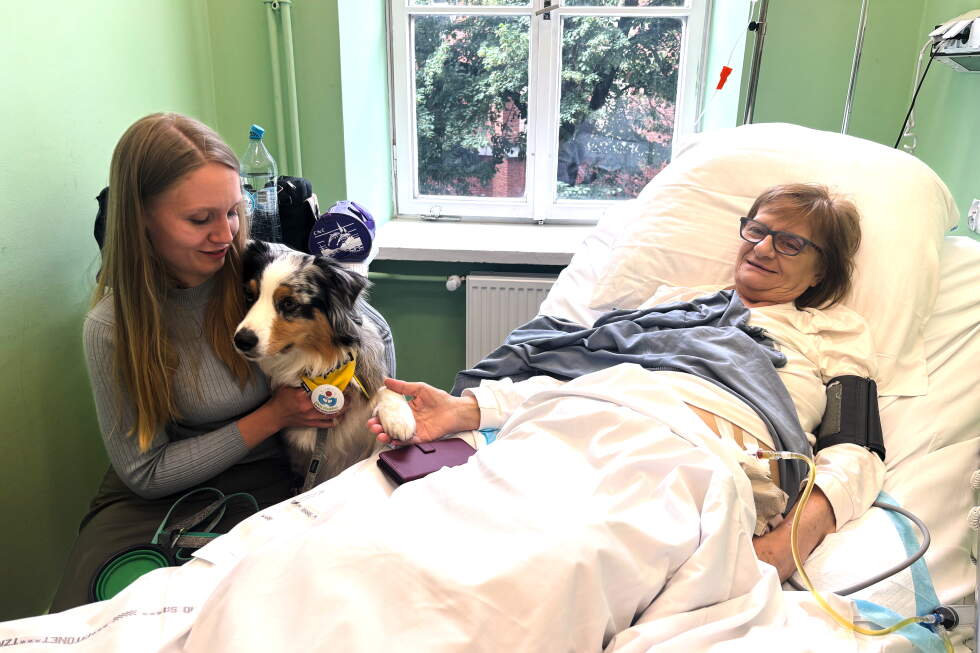
Beyond visits from patients’ own pets, the clinic already hosts regular visits from therapy dogs, with tangible benefits for patients and staff alike. During an AP visit to the ward, an Australian shepherd named Kluska — whose name translates to “dumpling” in Polish — made her regular rounds with her owner, medical student Małgorzata Brzozowska. Kluska brought a much-needed moment of joy to Lutka-Krawczyk, who held the dog’s paw and smiled through her discomfort. For 58-year-old Wojciech Zelik, a patient admitted for tumor care, the visit offered a lighthearted break from his treatment: as Brzozowska walked Kluska through her routine tricks, Zelik propped himself up in bed to admire the dog, noting “she has such lovely, fluffy fur to pet.”
Brzozowska explained that therapy dog visits don’t just help patients — they also ease the chronic stress that clinical staff experience while caring for terminally ill patients. During Kluska’s visit, multiple nurses and even the hospital cook paused their work to greet her in the hallway, with the cook slipping the dog slices of ham as a treat.
Still, Brzozowska emphasized that the emotional benefits of a visit from a patient’s own pet far outweigh those of a therapy animal visit. Reuniting a patient with their beloved companion calms the patient, comforts their family members, and eases the stress of the pet, who often grows anxious when their owner suddenly disappears from the home.
“The dog isn’t as stressed when they see their owner,” she explained. “We think that means they understand what’s happening — they know where the person who was always with them has gone.”