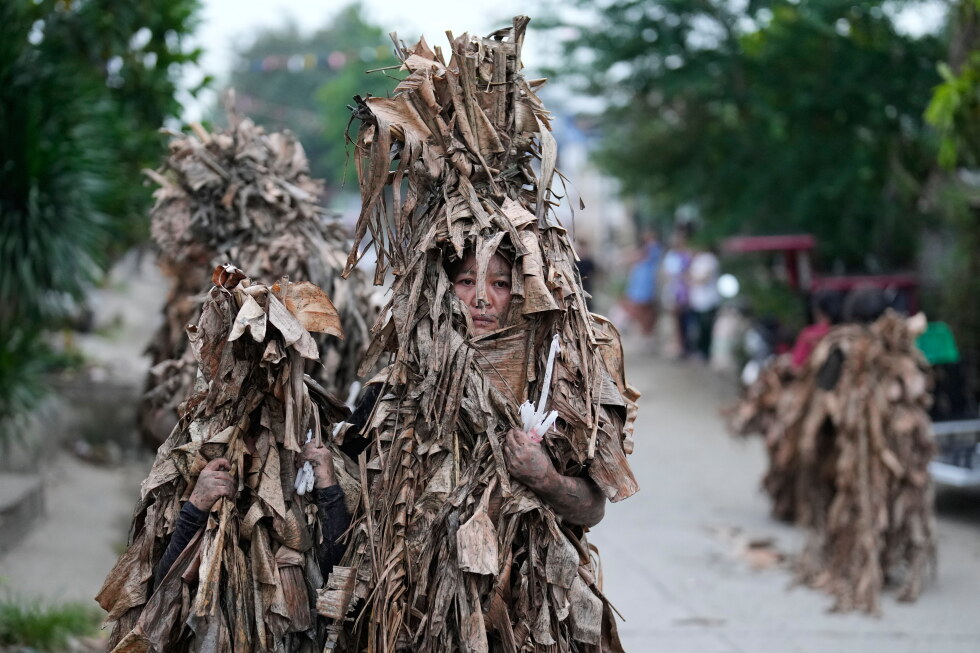
On June 24, 2026, hundreds of devout Catholic worshippers gathered in the small rural village of Bibiclat, located in Nueva Ecija province in the northern Philippines, to carry out a centuries-old ritual of faith honoring St. John the Baptist. For the annual Taong Putik, or Mud People, festival, these devotees traded their ordinary clothes for a covering of thick soft mud scavenged from local rice paddies, followed by layers of dried banana leaves wrapped around their bodies, continuing a tradition that ties deeply personal piety to centuries of communal history.
The tradition traces its origins back to the 1800s, rooted in humble beginnings shaped by historical hardship. Local church leaders record that poor 19th century farmers began the practice as an outward act of humility before God; the mud symbolized their connection to the land they worked, while the dried banana leaves allowed them to hide their identities, shielding themselves from widespread discrimination targeting low-income rural communities at the time.
The devotion to St. John the Baptist grew dramatically in the decades following World War II, after a pivotal event that local residents still frame as divine intervention. According to the Rev. Elmer Villamayor, who led the Bibiclat parish between 2014 and 2021, a group of local men were set to be executed by Japanese occupying forces, when a sudden, heavy rainstorm halted the execution entirely, sparing their lives. Local worshippers widely interpreted this turn of events as a miracle granted by their patron saint, cementing the festival’s central role in the village’s spiritual life.
Today, the festival carries on as a way for devotees to honor vows made in private prayer and give thanks for answered miracles and personal blessings. While no official attendance counts are maintained, Villamayor estimates that as many as 3,000 worshippers now participate each year, a number that has grown steadily in recent years as more people report personal blessings through their devotion.
For many participants, the ritual is a multi-generational family tradition, passed down through generations after answered prayers. Melencio Nenuda, a 39-year-old construction worker, recalled that as a child the sight of mud-covered procession participants frightened him so much that he would hide when they passed through the village. That changed when he fell seriously ill in sixth grade: his mother prayed to St. John the Baptist, vowing that Nenuda would join the annual ritual if he recovered. Now, Nenuda returns every year, alongside his wife and son. “I will continue to go back to this tradition because it gives me a good future,” he explained.
Forty-three-year-old Rickmar Castilio, who has participated in the festival for 20 consecutive years, brought his 11-year-old son Nathan for the first time in 2026, carrying out a vow he made years earlier. After Castilio lost his first child in infancy, he promised St. John the Baptist that he would return for the ritual every year if his next child survived. After his prayer was answered, he has kept his promise annually, and now aims to pass his devotion on to the next generation. “(I bring my child so) that he will get closer to St. John. The youth now are starting that path,” Castilio said. He added that he has observed a steady rise in participation in recent years, noting that growing numbers of worshippers are drawn to the tradition after experiencing personal miracles or seeing blessings in their own lives.
The ritual follows a strict, familiar schedule that has remained unchanged for generations. Devotees begin their preparations before dawn, heading out to the surrounding rice fields around 4 a.m. to collect soft mud, which they smear across their entire bodies before wrapping themselves in dried banana leaves. Once fully prepared, they walk barefoot back to the village’s St. John the Baptist Church, carrying only lighted candles and their cellphones. As they wait for the start of the celebratory Mass, they gather to sing hymns around a small fire lit from the accumulated candle offerings.
The Philippines is home to the largest Catholic population in Asia, and the Taong Putik festival remains one of the nation’s most distinctive examples of folk Catholicism, blending centuries of indigenous rural tradition with formal Catholic devotion. This report is from the Associated Press, with religious coverage supported through AP’s collaboration with The Conversation US, with funding from Lilly Endowment Inc. The AP holds sole responsibility for this content.