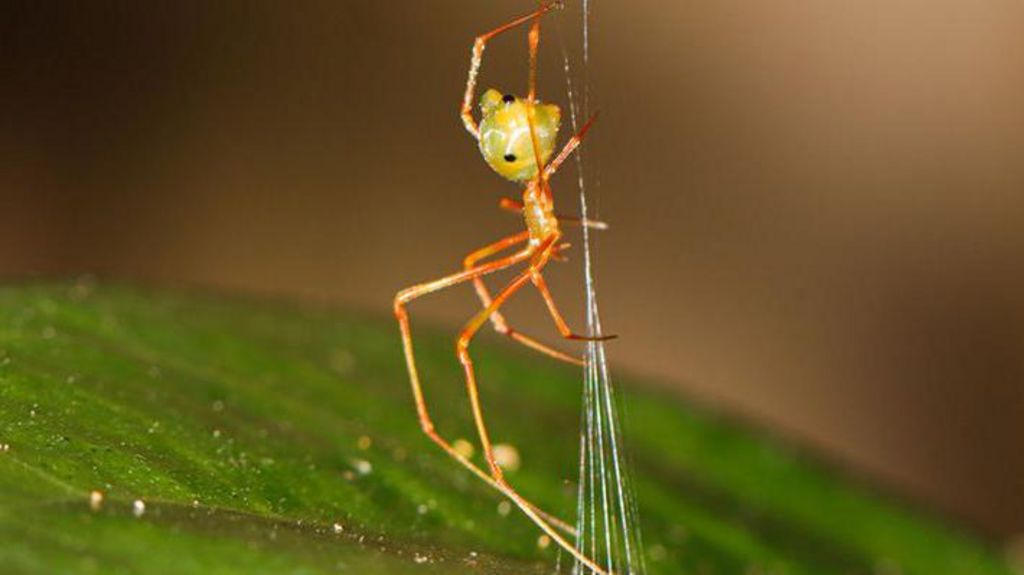
In the remote, dense rainforests of northern Queensland, Australia, a team of researchers from Macquarie University has uncovered a remarkable new species of spider with a one-of-a-kind hunting strategy that has stunned arachnid biologists. The tiny arachnid, already nicknamed ‘ballista’ after the ancient stone-hurling battle weapon, has evolved a specialized catapult-like silk trap built exclusively to catch a single, dangerous target: aggressive green tree ants (*Oecophylla smaragdina*).
Lead researcher Professor Ajay Narendra explained that targeting this notoriously risky prey required a completely unprecedented evolutionary adaptation. Green ants are formidable opponents for most spiders: they carry powerful chemical defenses, many can deliver painful stings, and they can call in swarms of backup colony members within minutes to overwhelm predators. To overcome these risks, the ballista spider developed a hunting mechanism that delivers what researchers call “exceptionally high power” to subdue prey before it can mount a defense.
To document the spider’s unique behavior, the research team spent 10 nights conducting field observations in the tropical rainforest, capturing the trap mechanism using high-speed and infrared imaging technology. Their findings, published in the peer-reviewed journal *Current Biology*, detail the spider’s careful, hours-long trap-building process.
During daylight hours, the ballista spider hides in small silk nests on the undersides of leaves on trees occupied by green tree ant colonies. After night falls, it descends roughly 50 centimeters to a nearby leaf, branch, or forest floor to begin construction. First, it anchors the trap with a sturdy silk anchor line. It then builds a cone-shaped scaffold made up of dozens of tensioned silk lines, before wrapping the entire structure in a thinner, more elastic silk layer and retreating back up to a waiting position above the trap.
When a green tree ant approaches the snare and bites the silk, the tensioned structure triggers instantly, hurling the ant upward into a larger capture web above with extraordinary force. Researchers calculate the acceleration generates g-forces 15 times higher than the maximum extreme g-forces experienced by fighter jet pilots — a level of power never before recorded in a spider’s web.
After the ant is launched into the upper web, the spider waits until the prey is fully immobilized before moving in to feed, eliminating any risk of counterattack from the ant. What makes this adaptation even more unusual is the spider’s extreme prey specificity: tests showed the ballista spider only catches green tree ants, even when other species of nocturnal ants were placed within reach of the trap. Researchers suspect the spider lures green ants specifically by adding species-specific pheromones to the trap silk, a strategy that triggers the ants to attack the structure unknowingly.
Professor Narendra noted that this discovery breaks new ground for arachnology. “This seems to be the only case where a spider’s web is designed to catch a single prey species, and where the mechanism is triggered by the prey rather than by the predator,” he said. Co-researcher Dr. Jonas Wolff added that the trap mechanism evolved as a highly specialized way for the tiny spider to pick off individual hazardous ants one by one, moving them to a safe distance far from ant trails and colonies before the prey can alert the rest of the colony.
The new species belongs to the genus *Propostira*, and was first spotted by Greg Anderson, a biomedical researcher and amateur arachnid researcher and photographer, before the formal study was launched. It is yet to receive a formal scientific name, but the common nickname ‘ballista’ has already been widely adopted by the research team in reference to the extreme speed and force of its hunting weapon.