Keir Starmer’s sudden resignation as British prime minister, delivered less than two full years after he secured a historic landslide general election victory, has brought a abrupt end to a premiership undone largely by his inconsistent and deeply unpopular approach to Israel’s military campaign in Gaza. The collapse of Labour’s public support has benefited rising right-wing party Reform UK and left-wing rivals the Green Party, with new polling confirming more Labour voters defected to the Greens than to Reform in last month’s local elections.
A recent survey of former Labour supporters who plan to back another centre-left or left-wing party in the next general election found that more than half cited UK collaboration with what they frame as Israel’s genocide in Gaza as the primary reason for abandoning Starmer’s party. These findings underscore how the Gaza conflict, and Starmer’s response to it, has come to define his toxic political legacy.
Critics across the UK left have condemned Starmer’s tenure as a betrayal of core progressive values. His predecessor as Labour leader Jeremy Corbyn told Middle East Eye that Starmer “swapped political principles for corporate donors – and leaves behind a legacy of broken pledges, grotesque inequality and complicity in genocide. If that isn’t moral bankruptcy, then what is?” Green Party leader Zack Polanski offered an equally scathing assessment, listing “shit in our rivers, pensioners jailed for protesting, migrants thrown under the bus, supporting a genocide” as Starmer’s core contributions to public life.
To understand the roots of Starmer’s political downfall over Gaza, it is necessary to trace his shifting positions from his time in opposition through his premiership. The conflict began on 7 October 2023, when a Hamas attack killed roughly 1,200 people in southern Israel. In the months that followed, Israeli military operations in Gaza killed nearly 73,000 Palestinians, wounded more than 170,000, and left thousands more missing and presumed dead beneath the rubble of destroyed infrastructure.
Immediately after the 7 October attacks, while still leading the Labour opposition, Starmer aligned firmly with the then-Conservative government’s pro-Israel stance. In an 11 October 2023 interview with LBC, when asked whether Israel’s siege of Gaza – involving cuts to power and water access for the entire enclave – was appropriate, Starmer replied: “I think that Israel does have that right, it is an ongoing situation, obviously everything should be done within international law but I don’t want to step away from the core principles that Israel has the right to defend herself.” He refused to condemn the collective punishment of Gaza’s civilian population for days, only issuing a partial retraction of his comments on 20 October.
That same November, Starmer ordered all Labour Members of Parliament to reject a Scottish National Party (SNP) parliamentary motion calling for an immediate end to the collective punishment of Palestinians. Weeks later, after an Israeli strike on a Gaza refugee camp killed more than 50 civilians alongside a Hamas commander, Starmer’s shadow foreign secretary David Lammy argued that “it’s clear to me that it’s wrong to bomb a refugee camp but clearly if there is a military objective it can be legally justifiable.”
In early 2024, Starmer was accused of undermining parliamentary procedure to block a ceasefire motion: reports emerged that he had lobbied House of Commons Speaker Lindsay Hoyle to break with longstanding convention and allow a watered-down Labour motion to be debated ahead of a stronger SNP ceasefire proposal, effectively killing the latter. The move triggered widespread procedural chaos, with SNP and Conservative MPs walking out of the chamber in protest before Labour’s watered-down amendment passed.
It was not until later in 2024 that Labour began to draw modest distinctions between its position and that of the outgoing Conservative government. Lammy called on the Conservative administration to publish legal advice it had received on arms sales to Israel, accusing the then-foreign secretary of avoiding democratic scrutiny. In May 2024, Labour broke with the Tories to back the International Criminal Court after its chief prosecutor announced applications for arrest warrants for senior Israeli ministers.
Once in office, Starmer maintained Britain’s deep military and intelligence cooperation with Israel throughout the campaign in Gaza. Under his premiership, the Royal Air Force conducted at least 518 surveillance flights over Gaza, with British officials claiming the flights were “solely to locate hostages” despite the operation being shrouded in official secrecy. British intelligence collected from these flights was shared directly with Israeli forces, including footage captured on days when Israeli strikes killed British citizens in Gaza.
One high-profile case that exposed the secrecy around this cooperation was the April 2024 Israeli strike on a World Central Kitchen aid convoy that killed seven aid workers, including former British Royal Marine James Henderson. The UK Ministry of Defence (MoD) held RAF surveillance footage of the strike site from the day of Henderson’s death, but repeatedly refused to release the footage under Freedom of Information requests, citing national security and defence exemptions.
Starmer’s government also enshrined legal protections for roughly 2,000 British-Israeli dual nationals who served in the Israeli military during the Gaza campaign, formally recognising “the right of British dual nationals” to serve in Israeli operations.
While Starmer never fully broke with the UK’s longstanding pro-Israel posture, his government did adopt some limited policy shifts that put it at odds with the Israeli leadership. Most notably, Starmer’s administration ended Britain’s longstanding objection to the ICC’s jurisdiction over territories occupied by Israel, and imposed sanctions on far-right Israeli cabinet ministers Itamar Ben Gvir and Bezalel Smotrich. In June 2026, it became the first British government to formally announce “that there should be no economic involvement in illegal Israeli settlements” in the occupied West Bank, and joined France, Norway, Canada, New Zealand and Australia in imposing new sanctions on networks that fund and enable violent settler attacks against Palestinians. Even so, Starmer resisted widespread calls from his own backbenchers to implement a full ban on imports of goods produced in illegal settlements.
The most contentious domestic and international debate surrounding Starmer’s Gaza policy centered on UK arms sales to Israel. In September 2024, shortly after taking office, Starmer’s Labour government suspended roughly 30 direct arms export licenses to Israel after an official assessment concluded there was a “clear risk” UK-made weapons could be used to commit serious violations of international humanitarian law in Gaza. This included a suspension of licenses for direct exports of F-35 fighter jet components to Israel. Critically, however, components sent to a global F-35 spare parts pool – which can still be diverted to Israeli aircraft – were exempted from the ban.
UK-made components make up 15 percent of every F-35, one of the most advanced fighter jets in the world, which Israel deployed extensively across its Gaza campaign as well as strikes in Lebanon and Iran. The Starmer government argued that a full halt to all F-35 component exports would disrupt the entire global F-35 fleet and threaten international security, justifying the partial ban.
Even with the partial suspension, Starmer’s government approved $169 million in new military exports to Israel in just three months – more than the total value of arms approvals granted by the Conservative government between 2020 and 2023. Lammy, who served as foreign secretary under Starmer, told parliament that most of the exports were “defensive in nature” such as helmets and goggles, and “not what we describe routinely as arms.” Official records show the shipments included 8,630 separate munitions exports classified as “bombs, grenades, torpedoes, mines, missiles and other similar munitions.”
Starmer faced the most damaging internal criticism in March 2025, when a close ally and former cabinet member accused him of deliberately suppressing evidence of Israeli war crimes. Former Health Secretary Wes Streeting told the News Agents podcast that he had shared a dossier of war crime evidence collected by British doctors who had worked in Gaza, only for Starmer to accuse him of leaking the document for political gain. Streeting explained: “I had met British doctors, I had been distressed by what they told me, I had seen serious and substantial allegations of war crimes being committed and I felt this country had a moral and legal responsibility to respond.” Starmer has consistently refused to publicly describe Israeli actions in Gaza as war crimes, and previously walked back comments by Lammy that Israeli operations amounted to a “breach of international law.”
Throughout his premiership, Starmer’s Gaza policy was marked by growing contradictions. In July 2025, his government announced it would formally recognise a Palestinian state, but infuriated left-wing Labour MPs by tying recognition to a series of preconditions related to Israeli security demands. It ultimately extended recognition in September 2025, triggering a furious diplomatic backlash from the Israeli government.
These contradictions extended to other areas of foreign policy as well. After aligning closely with United States foreign policy during his time in opposition, Starmer clashed with US President Donald Trump earlier this year even as he continued to cooperate with US military operations against Iran. Starmer initially announced Britain would not participate in February 2026 US strikes on Iran, and told the US it could not use British military bases for the attacks. He quickly reversed course, however, allowing the US to launch strikes on Iranian missile sites from British bases – a move legal experts described as a violation of international law. Starmer then campaigned in last month’s local elections on the claim that he had kept Britain out of the war with Iran.
At home, Starmer’s government drew accusations of authoritarianism for its crackdown on pro-Palestinian advocacy. In July 2025, Home Secretary Yvette Cooper designated direct action group Palestine Action as a proscribed terrorist organisation, making any public expression of support for the group a criminal offence punishable by up to 14 years in prison. The High Court initially ruled the proscription was “unlawful” and “discriminatory” following a legal challenge by group co-founder Huda Ammori, but the Court of Appeal overturned that ruling last week after a government appeal. Since the ban was first introduced, thousands of people across the UK have been arrested on terrorism charges for holding pro-Palestine Action signs at silent vigils.
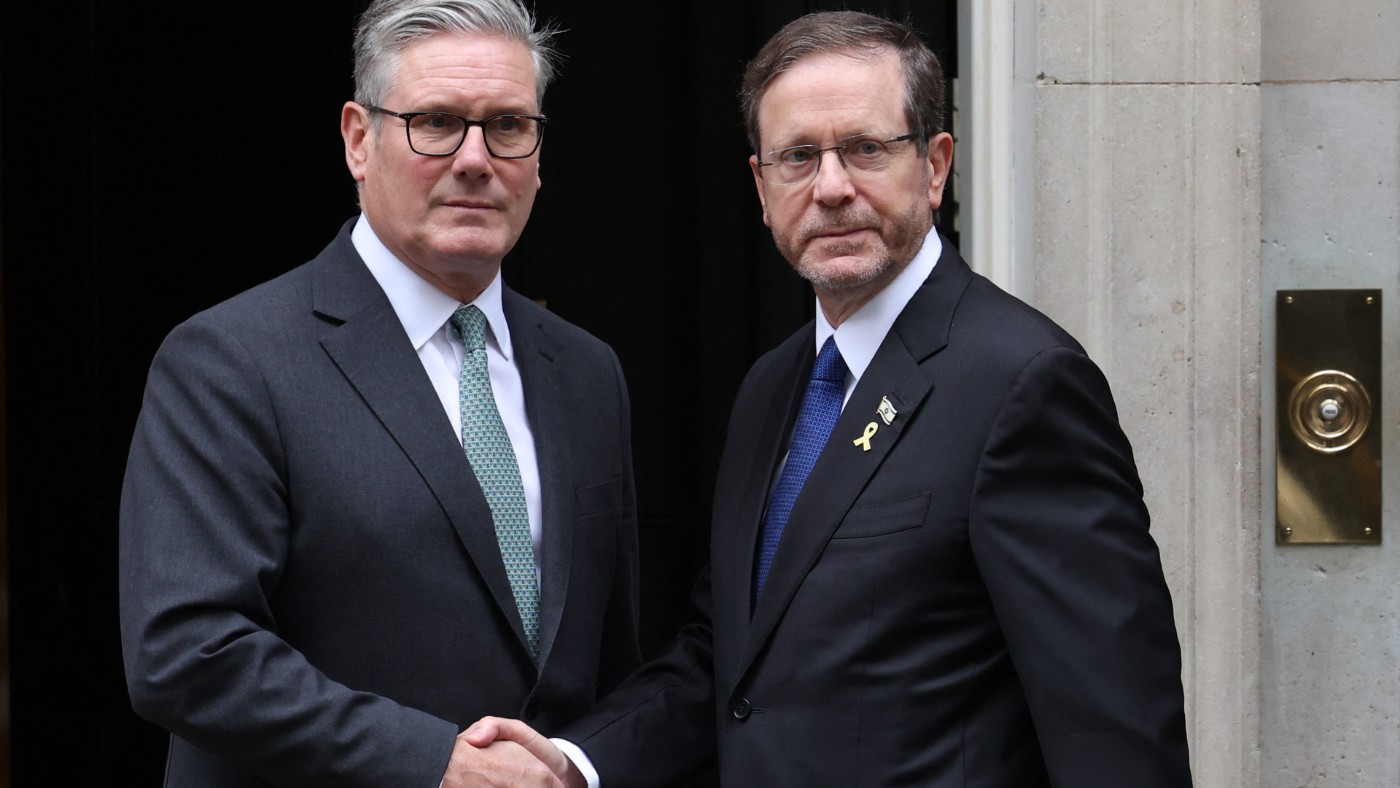
Last month, high-profile American progressive political commentators Cenk Uygur and Hasan Piker were barred from entering the United Kingdom, a move widely attributed to their public criticism of Israel. By contrast, senior Israeli military and political figures have remained welcome in the UK under Starmer: in November 2024, Israeli military chief Herzi Halevi made a secret visit to London to meet UK Attorney General Richard Hermer, and the government granted him special diplomatic immunity for the trip. Israeli Foreign Minister Gideon Saar visited in April 2025 to meet Lammy, and Israeli President Isaac Herzog held a formal meeting with Starmer in London that September.
Rohan Talbot, director of advocacy and campaigns at Medical Aid for Palestinians, summed up the widespread criticism of Starmer’s legacy on Monday, saying: “Starmer’s ‘international record will forever be marred by half measures and inaction in the face of Israel’s atrocities. Under Starmer’s leadership, the UK continued to provide arms to Israel while its forces bombed Gaza’s hospitals into rubble and deliberately starved an entire population of the food and medicines they needed to survive.”
Ultimately, Starmer’s inconsistent approach to Gaza left him unpopular with virtually all segments of the British electorate. He imposed a partial arms embargo but rejected a full ban, shared British intelligence with Israel while calling for an end to the war, and left office facing accusations from his own former cabinet of covering up evidence of war crimes. It remains to be seen whether the next British prime minister will shift course on UK policy toward Israel and Gaza.
This article is produced by Middle East Eye, an independent outlet providing unrivaled reporting and analysis of the Middle East, North Africa and global issues connected to the region.