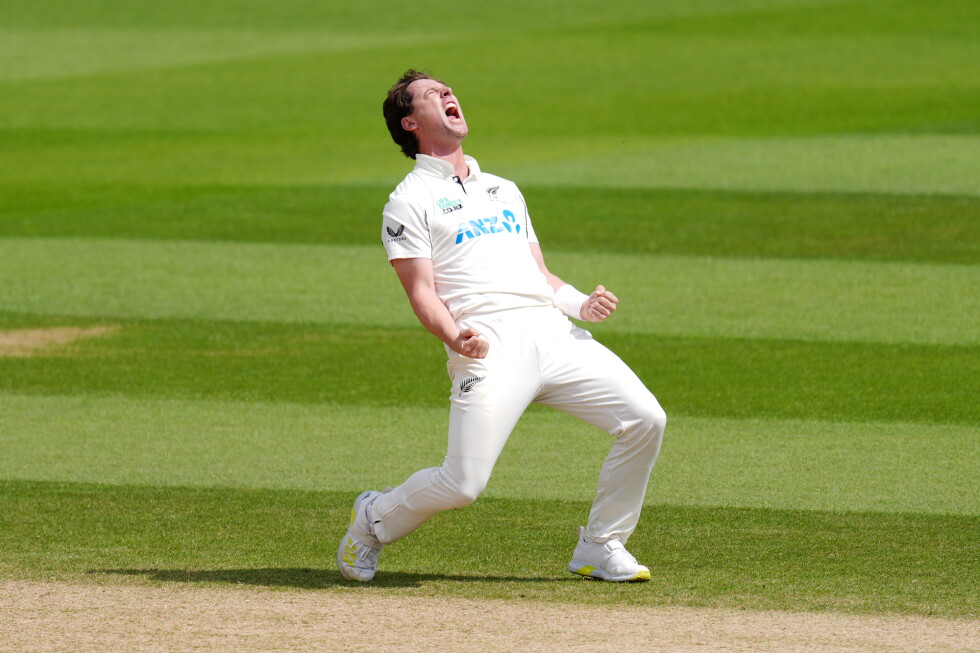
On the fifth and final day of the second Test between New Zealand and England at London’s iconic Oval ground, fast bowler Matt Henry produced a career-defining performance to deliver a crushing 253-run victory for the Black Caps, pushing the three-match series to a decisive decider in Nottingham kicking off this Thursday.
England resumed play on Sunday morning at 182 for five wickets, chasing an improbable 463 runs to secure victory. What followed was a relentless masterclass in fast bowling from Henry, who ripped through the hosts’ lower order to claim the final five wickets in just 31 balls, a stretch that yielded only three runs. By the end of the innings, Henry finished with sensational figures of six wickets for 29 runs, combining this with his first-innings five wickets for 80 runs to end the match with 11 wickets for just 109 runs.
This extraordinary haul marks the best match bowling figures ever recorded by a New Zealand seamer against England, and also marks Henry’s first 10-wicket match haul across his 35-Test career. He is also the first bowler to claim 10 wickets in an Oval Test since legendary Australian spinner Shane Warne during the 2005 Ashes series, and the first fast bowler to hit the milestone since Devon Malcolm’s 1994 performance against South Africa.
Henry’s late-match spell included two consecutive double-wicket maidens that removed England star Joe Root, Jofra Archer, Matthew Fisher and Josh Tongue. The seamer even came within one delivery of a hat trick, only for Jordan Cox to successfully defend the final ball. Root, who carried England’s last faint hope of a comeback overnight on 75, added just two more runs before he was trapped lbw between bat and pad, ending his innings at 77 off 145 balls. His review of the decision was rejected, and England’s chances of a win departed with him.
Archer fell to an unplayable delivery that skidded under his bat, ending his innings on a two-ball duck, while Fisher chopped onto his own leg stump and Tongue edged a catch to first slip—both batters gone without scoring. Henry celebrated his milestone five-wicket innings haul and 10-wicket match haul with a quiet roar before he was mobbed by his celebrating teammates. Cox, who resumed on zero, managed a quick 25 runs before he was bowled attempting a sweep, bringing the match to a close just 48 minutes after play began on the final day. Tailender Sonny Baker failed to score.
This win marks only New Zealand’s seventh Test victory in England across 95 years of touring, and just their second at the Oval, with the last coming back in 1999. It follows a dominant England victory at Lord’s in the first Test of the series, setting up an all-or-nothing decider in Nottingham.
For Henry, the historic performance marked a personal redemption arc. The senior seamer suffered back spasms on the first morning of the Lord’s Test, leaving him sidelined and unable to contribute meaningfully to the team’s effort. A 10-day break between matches allowed him to make a full recovery heading into the second Test.
“It feels bad when you let the guys down on day one at Lord’s,” Henry told reporters after receiving the Player of the Match award. “It was great to come here and get my quota out. I didn’t expect it to unfold like that today but probably saved a hot day in the field.”
Henry credited his wicketkeeper Tom Blundell for a key tactical contribution that unsettled England’s batters, noting Blundell’s decision to stand up to the stumps while he bowled kept batters guessing at the crease. “Having a world-class operator like Tom is huge,” he said. “He’s always up for it. You can’t do it unless you’ve got someone good behind the stumps. We know England like to create a flow of runs.”
Beyond Henry’s magical bowling performance, the Black Caps’ win was built on strong contributions across the side, Henry noted. Kyle Jamieson claimed four wickets in the match after a standout bowling spell on Saturday evening, while Glenn Phillips hit his maiden Test century in New Zealand’s first innings to put the Black Caps in a commanding position. Henry Nicholls added a second century in the second innings, combining with Rachin Ravindra for a massive partnership that effectively batted England out of the contest before the final day.
“Little moments in the first innings set the platform for the ball to get soft and Glenn to do his thing,” Henry said. “Top order did a job for us. The way the guys applied themselves with the ball, we talked about being relentless and different from each end. We stuck at it and got the rewards.”