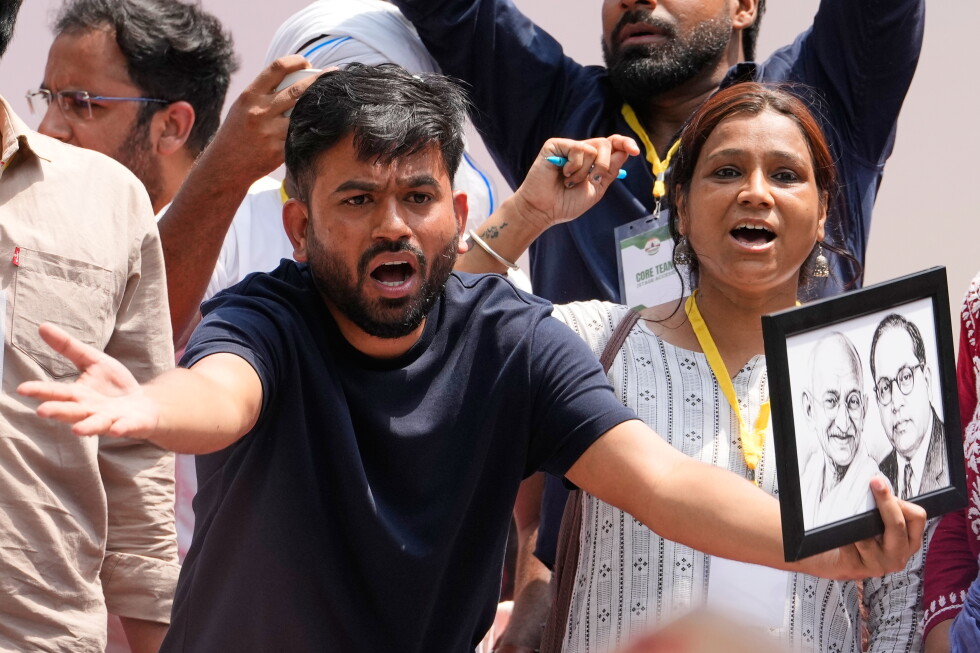
Hundreds of young Indian supporters of the viral grassroots movement Cockroach Janta Party (CJP) gathered near India’s Parliament in New Delhi on Saturday, staging a noisy, creative demonstration that ratcheted up political pressure on Prime Minister Narendra Modi’s incumbent government. Protesters called for the resignation of Union Education Minister Dharmendra Pradhan, responding to widespread public anger over persistent examination irregularities and multiple high-stakes exam paper leaks that have upended the futures of thousands of student candidates across the country.
In a display of unconventional protest, participants banged steel plates with wooden spoons to create a raucous din, while many carried hand-drawn placards highlighting their grievances. Deepak Kumar, one of the CJP supporters who spoke on-site at the demonstration, warned that the demonstration was only an opening step. “This is just the beginning,” Kumar said. “If Dharmendra Pradhan does not resign, and no meaningful action is taken to resolve this issue, this protest will not end here.”
The immediate trigger for the demonstration was last month’s leak of the entrance exam for a nationwide postgraduate medical program, which was shared widely via the messaging platform Telegram. Indian authorities responded by postponing the scheduled exam, imposing a temporary nationwide ban on Telegram’s services, and launching an official investigation into the breach. The rescheduled exam is set to be held this coming Sunday, with the government still yet to release findings from its ongoing probe.
For Vicky Kumar, a participating student, the repeated leaks represent a devastating betrayal of years of hard work for low-income youth like himself. “We study in poverty, live in poverty 24 hours a day, for years on end, and after all that, our exam papers get leaked,” he told reporters. “Will I not get angry at that?”
Local law enforcement responded to the demonstration by deploying heavy security personnel across the area, and used both fixed surveillance cameras and aerial drones to monitor the crowd and track protest activity, a common precaution for demonstrations held near India’s central legislative complex.
The CJP is a newly emerged grassroots political movement that took its unusual name from an offhand comment by a Supreme Court judge that sparked national outrage. In May, Supreme Court Justice Surya Kant made remarks comparing a group of unemployed young protestors to “cockroaches,” a comment that drew widespread condemnation from youth groups across the country. Instead of rejecting the label, unemployed young activists embraced it as a badge of resilience, adopting the name Cockroach Janta Party — or Cockroach People’s Party — and building a massive online following in just a few months.
The movement has gained viral traction across Indian social media, boasting more than 22 million followers on the platform Instagram alone. CJP’s political identity blends self-deprecating internet humor with sharp criticism of government policy: supporters jokingly refer to themselves as “unemployed and chronically online,” while viral memes and short videos mocking systemic unemployment, institutional corruption, and political dysfunction have racked up hundreds of millions of views across social platforms. The movement’s messaging has expanded far beyond its origins to encompass broad popular grievances including widespread youth unemployment, skyrocketing living costs, and demands for greater government accountability. The cockroach symbol has even been adopted by dozens of parody political accounts, cementing its status as a viral satirical symbol of youth discontent with the status quo.