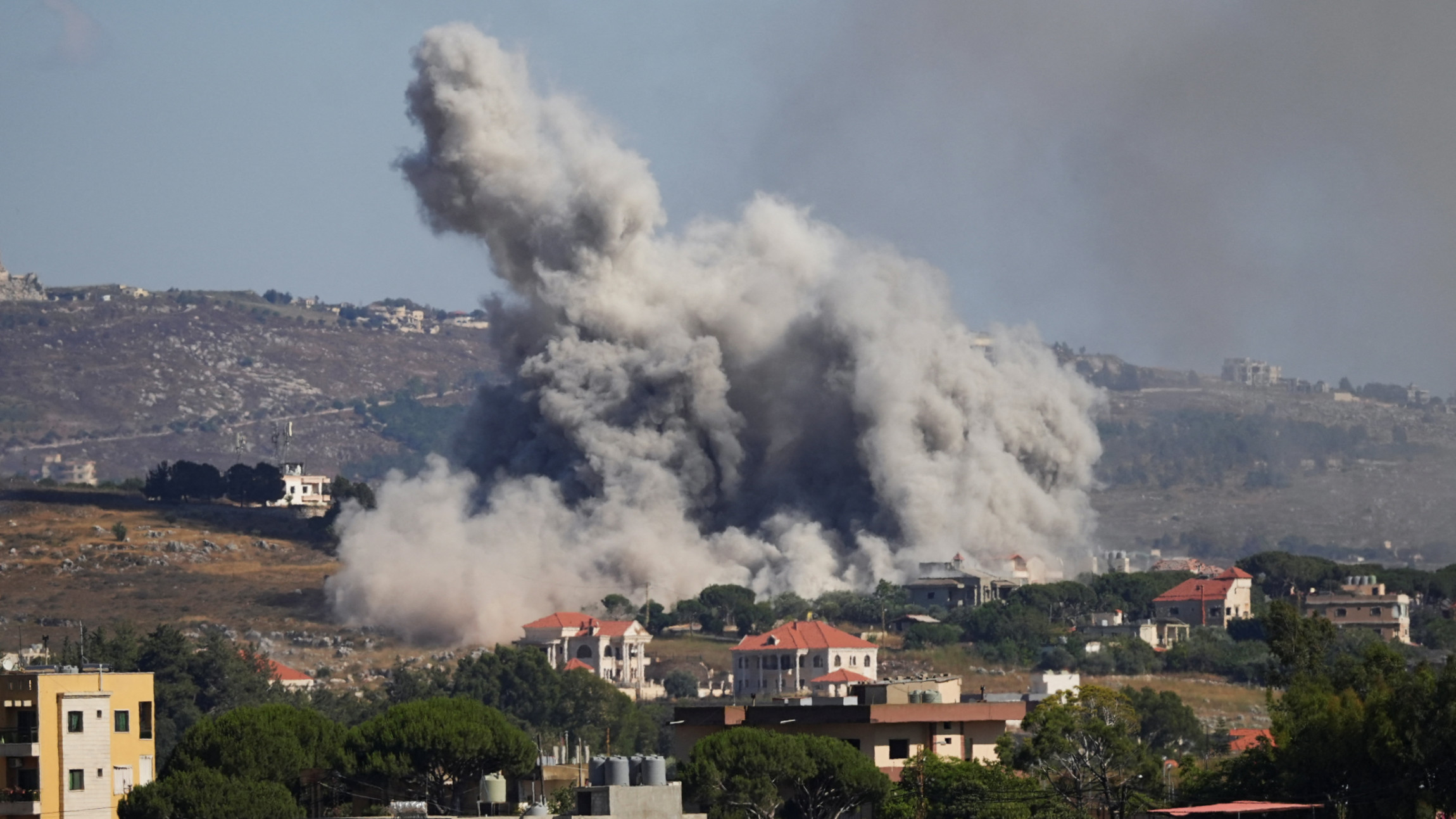
Just 24 hours after the United States and Iran finalized a broader agreement aimed at ending cross-regional hostilities, a dramatic surge in clashes between Israel and Lebanon’s Hezbollah pushed the Middle East to the brink of a wider regional war, before the two parties agreed to a ceasefire that took effect at 4 p.m. local time Friday.
Diplomatic efforts to broker the truce were led by intensive backchannel negotiations and calls mediated by both Washington and Tehran, a source with direct knowledge of Hezbollah’s position confirmed to Middle East Eye. The breakthrough came only after Tehran threatened to pull out of planned follow-up talks with U.S. negotiators scheduled in Geneva in response to heavy Israeli airstrikes across Lebanon, the source added. The agreement remains conditional on Israel abiding by its terms, the source emphasized.
A senior Israeli official confirmed the truce to Reuters, noting that the ceasefire would hold only so long as Hezbollah halts all attacks on Israeli targets. The official also confirmed that Israeli military forces will remain positioned in areas of southern Lebanon they have seized during recent advances.
The rapid escalation that preceded the ceasefire began Thursday night, when Hezbollah fighters ambushed advancing Israeli troops near Ali al-Taher, a strategically critical hilltop outpost just outside the southern Lebanese city of Nabatieh. The ambush left four Israeli service members dead, including a senior battalion commander, and multiple others wounded, the Israeli military confirmed. Hezbollah claimed responsibility for the attack, stating its fighters had used both ambushes and drone strikes to repel the Israeli advance into the area.
Israel responded within hours with a massive wave of airstrikes that hit more than 80 targets across southern and eastern Lebanon. By Friday morning, Lebanon’s Ministry of Health reported that at least 47 civilians and combatants had been killed in the bombardment, with another 39 people wounded across 11 affected towns. Rescue teams have been unable to reach trapped survivors due to ongoing shelling, health officials warned, adding that the final casualty count is expected to climb.
Seven people were killed in the southern Lebanese village of Harouf alone, with additional residents still believed to be trapped under collapsed buildings, health ministry sources told Middle East Eye. Lebanon’s state-run National News Agency documented mass displacement from the southern districts of Tyre and Bint Jbeil, as thousands of residents fled north to escape the violence. Many of those fleeing had only just returned to their home villages in the days after the U.S.-Iran interim agreement was reached earlier this week.
Hezbollah officials argue that the scale and scope of Israel’s retaliation went far beyond a proportional response to the ambush, suggesting the assault was a deliberate attempt to derail the broader U.S.-Iran regional peace deal. The U.S.-Iran agreement has already sparked fierce backlash in Israel, where political leaders across the ruling coalition have condemned it as a strategic victory for Tehran.
“If this were merely a response to the ambush, then why did Israel also strike Baalbek and the Bekaa Valley in eastern Lebanon?” a second Hezbollah source asked, pointing to the geographic spread of attacks far from the site of the Thursday clash. The source explained that Israeli troop movements and the intensity of bombardment indicate the Israeli military’s core goal is to seize full control of the Ali al-Taher position, which offers unobstructed commanding views over most of the Nabatieh district and the Iqlim al-Tuffah region.
“Israel considers it strategically significant because of its location within the area it is attempting to control, which it has described as the ‘Yellow Line’,” the source said. “Control of this position would allow Israel to overlook the entirety of the Nabatieh district and the Iqlim area, as part of an attempt to consolidate its presence in the same territory it occupied before Lebanon’s liberation in 2000.”
The escalation came one day after the Israeli government published an official map expanding its declared military deployment zone in southern Lebanon, pushing the boundary of controlled territory all the way to the outskirts of Nabatieh, north of the Litani River. Israeli Defense Minister Israel Katz made clear the operation’s territorial goals during an interview with Israeli television, stating that holding seized territory is the military’s top priority. Katz added that the Israeli military is destroying villages in occupied areas of southern Lebanon and will not allow displaced residents to return to their homes.
“The 200,000 residents who lived in the security zone are not returning. None of them are returning,” Katz said.
Prime Minister Benjamin Netanyahu confirmed he had personally ordered strikes against dozens of Hezbollah targets in response to the deaths of the four Israeli soldiers, adding that Israeli forces will remain in the southern Lebanon security zone “for as long as necessary.” Far-right National Security Minister Itamar Ben Gvir doubled down on the aggressive rhetoric, calling for “all of Lebanon to burn.”
When asked whether Hezbollah believes the Israeli escalation was carried out with U.S. approval, the second Hezbollah source said the group now assesses that public disagreements between Israeli Prime Minister Benjamin Netanyahu’s far-right government and the U.S. administration are genuine. This marks a shift from the long-held view among Hezbollah supporters that public disputes between the two allies often mask broad alignment on core regional strategic goals.
International pressure for a de-escalation grew quickly after the violence erupted: former U.S. President Donald Trump said Washington expected a full and immediate ceasefire between Israel and Hezbollah, while France called on the U.S. to intervene aggressively to prevent the fighting from spilling into a full-scale regional war.
The outbreak of renewed violence derailed planned diplomatic talks between the U.S. and Iran in Geneva, with negotiations scrapped as tensions flared. A third source familiar with Hezbollah’s position said Tehran has given the group clear assurances that it will not sign any final agreement with Washington that does not include binding provisions addressing Lebanon’s security and territorial integrity. Specifically, Iran will reject any deal that does not include “a complete and comprehensive cessation of hostilities against Lebanon across all Lebanese territory” alongside a formal commitment to a full Israeli military withdrawal from all seized Lebanese territory, the source said.
When asked whether indirect diplomatic contacts between Hezbollah and the U.S. are still ongoing, the source said he would “neither confirm nor deny” that such communications are taking place, but added that when American officials wish to reach Hezbollah, “they know exactly which channels to use.”
Hezbollah has repeatedly accused Israel of intentionally violating both the existing Lebanon ceasefire and the new U.S.-Iran regional agreement, noting that Israel has continued to target civilians, destroy civilian infrastructure and push forward with its ground incursion into southern Lebanon. The third source confirmed that Hezbollah still opposes any new round of direct bilateral negotiations between the Lebanese government and Israel hosted in Washington, and does not consider itself bound by that process. The source also added that the group has received multiple indications that the U.S. itself is no longer committed to the proposed negotiating track.
The latest round of fighting has laid bare the core, unresolved divide that has undermined all regional efforts to end the long-running conflict. Israel insists it will retain control of seized territory in southern Lebanon and bar displaced Lebanese residents from returning to their border communities. Hezbollah, by contrast, maintains that no final regional peace agreement can be accepted without an immediate end to all Israeli attacks and a full Israeli military withdrawal from all Lebanese territory.
As thousands of residents flee southern Lebanese towns for the second time in as many weeks, the standoff over the Ali al-Taher position has emerged as both a critical battle for strategic terrain and an early make-or-break test for the fragile U.S.-Iran negotiated framework that was meant to bring an end to cross-regional hostilities.